


DRB Presents: Lois Gearing talking about Naretha Bluebonnet Parrot
DRB Presents: Lois Gearing talking about Naretha Bluebonnet Parrot
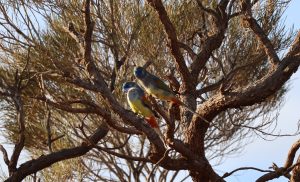
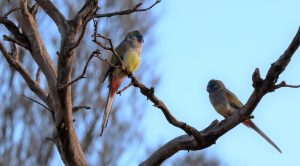
The Naretha Bluebonnet (Northiella narethae) is one of Australia’s least-known parrots — and one of the very last to be discovered, formally described as recently as 1921. Even its name carries deep meaning: narethae is derived from the local Indigenous name for saltbush, a vital and lifesaving food source in the remote and often hostile country this parrot inhabits.
This remarkable species is confined to the Myall belt of Western and South Australia, on the fringe of the Nullarbor Plain — a landscape characterised by vast distances, saline soils, bluebush and saltbush, and very few trees. It is a land where survival itself seems improbable, yet the Naretha Bluebonnet has evolved to endure and persist.
For a time, agricultural development across parts of this region inadvertently benefited the species by providing more reliable sources of water, and flocks once numbered in the hundreds. However, other landscape changes have since made survival far more challenging. Gone are the days of flocks of 400, and populations have declined significantly, particularly in Western Australia.
In the 1990s, the then Department of Conservation and Land Management (CALM) established a pioneering captive breeding program in partnership with private aviculturists — a novel and forward-thinking initiative for Western Australia. As part of this program, surplus birds were made available to the public through CALM-run auctions. These auctions not only helped support the program, but also played a critical role in raising awareness of a parrot that, until then, very few people knew existed — or that it lived in WA at all.
It was through one of these CALM auctions that Lois and Wayne Gearing first came to meet the Naretha Bluebonnet and began what has become a decades-long commitment to the species, not as owners, but as guardians. Their involvement has spanned both intensive avicultural work and time spent in the bird’s remote homelands — landscapes that leave one asking how any creature survives there, let alone breeds successfully.
Today, the greatest threat facing the Naretha Bluebonnet is the loss of nesting habitat. Suitable nesting trees are few and far between, and many of the mature Allocasuarina pauper trees — relied upon for nesting hollows — are now splitting and collapsing with age. Regeneration of younger trees is minimal or absent. Without active intervention, the lack of nesting trees places this resilient little parrot at serious risk of extinction.
As of 2026, there are no Naretha Bluebonnets held in any zoos or wildlife parks in Australia.
This presentation explores the ecology of the Naretha Bluebonnet, the harsh and beautiful landscapes it inhabits, and the plants and trees essential to its survival — and tells the story of a small, tough Australian battler that urgently needs our understanding, advocacy and help.
- Kids’ talk – one of your younger members will be giving a 5 minutes kids’ talk.
- Boffins talk – A member will give an 8 minutes Boffins’ talk.
- “Nature road show”. Members and visitors are encouraged to bring items to place on the display table or to send photographs to the MC in advance, e.g. a sample flower, an insect, and so on – anything of natural history interest that has legally been obtained. If we have time, one of our experts will identify them or briefly talk about them, or the person bringing them can talk about where they saw it, etc. Photographs are particularly welcome, as everyone can see them. If you wish to show a photograph please email it, no later than the Wednesday before the meeting, to our MC for this night, and she/he will include it on her PowerPoint slides. We have a dedicated email for this purpose” natclub@webco.com.au
- Thing of the month / Things coming up next month: These two presentations are about things in nature happening this month and things coming up, so if you have any photos or information, send them to: natclub@webco.com.au
- Door prizes: You could also be the lucky winner of a door prize. We make sure there are prizes for both members and visitors.
- Raffle: We will have a great raffle – please raid your piggy bank for a bit more cash, $5 for 3 tickets.