

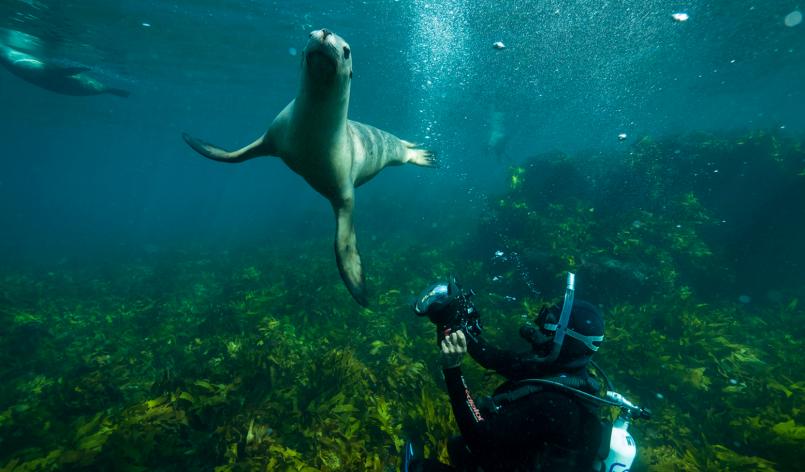
Leighton films a Sea Lion
Our speaker, Leighton De Barros, has 30 years’ experience in the television industry, as producer, director, writer and cinematographer. He has worked on a great many films broadcast on television, has won 15 industry awards and been nominated for Emmy awards four times. He is the founder and joint CEO of Sea Dog TV International. He specialises in producing epic natural history and wildlife documentaries that capture unique animal behaviour on land and sea in Western Australia.
Leighton began by dedicating this talk to the late Doug Coughran, a colleague who had pioneered whale rescue technique, and whose funeral he had attended that very day, just before the meeting. Some of the film that Leighton showed us included footage of Doug at work.
Marine life, especially dolphins, is Leighton’s favourite subject for filming but he has done lots of work on terrestrial life in WA also, particularly on Rottnest, Garden and Carnac Islands. He has made films on the lifecycle of Quokkas, Ospreys and dolphins. We saw footage from the film Ocean Giants, in which a dolphin shadows a stingray and steals its food (an octopus) that the ray had located under the weed using its electro-sensitivity. We also saw dolphins hydroplaning—a risky technique which they sometimes use to catch fish very close to the beach.
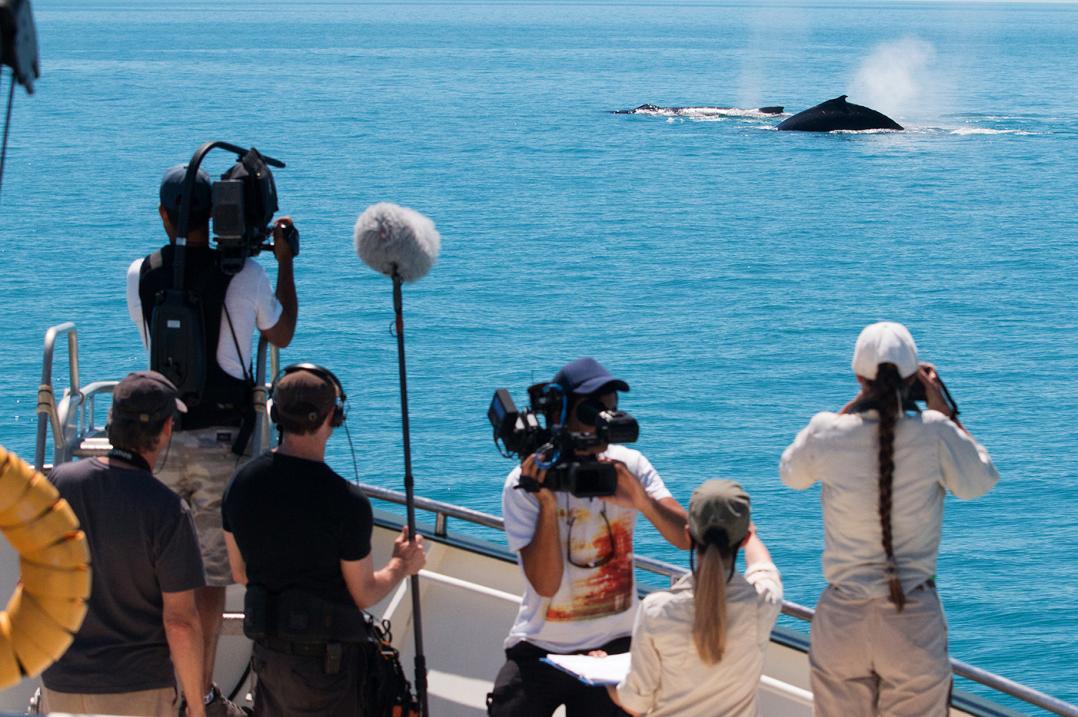
Crew filming Humpbacks in Buccaneer Archipelago
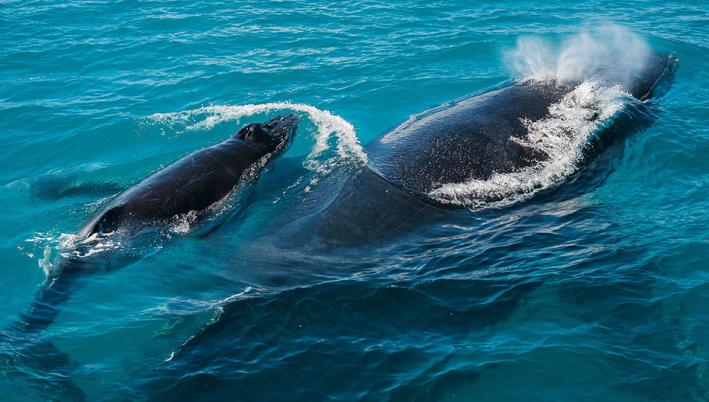
A whale with her calf
In making Birthplace of the Giants, together with Doug Coughran, individual whales were identified by their markings and given a name. Amazingly, of one of those whales was identified as a Humpback that had been rescued by the team a year beforehand; it had been entangled in lobster pots and ropes. Doug Coughran and Leighton were thrilled that this validated the rescue of whales and demonstrated that they can survive and don’t, for example, die of stress once they swim off.
Leighton talked about the accidental discovery of the Bremer Canyon off our south coast, where upwelling currents bring nutrients that feed an extraordinary food chain that includes Orcas, Pygmy Blue Whales and Sperm Whales as well as Great White Sharks.
Together with Rick Dawson and Denis Saunders, Leighton filmed Black Cockatoos for a documentary he produced called On a Wing and a Prayer, by putting camera portholes in their tree-hollow nests. One discovery was that the female supplemented the chick’s diet with grubs she dug out of the nest floor while the male was out collecting food.
On one occasion while filming a juvenile Southern Right Whale off the south coast, Leighton was almost crushed against the sea floor by the curious whale as it came closer and closer, apparently to investigate the investigator! Now the team finds pole cameras a safer option.
 ♦1
♦1
We were shown footage from a “rough cut” of a film currently being made called Kingdom of the Quokka, documenting that marsupial’s entire lifecycle. Rather than being the “happiest” animal as depicted in tourists’ “selfies”, Leighton suggests it might be the toughest animal, existing as it does on Rottnest in a high-salt, low-nutrient environment. The team has filmed Quokkas climbing trees, fighting and going into the sea. Surprisingly, says Leighton, the islands off the coast of WA, with their harsh environments, sometimes serve as strongholds for the survival of species.
We then saw footage of the team working in a quite distressing situation, carrying out euthanasia on a whale that had stranded itself. Apparently sick whales will come into the shallows where they can rest and be safe from sharks, but in that situation their thermoregulation can break down and they overheat and eventually die. It was decided that a quick death by explosive destruction of its brain would be more humane.
As Leighton said, these wonders of nature are occurring “all in our back yard”. But without the benefit of cinematography we don’t always get an opportunity to see them. However, it is a battle to get funds to make these documentaries.
There was some discussion in question time about mass whale beaching, the effects of krill harvesting and of marine seismic testing, to conclude a fascinating presentation.
Mike Gregson
♦1 An interesting story appeared in Rottnest Island Wildlife blog concerning a discovery during the filming of Rottnest & The Mystery Islands. See Rare “electric purple” Jelly Fish found on Rottnest Island!