

NS Branch September 2018 Meeting
Pearls have fascinated people for thousands of years, no more so than at our September meeting when members and visitors were still glued to the words of our guest speaker, Michael Seifert-Weiss after one and a half hours.
Michael’s presentation covered a wide range of topics, all explained with passion and professionalism, befitting his position of Showroom Manager at Willie Creek Pearl’s Elizabeth Quay outlet.
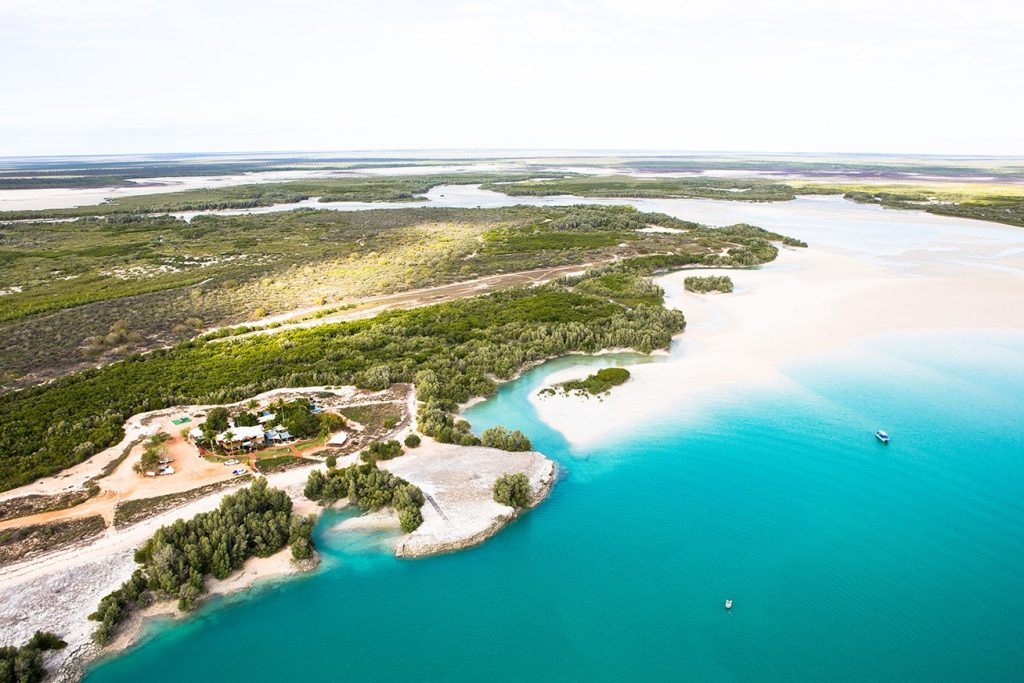
Willie Creek itself is located (Above ↑ ) at the northern end of Cable Beach, approximately 38 km north of Broome.
The company has two licences; one for taking wild shell and one for running a hatchery. Several thousand wild shells of the Pearl Oyster, Pinctada maxima, are collected at one time and brought back to the farm for seeding – a process involving the insertion of a seed pearl or nucleus produced from the shell of an American freshwater mussel, together with a small section of living mantle tissue, both of which are implanted into the gonadal tissue of the oyster. The mantle tissue proliferates forming a sac around the pearl, the pearl sac. The cells of the pearl sac subsequently produce concentric layers of nacre around the nucleus to form the pearl. Following harvest of the pearl, a further nucleus maybe inserted into the now present pearl sac of the same oyster.
Michael handed around numerous examples of shells, seeds and pearls, the most valuable being worth about $12,000, to explain and demonstrate the anatomy of the Pearl Oyster and various aspects of pearl production.

Some of the many things we learnt were:
- There are over 20,000 years of pearling history.
- DNA evidence indicates pearls from Broome were traded as far away as Victoria.
- Pearl shell is harder than concrete due to its multilayers of chiton between the layers of calcite.
- P. maxima is a protandrous hermaphrodite, reaching maturity as a male in the first year of its life, with the incidence of female animals increasing with age thereafter.
- Mature oysters filter around 50 litres of water per hour.
- All shells are microchipped at the time of seeding then panels containing 4 shells are put back in the water to rest for 10 days before being pulled up and repositioned to float a few metres below the surface. During the next two years they are cleaned several times.
- Each shell is x-rayed to see if a pearl has developed. If an A class pearl is found the shell is kept and an identical sized seed will be emplaced. The best producers may be used up to four times with each pearl being larger.
- Only 1 in every 10,000-15,000 shells contains a gem quality pearl.
- Less than 5% of all pearls are spherical (commonly referred to as round). The roundness of a pearl is best checked, not by calipers, but by rolling on a flat surface.
- P. maxima produce pearls with a much thicker coating of aragonite (a form of calcium carbonate responsible for the lustre) than cultured pearls. A 10mm pearl will have at least 5mm of aragonite compared to less than 0.5mm in a cultured pearl.
- 95% of shells contain a female pea crab (Pinnotheres spp).
- Only 5% of pearls are retained in Australia, most of the rest go to the Hong Kong pearl market.
- Pearl production in Australia is worth about $250 million per annum.
- Non-pearl producing shells are not wasted as the meat from the abductor muscles is highly regarded delicacy in Asia and North America, while the shell is sold as mother of pearl.
During the evening Christine Curry and Nel Elber were each able to extract a pearl from the pearl sac of shells Michael had brought with him. But alas, neither was able to take their finds home.
Michael concluded his presentation by telling of the terrible conditions under which Aboriginal boys and women were made to work by cruel pearling masters in the early days, and a plea for us all to show tolerance to people of all races and in all circumstances.
Don Poynton