

NS Branch September 2018
Despite Trigg Bushland Reserve being one of the best known natural areas in the northern suburbs, only a handful of our 19 GOLLY walkers had previously visited the section north of Karrinyup Road. While the section on the south side of the road is dominated by dunes with low lying vegetation, the area to the north is all woodlands with a lot of Marri, Tuart and Jarrah making up the upper story. Beneath these we found large areas of Balga and many shrubs in flower, including One-sided Bottlebrush, Coastal Spider-net Grevillea, Berrung (Grevillea crithmifolia), Prickly Moses and Yellow Buttercup. One plant we could not identify was a 1-2m high shrub with bunches of small white flowers. Our best guess was a species of Logania, its leaf being slightly larger than L. vaginalis which grows closer to the coast on limestone.
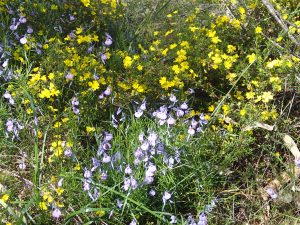
Closer to the ground we saw Yellow Leschenaultia, Native Violet (below left, D Poynton), False Boronia, Grey Scaevola and both the green and grey Cottonheads (Conostylis spp). The Native Wisteria was almost finished but Old Man’s Beard or Native Clematis was quite abundant.
Five orchids were seen: Common Donkey, Pansy, Pink Fairy, White Spider and several Greenhoods which had withered but were still intact.
 ::
::
Twenty bird species were recorded, with 17 species in the bushland and another three species just outside. The most remarkable were the Brown Goshawk, Grey Fantail, Western Gerygone, Rufous Whistler, Weebill, and an unidentified fairy-wren (most likely the Purple-backed, which was until recently known as the Variegated Fairy-wren.)
Halfway through our walk we stopped for a few minutes of silence to listen to the birds. Ian Abbot and Wayne Merritt identified the calls and where possible pointed out the songster.
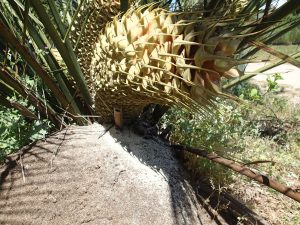
Our ‘GOLLY moment’ came on our walk back to the cars, when Wayne Merritt spotted a male Macrozamia (above right, D Poynton).
“GOLLY, I have never seen that before!” Wayne had spotted a male zamia shedding so much pollen that you could see it building up on a fortuitously placed termite mound.
The only reptile we found was a juvenile Bobtail.
Don Poynton