

Our planned excursion to Penguin Island in December 2015 had to be called off due to unseasonal rough weather conditions so it was decided to make it the destination for our first field trip of 2016.
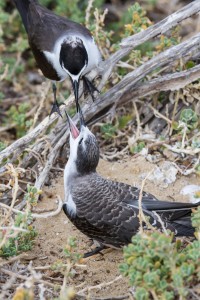
Nine members caught the 9am ferry across to Penguin Island where we were greeted by the sight of large numbers of Bridled Terns filling the sky. There were also crested and a few fairy terns around the sand bar near the island’s jetty. During the walk towards the picnic area we spotted Buff Banded Rails on the beach and around the picnic area. During our initial walk around the island we spotted Bridle Tern chicks in various stages of development, from fluffy young chicks to those that were fully fledged. Their parents were busy flying out to forage for small fish to feed the ever-hungry chicks. We spotted several Kings Skinks in the shrubs, a welcome sign of their recovery from the losses that resulted from the rat invasion a few years ago. One Little Penguin was seen under a walkway. Unfortunately Penguin Island is also used as a nesting/roosting site for feral pigeons (and, as we noted later, this is true for all the other islands) and we saw a large number of pigeons. The Berry Saltbush (Rhagodia baccata) was in flower and providing nectar to small Common Grass Blue butterflies (Zizina labradus) and Slender Bee-fly (Geron sp.). Various moths were seen, often with a Buff-banded Rail in hot pursuit.
We took a cruise around Seal Island and other rocky islands. A small pod of dolphins was seen shortly after we left Penguin Island. On our approach to Seal Island we saw a White-bellied Sea Eagle sitting atop a rocky outcrop, the tour guide told us that it was believed that a pair had taken up residence in an old Osprey nest. On Seal Island there were a number of male Australian Sea Lions resting on the beach plus another in the water. Sizes ranged from a very large mature male through to a young male. Only males are found here, with the females remaining at the Houtman Abrolos Islands throughout the year. The mature males make the trip up during the breeding season.
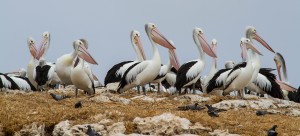
Pelicans were roosting on top of one of the smaller islands along with Pied Cormorants. Some of the Pelicans were exhibiting breeding colours, and were displaying by fluttering their facial skin to attract potential mates.
The water was very clear and it was noted that nudibranchs were visible even without the glass bottom.
Following the tour most of our group caught the ferry back to the mainland. However, Daniel Heald stayed on Penguin Island for the afternoon to further explore the marine habitat by snorkeling on the eastern side in the shallow seagrass beds – he ran out of time before he could do the western, rockier side.
Daniel provided the following list of sightings; Tarwhine (Rhabdosargus sarba), Zebrafish (Girella zebra), Small-tooth Flounder (Psuedorhombus jenynsii)- immediately on entering the water, and immediately followed by an adorable juvenile smaller than my first thumb joint – Banded Toadfish (Torquigener pleurogramma), abundant Striped Trumpeter (Pelates octolineatus), a large Rainbow Cale (Odax acroptilas) under the wreck in Penguin Bay who kept sticking his head out to see if I’d gone yet, Wavy Grubfish (Parapercis haackei), King George Whiting (Sillaginodes punctata), Sea Mullet (Mugil cephalus), Stripey (Microcanthus strigatus), Germain’s Blenny (Omobranchus germaini), Western Butterfish (Pentapodus vitta) and several others I haven’t learned to ID yet.
Several large and vividly blue Blue Swimmer crabs (Portunus pelagicus) were seen, one dissecting a large bivalve, and the other attempting to dissect my foot after we startled each other.
A large Bobbit Worm (Eunice sp) lurking in the mouth of her burrow, waiting for a fish to swim past so she could lunge out in ambush.
Seaweeds washed up on the western side of the island included Common Kelp (Ecklonia radiata), dried detached floats of Sargassum sp. which were piled up in drifts high on the beach, Doubling Weed (Dictyota dichotoma) which is brown out of the water but shimmering green-blue when underneath, Hennedya crispa, an unusual Dead Man’s Fingers (Codium sp.) with flattened fronds, and the beautiful red Euptilota articulata.
Epiphytes on the seagrasses in the bay – Dicranema revolutum, Oyster Thief (Colpomenia sp.) growing as floating bubbles at the tip of the Posidonia fronds, and the corallines Metagoniolithon chara and Metagoniolithon stelliferum on the Wireweed (Amphibolis sp.) meadows.
There was an outstanding growth of Amphirhoa coralline algae at the north end of the island, on some of the underwater rock faces.
Our visit had been very enjoyable and had reinforced our understanding of the importance of the Shoalwater islands, and Penguin Island in particular, as a nesting area for the Little Penguins and the various Terns, Cormorants and Pelicans. It is also evident that Penguin Island is very popular with day visitors, during our visit the ferries and tour boats were full and extra ferries had to be scheduled. Unfortunately the large number of visitors does have an impact on the island’s fauna. One example was noted while awaiting my return ferry – a family walking along the beach did not consider a group of 5 Fairy Terns that were resting at the shoreline after foraging, they walked directly at the terns without a thought of the birds’ welfare causing them to fly off. It is important that DPAW is able to balance the need to conserve the island’s fauna with the public’s enjoyment of a day trip to this amazing reserve.
Colin Prickett