

It was a long drive from Perth and we arrived at the Coalmine Beach Caravan Park in the early afternoon of Monday April 4th. Those who had arrived earlier were off on a drive around the nearby Knoll, so we followed. At the beach car park we saw a Western Brush-tailed Wallaby with a young one. The adult had striking white markings on its head as well as black ends to its feet and tail. Along the roadside were the bright orange-red brushes of the Beaufortia sparsa and yellow-orange cones of Banksia seminuda. In the undergrowth, the early Bunny Orchids (Eriochilus dilatatus probably ss. magnus) could be seen.
Margaret Larke
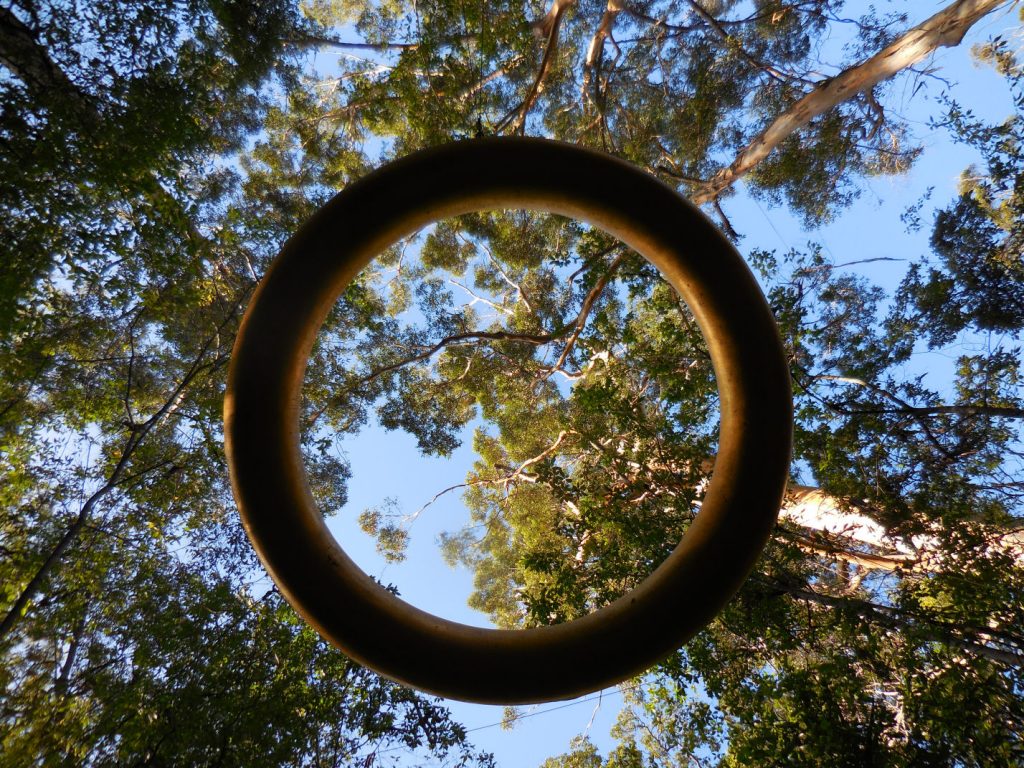
Tuesday 5th emerged as overcast but mild and we duly gathered for the day’s events at 9 am then set off in convoy to climb Mt Franklin. The walk began quite leisurely but the last part was somewhat of a challenge with uneven concrete steps and a metal ladder to the top. Unfortunately there was a strong wind at the top which tended to make your eyes water and the view was somewhat hindered by the overcast day. Notable observations along the way were the Baudin’s Black-Cockatoo, a small pink geranium in flower, a bee swarm and a Hemiandra in flower. Morning tea/lunch was at the brilliant undercover interpretive area before walking around the base of the mountain to the walkway platform and more views. It was then off to Fernhook Falls on the Deep River and the beautiful Rowell’s Pool walk, again with an interpretive undercover area showing us what to expect and where the name came from (a fern-hook was found here.) Lastly we stopped at the Walpole Wilderness Discovery Swarbeck Art Sculpture Loop amongst the towering Karri trees. These sculptures were done by Lorenna Grant and Alan Clark. The reflective wall was impressive with its poetry and information.
Lyn Myles
On Wednesday 6th most of us went on a boat trip across the inlet. We were lucky to have a cool, partly overcast day with no wind, which made for a very pleasant outing. The boat tour is operated by Gary Muir who is a member of one of the oldest families in the area. Gary has an amazing knowledge of both the social and natural history of the area and kept us all entertained with his interesting and amusing stories on both the outward and the return journeys.* During the crossing we saw a number of birds including Australian Pelicans, Black Swans, Pacific Black Ducks and a Great Cormorant. Gary also pointed out a White-bellied Sea Eagle as well as an Osprey perched in a tree above a 6000-year-old Aboriginal fish trap. We continued past Snake Island, named because of the number of resident black (Tiger) snakes. A peculiarity of the island is that, although surrounded by salt water, it is inhabited by several species of frogs, including the Motorbike Frog (Litoria moorei) and the Quacking Froglet (Crinia georgiana). The frogs reach the island by means of the fresh water current of a river flowing into the inlet and once on the island they form a major part of the diet of the snakes! As we headed towards the beach near the inlet’s opening, Gary told us that although boats can normally get through, the previous week a storm had swept sand through the opening, forming sand bars within the inlet and making it inaccessible from the sea. On the sand bars were a number of birds—Pied Oyster-catchers, Pied Cormorants, an immature Great Cormorant, Crested Terns, Silver Gulls and a Red-capped Plover. Approaching the beach took some time as Gary and his skipper struggled to push the boat through the shallow water around the sand bars. However, we were eventually able to land and walk across the sand to the sea as well as enjoying delicious home-made cakes supplied by Gary’s mother for morning tea. We re-boarded the boat and—after negotiating the sand bars again—returned across the inlet.
Audrey Bolger
*Never before had I seen someone demonstrate plate tectonics using a collection of stuffed native animals, with a kookaburra’s tail representing the rising Himalaya—you had to be there! (Editor)
On Thursday 7th most of us met at John Rate Lookout for a group photo and view of the distant inlet framed with trees before some set off in cars and others walked the 4+ kilometres to Mt Clare. Conditions were perfect for walking: still, cloudy, but with occasional sunshine. The magnificent Karri, Tingle and Marri trees dominated but we were all impressed by the Karri Sheoak (Allocasuarina decussata) which is slender, much taller than other she-oaks and has dense green needles and deeply grooved, corky bark. There were few plants in flower, but as well as Bunny Orchids, we noticed some Scaevola, Lobelia and Dampiera in flower, all with small flowers and trailing habits. There were fungi, including boletes and white amanitas. Not many birds were about, but White-breasted Robins were seen, and Purple-crowned Lorikeets and a Fantail Cuckoo were heard. At the Mt Clare walk, there were some impressive, bulbous-based Red Tingle. Some people braved the steep walk to the suspension bridge over the Deep River before lunch and our return home. The day finished on a high note with an enjoyable meal at the Philippine Magic Café in Walpole.
On Friday, people were packing and preparing to go their different ways but there was still time to walk—along Coalmine Beach, the inlet beautiful and still, reflecting the hills with their trees coming down to the water’s edge; and on the track into town, lined with white-flowered Taxandria juniperina, many sedges, flame-like Beaufortia sparsa and a tall pink Boronia that was just coming into flower. The spectacular Treetop and Ancient Empires walks were the last group activity and tourist-magnet though it may be, the centre gives a wonderful experience of those magnificent trees. It is well signposted, including a sign pointing out a Slipper Orchid bearing seed capsules growing high in a tree. On our drive back to Manjimup, Mike and I noted the new green leaves furring the entire trunks and branches of some of the trees burnt by the terrible bushfire the summer before last, the epicormic growth a sign, hopefully, of renewal. We were also interested to see a Podocarpus, heavy with its unusual fruit. It was a very enjoyable Late Easter Camp and we hope that this tradition started by the late Alan Notley continues.
Jacquie Gregson
Click on link for Full Species List from Late Easter Camp 2016