

Insights from Dr Paul Brown
Darling Range Branch, 12 December 2025
Dr Paul Brown, a mammal ecologist, has played a key role in understanding ecological change in Dryandra Forest, Southwest Western Australia. His book on Dryandra Woodland National Park is the first since Vincent Serventy wrote in 1970 about the area in Dryandra: The Story of an Australian Forest. The Woylie or Brush-tailed Bettong (Bettongia penicillata) is his favourite animal and an important keystone species whose presence significantly improves ecosystem health. Brown uses Aboriginal names for all the species listed.
His talk demonstrated the impact of predation on woylie populations. In 1982, capture rates were around 1%, equivalent to one woylie per 80–100 traps, placing the species at serious risk. Intensive fox control began, led in part by Tony Friend, reducing fox numbers. By 1987, these efforts resulted in dramatic population recovery. Within three years, woylies reached saturation levels, capture rates of 60–80 animals per 100 traps. 192 Woylies were removed from the list of rare and endangered species in 1992.
Then, between 2000 and 2005, woylie numbers declined sharply, dropping to around 10 captures per 100 traps. Several theories were investigated to explain this collapse. Avoidance of poisoned bait by foxes was dismissed, as fox mortality remained high. Increased vehicle traffic was observed through camera monitoring, but it was insufficient to account for the scale of the decline. Disease was also considered. After 10–15 years of research, feral cats were identified as the primary cause, responsible for approximately 60% of woylie deaths, compared with around 20% caused by foxes. In response, monthly cat-baiting programs began in the early 2000s, alongside ongoing work with farmers to manage cat populations. These measures have been successful, with capture rates in managed areas now returning to around 60 per 100 traps.
Woylies are vital ecosystem engineers. They dig extensively while feeding on underground fungi, improving soil aeration, nutrient cycling, and plant health. Each woylie can move an estimated 4.8 tonnes of soil per year. They also spread fungal spores and organic material throughout the landscape, reduce deadwood accumulation, and even crack hard sandalwood nuts. Their absence leads to poorer soil quality and reduced ecosystem resilience.
Beyond mammals, Dr Brown has documented exceptional bird diversity in the Wheat belt and Dryandra regions in his book. Approximately 110 bird species have been recorded, with only three known extinctions. This success is linked to limited burning, minimal logging, tall forest canopies, abundant nesting hollows, and reliable ground food sources. Around 30–40% of the area consists of brown mallet plantations, which still support diverse birdlife. The region supports birds adapted to dry, wet, and transitional conditions, as well as some northern species.
Notable species include:
- Rufous Treecreeper – Climacteris rufa.
- Bush Stone-curlew – Burhinus grallarius
- Grey Currawong – Strepera versicolor
- Western Yellow Robin – Eopsaltria griseogularis
- Southern Barking Owl – Ninox connivens
Overall, Dr Paul Brown’s work demonstrates how targeted conservation, predator management, and habitat protection are essential for maintaining healthy ecosystems.
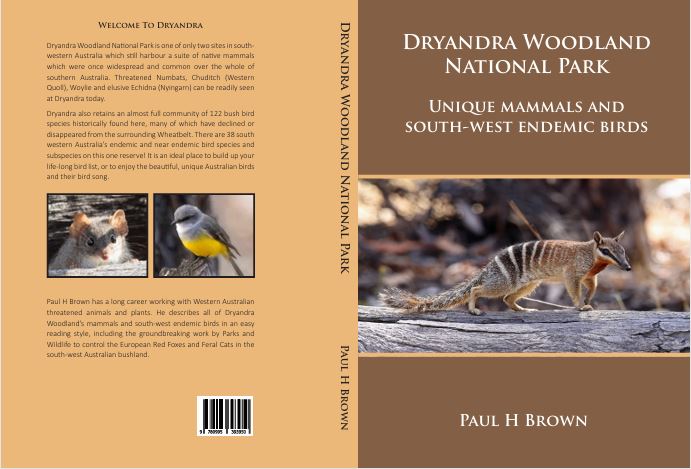
Ref:
Dryandra Woodland National Park Unique Mammals and Southwest Endemic Birds
First Ed April 2025 Brown, Paul H.
Arlene Quinn