

Main Club, 6 February 2026
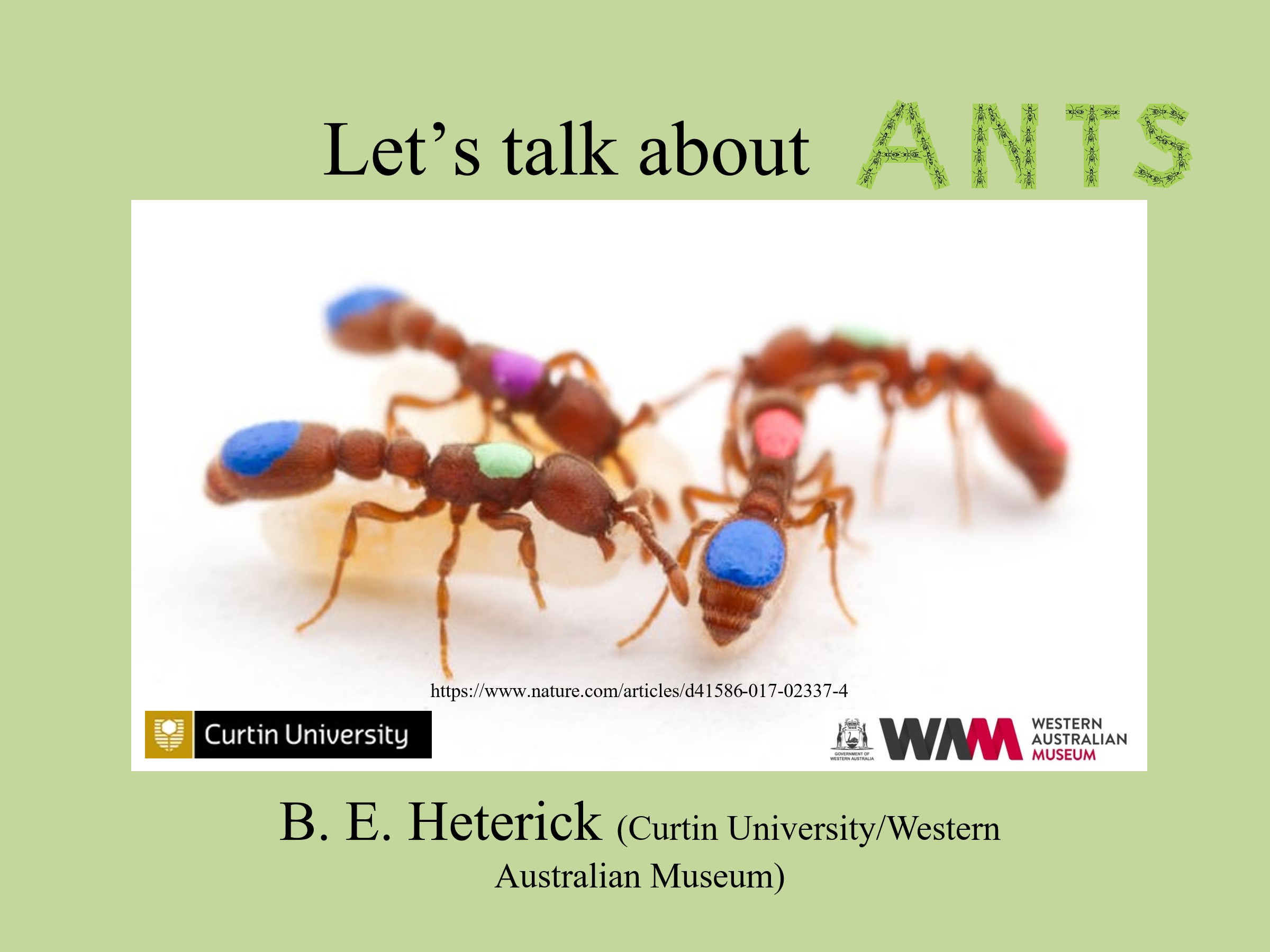
Entomologist Dr Brian Heterick was our speaker. Brian is officially retired but still actively involved in research at the WA Museum. He talked to us about what an ant is and its role in ecosystems.
Ants (Hymenoptera: Formicidae) are closely related to bees. They are social insects that share their food and have reproductive females (queens), sterile females (workers), and males (drones). Ants are not entirely wingless because at suitable times the colony produces winged males and virgin queens, called alates, which take a nuptial flight. The fertilised queens can then start a new colony.
Brian gave us a bag of surprising facts about ants: they have a huge biomass relative to other organisms in a rainforest. Some can lift 4000 times their own weight.
In Africa, driver ants were reportedly once used to execute criminals. Some ants share colonies. Trap-jaw ants have super-fast bites. Others can be less than 1mm long. Parasitic queens may kill the queen of their host colony. Some arboreal ants (Pseudomyrmex spp.) protect their host trees. Leafcutters cultivate fungi. Some queens live for over 20 years. There are beautiful ants, glider ants, some guard their nest by blocking the entry with their head, and one species is a suicide bomber!
Brian asked the rhetorical question, “What use is an ant?” (Should we ask that question about humans?!) As part of an ecosystem, ants are active decomposers, scavenging dead animal remains. Many ants protect seeds, after eating the soft elaiosome, by taking them underground where they can germinate. However, some introduced species (e.g., Argentine ants) hinder germination and often disrupt native ecosystems. Ant nests help to aerate the ground and can serve as homes for native animals. A few ants are pollinators, but most are not (because their metapleural gland secretions damage pollen).
Ants can be both agricultural pests and domestic pests, as we well know. (The pain is from the sting, not the bite, and deaths from stings are due to allergies.) Brian said that the only effective formicides are those that get to the queen.
There are about 15,000 named species of ants in the world. WA is an ant-rich state, with approximately 833 species, though Perth gardens often have half a dozen or fewer species.
Ant species are identified by examining structures such as the head, mandibles, antennae, sting, eyes, and claws, as well as the mesosoma and metasoma, which combine thoracic and abdominal segments—the Formicinae squirt formic acid through a funnel. Dolichoderinae have a slit that exudes toxic chemicals. Other groups have a sting.
Ants can be classified by functional group – e.g., cold-climate, cryptic, opportunistic, specialised predator, etc. Analysis of suites of ant species and their abundance (e.g., by using pitfall traps) can be used to monitor ecosystem health. Some species, for example, only live in old-growth forests. These forests have high ant diversity and a good balance of different species, in contrast to degraded areas.
Brian’s talk only scratched the surface. There is an extraordinary amount to know about ants!
Mike Gregson