

It was a cloudy, damp day as eleven of us set off on October 7 with the Deputy Principal of Good Shepherd School, to do the first survey of their 12-acre bush block in Arbuthnot St, Kelmscott. The DRB has committed to doing a survey every two months until the end of 2018, in line with the six Nyoongar seasons, to help the students and teachers learn more about natural history.
The area is located in the transition zone from the Darling Scarp to the base of the scarp—from coastal plain to lateritic zone. It was initially a site used to accommodate people displaced post-World War II from Europe, before it was leased to the school.
We split into four groups: Kevn Griffiths led the fungi search, Mike Green the birds, Robert Davis (from the herbarium) the plants, and John Abbott the ‘other’ section. All were ably supported by observers, photographers and list-makers.
The bird list alone was 18, which in the weather conditions and over only 1.5 hours was very pleasing. It included the Red-tailed Black-cockatoo (Calyptorhynchus banksia) (below), Weebill (Smicornis brevirostri), Common Bronzewing (Phaps chalcoptera) and a Striated Pardalote (Pardalotus striatus.) Thanks to Alex Graham for taking the bird photographs.

We were delighted with the flora. There were small pockets of nearly pristine bush that just needed some Watsonia removed to make it perfect. The flora list included approximately 53 species and we are currently uploading photographs and the full data onto the Atlas of Living Australia. Our records are under project Arbuthnot St, Kelmscott Western Australia Darling Range Branch of the WA Naturalists’ Club ⇐link
with Survey 1 currently being compiled.
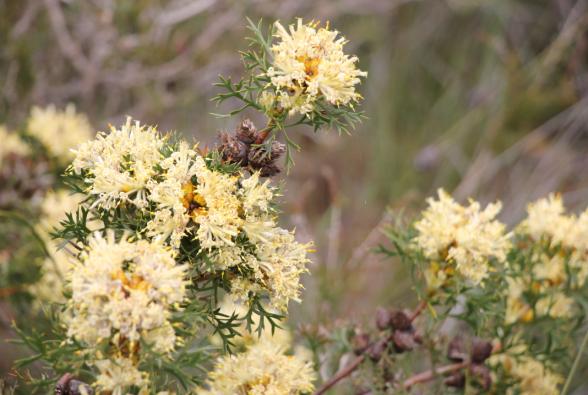
Plants included: Chorizema dicksonii, Petrophile serruriae (above, R Green), Semaphore Sedge (Mesomelaena tetragona), Banksia armata, Daviesia horrida, Gompholobium marginatum complete with large round fruits, Stylidium affine, Prickly Hakea (Hakea amplexicaulis) and Harsh Hakea (Hakea prostrata), and so many more.
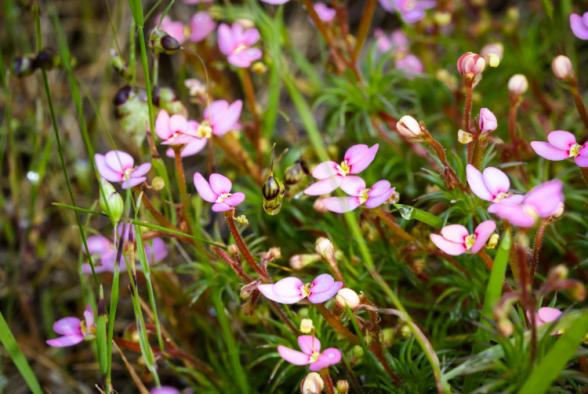
The vast numbers of pink Trigger Plants (Stylidium repens) (above, R Green) and the Blue Leschenaultia (Leschenaultia biloba) were stunning. Thanks to Joy McGilvray for sorting out the flora list and Wendy Jacobs for photographing the flowers—there were too many for a single photographer to keep up with!
We also saw fungi, which Marilyn Honeybun photographed for us and Kevn is still identifying; he commented that he didn’t expect to find so many. John’s group found a damselfly, butterfly, Quenda, Bobtail and more, which Sally Robertson and Kate Tarnowy photographed.
Sadly, there were masses of weeds. We hope that we can help the school get a grant to reduce the weeds in future.
It was a great team effort which produced excellent results. Next time, we take the Year 6 children on a walk to help them identify what is there. We look forward to returning in December and seeing what each season brings after that. A big ‘thank you’ to Diana Newman for feeding us all at the end—it was a great way to finish a very satisfying excursion.
Rachel Green