

GOLLY! The Baigup Wetlands lived up to its name midway through our planned walk! The forecast of up to 30mm of rain deterred most of our regulars but first-time walkers, Terri and Kim Richardson, joined Alex Saar and myself as we started our expedition in fine weather.
I was surprised to see how quickly the Swan River had risen. The approach to the boardwalk on the south side of the Garret Road Bridge was underwater. Two days earlier, at the same time of day, I had no problem getting to it.
The other obvious change in two days was the sudden growth of fungi! Or was it just having an experienced eye that was the difference? On my reconnaissance trip I had seen a single specimen of the Scarlet Bracket Fungi (Trametes coccinea) growing on the limb of a dead paperbark about half way along the path. With eagle-eyed Alex along, we saw four species within the first 50 metres!
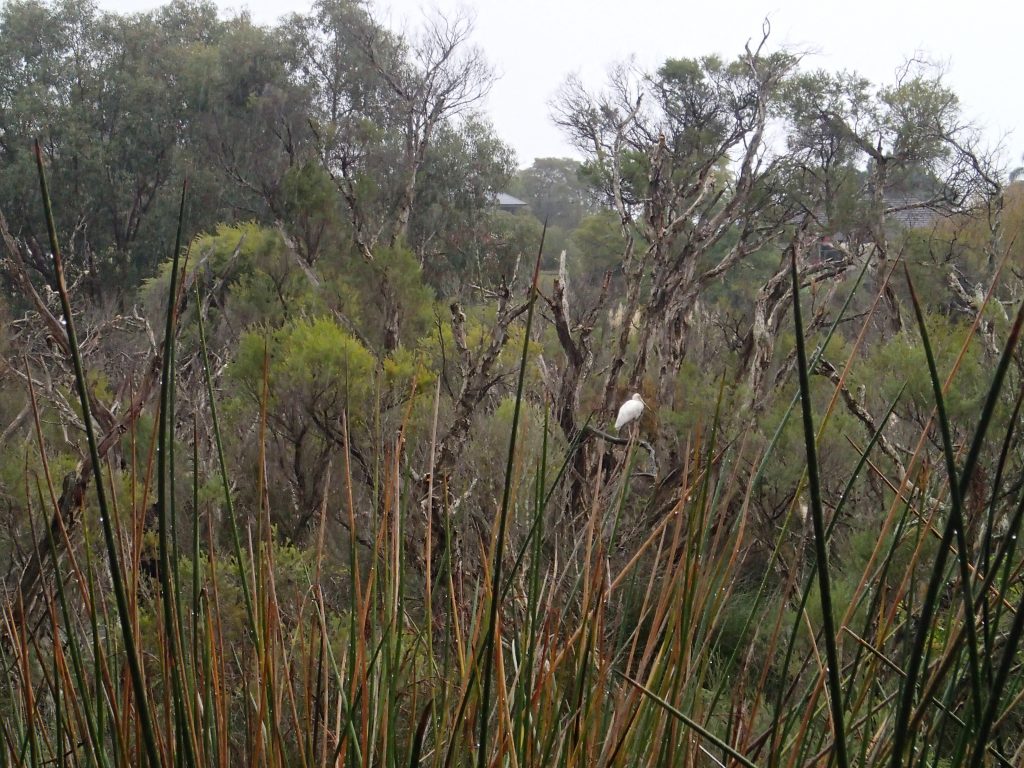
The weather meant many of the birds I had seen on Monday were nowhere to be seen or heard. Our count for the day was only 12 species (see list below) with the highlight being two Yellow-billed Spoonbills Platalea flavipes (Picture above D.Poynton). Could these have been the same two we saw at nearby Eric Singleton Bird Reserve a couple of years ago?
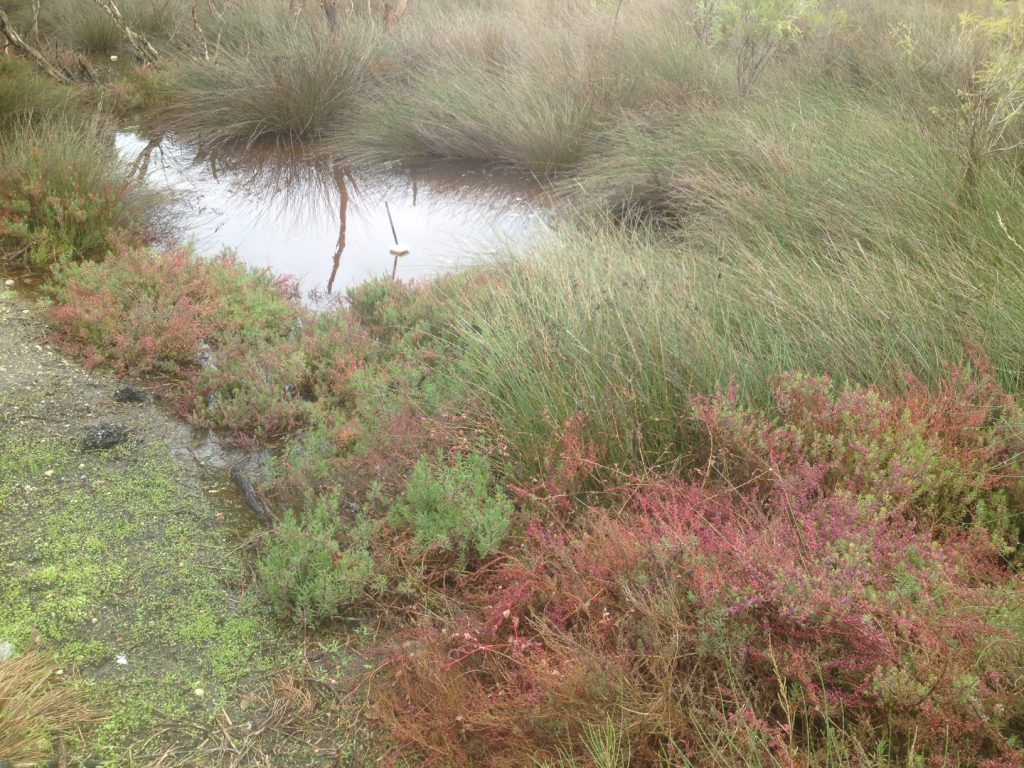
Baigup, in one of the Noongar language dialects, means “place of rushes”. The two common species we saw were Sea Rush (Juncus kraussii) and Marsh Club-rush (Bolboschoenus caldwelli). Seablite (Sueada australis) (below, D. Poynton) with its partly green, partly reddish–purple foliage made a contrast against the green of the rushes.
Soon after leaving the area dominated by sedges we came into an over-storey of remnant Freshwater Paperbarks (Melaleuca rhaphiophylla), Flooded Gum (Eucalyptus rudis) and Western Australian Swamp Sheoak (Casuarina obesa) although the latter has apparently been extensively replaced by the weedy eastern states Swamp Sheoak (C. glauca) that spreads by suckering.
We did manage to get to the end of the Primary Lake before the rain. This is one of two man-made lakes constructed in an attempt to improve the quality of water entering the riverside vegetation communities and the Swan River. The steady rain then forced us to abandon our plan to walk to the lookout over the river and return via the unsheltered path on the other side of the lakes.
The Baigup Wetlands Interest Group has just completed a fauna survey of the wetlands. The survey found 96 bird species, seven skinks, two snakes, one turtle, one fish, two water snails and one possible mammal species (Rakali) along with four feral mammals.
The weather was against us looking for many of these but the frogs were obviously there in abundance, based on the cacophony of sound. The Rattling or Clicking Froglet (Crinia glauerti) was most noticeable, particularly after Alex explained its common name comes from the fact its call sounds like a pea being shaken in a can.
For those who missed the walk I can recommend it on a dry day. Before taking the walk check out:
Baigup Wetland Interest Group website and Baigup Wetland Interest Group on Facebook
Bird list: Australian Pelican, Australian Raven, Eurasian Coot, Grey Teal, Laughing Kookaburra, Little Pied Cormorant, Pacific Black Duck, Purple Swamphen, Rainbow Lorikeet, Willie Wagtail, Yellow-billed Spoonbill, plus unidentified little birds.
Don Poynton