

Blackadder Creek Reserve is a small nature reserve of about a dozen hectares—much longer than it is wide—that straddles the winter-wet Blackadder Creek in Stratton in the City of Swan. Its major axis is east-west and it forms a contiguous extension of the much larger Talbot Road Reserve to the east.
On the morning of Sunday 18 March members of the DRB Nats plus guests joined with David Richards, convenor of the Friends of Blackadder Reserve, to carry out a bird survey of the reserve. Although the reserve is typically degraded with weeds, abandoned shopping trolleys, and the like, its dominant Marri trees are mostly in good health. True, there are some standing dead ones at the western end, but at the eastern end the trees are quite impressive, with a good selection of woodland birds to be seen among their branches.
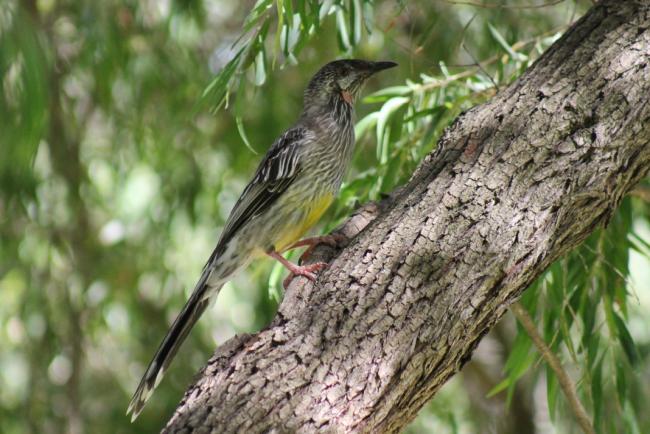
Red Wattle Bird (Anthochaera carunculata) Photo: R Green
We recorded 20 species of birds. At the larger end of the scale we had Red-tailed Black Cockatoos (Calyptorhynchus banksii), ranging down in size to numerous, very vocal, Weebills (Smicrornis brevirostris) that most people were eventually able to see for themselves. No raptors were seen, but David assures me that he does see them occasionally, and I would certainly expect to see something like a Goshawk lurking in the Marri trees at times. However, most of the usual woodland suspects were there: Striated Pardalote (Pardalotus striatus), Rufous Whistler (Pachycephala rufiventris), Grey Fantail (Rhipidura fuliginosa), Red Wattle Bird (Anthochaera carunculata) (Above, R Green), and Western Gerygone (Gerygone fusca). Not-so-typical woodland birds we saw included: Singing Honeyeater (Gavicalis viriscens), Australian Magpie (Cracticus tibicen), and Magpie Lark (Grallina cyanoleuca).
I was surprised to see a native shrub in full bloom. It turned out be Melaleuca fulgens (below, R Green), and there were lots of them right in the creek line itself. David said he presumed they were escapees from garden rubbish that thoughtful nearby residents had deposited, and I suppose they were in full bloom in opportunistic response to the heavy rain we had in January this year.
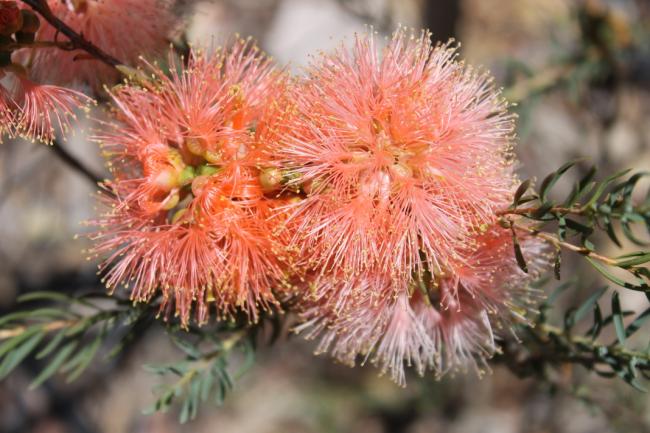
Melaleuca fulgens (Photo: R Green)
But the scoop of the day was undoubtedly the sighting of Varied Sittellas (Daphoenositta chrysoptera). There was a small flock of them, perhaps 10 or 12 birds, and everyone was able to see them feeding as they climbed and fluttered up and down the scaly Marri bark. It’s been some years since I have seen sittellas, and one of our visitors (an experienced bird watcher) was very excited because she had never seen one before.
Our thanks to David for inviting us to Blackadder Creek; it was a great morning. A full list of birds can be found on the Club’s website.
Mike Green