

Foreword
As the Murdoch University 2016 winner of the Serventy Memorial Prize, I am honoured to write this article for the WA Naturalists’ Club. During my studies for a degree in Conservation and Wildlife Biology I came to understand the enormity of conservation issues currently facing the world. One that presents of particular importance locally is the loss of wetland areas and resultant impact upon biota they support. This issue was looked at in some detail during my course, with student collected data contributing to a project on ‘Lakes as refugia for mammals of the northern Swan Coastal Plain’ – a collaboration between Murdoch University and the Department of Biodiversity, Conservation and Attractions (previously DPAW). The project focused on the impact of groundwater declines in the Gnangara Groundwater System and as it is a pressing issue I have chosen to produce this article on the matter.
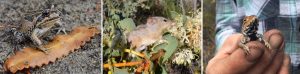
Some animals from the study: Western Banjo Frog (left), Honey Possum (middle),
and Western Heath Dragon (right) (Photography: Joe Porter)
Wetlands are important sites for biodiversity, both directly and indirectly supporting a range flora and fauna species. Their ability to support such biodiverse ecosystems is however reliant upon consistent rainfall and stable groundwater levels (Wilson et al. 2012). For many wetland areas this is now of primary concern, with climatic changes, modified land-use and groundwater abstraction threatening the stability and continuity of the water regimes that sustain these important ecological sites (Wilson and Valentine 2009; Wilson et al. 2012). Considering the range of biodiversity that are reliant upon wetland areas, there is risk that declining water levels will lead to the disappearance these biodiverse ecosystems along with the species they support.
For the Gnangara Groundwater System (GGS), located in the northern region of the Swan Coastal Plain (SCP) in the south-west of Western Australia, this issue is of major concern. In its north, the area encompasses some of the most extensive expanses of contiguous native bushland on the SCP, including Yanchep National Park and Yeal Nature Reserve, whilst in its south it comprises numerous urban bushland remnants, and hence is of important conservation value (Wilson and Valentine 2009). Ground-dwelling fauna of this region were once rich and abundant, however anthropological disturbances have resulted in widespread declines and many local extinctions – these impacts are particularly evident amongst mammals, where roughly two-thirds of species have disappeared over the past 150 years (How and Dell 2000). For those species that remain, wetland areas are thought to provide important areas of refuge (Wilson et al. 2012). However, with an estimated 80% of wetlands on the SCP already lost or irreversibly degraded, together with increased urbanisation, declining rainfall and high levels of groundwater abstraction, these wetland ecosystems are becoming increasingly threatened and so too the species they support (DPAW 2016).
Many of the wetlands supported by the GGS have been affected by reduced water levels, however Loch McNess, located within Yanchep National Park, has seen particularly large declines. From 1991 to 2010, levels within the GGS aquifer around Loch McNess recorded a decrease of roughly 3m, and consequently the extent of permanent water in the wetland has reduced substantially (Kretschmer and Kelsey, 2016). Considering the conservation value of the area and likely impact upon reliant species, a series of trapping surveys was conducted to provide an assessment of the diversity and relative abundance of ground-dwelling vertebrate fauna in the Yanchep National Park in relation to proximity to permanent water (specifically Loch McNess). Such assessment was hoped to provide important information on the impact of declining water levels on ground-dwelling vertebrate fauna at both Loch McNess and other wetland areas of the northern SCP.
The project was conducted at a total of six survey sites located at 0-150m, 150-1000m and >1000m from the water’s edge and conducted over a period of five days. Each site consisted of a set of pitfall, cage, Elliot and funnel traps, aimed at targeting mammal, reptile and frog species. Trapping effort over the period yielded a total of 21 species of vertebrate fauna, including 3 mammals, 12 reptiles, and 6 frogs. The species composition recorded is considered somewhat low in comparison to that expected to be present within the survey area, however this is likely a result of the small temporal and spatial scale of the study and thus should not be deemed a complete account of species presence. 11 native mammal, 64 reptile and 13 frog species are believed to still occur within the GGS region, and with relatively recent and far more in-depth studies recording roughly 60% of these, such figures should be considered a more accurate estimate of species composition (Valentine et al. 2009).
Due to the small scale of the study, findings were somewhat limited in their ability to provide accurate and conclusive evidence on exactly how diversity and abundance measures are affected by water proximity, however several broader scale patterns where evident. As expected frog species distribution correlated strongly with proximity to water with over 80% of captures occurring at <1000m, and only two species, Limnodynastes dorsalis (Western Banjo Frog) and Myobatrachus gouldii (Turtle Frog), occurring at greater distances. This result is not surprising as most frog species are reliant on permanent open water for at least part of their lifecycle. For mammal species, none of those recorded were considered to have a direct reliance upon open water, however the vegetative habitat supported by groundwater levels was considered to play an important role in their distribution. This was particularly evident for Rattus fuscipes (Bush Rat) where on the SCP the level of vegetation complexity and cover required by the species is only provided in vegetation surrounding wetlands (Wilson et al. 2012). Although not detected in this survey, Hydromys chrysogaster (Water Rat) which is reliant on permanent open water, was once common in Loch McNess, however it has not been recorded since 2009 and is believed to have become locally extinct from the wetland due to the disappearance of suitable habitat. As for reptile species, clear patterns in their distribution were less discernible. Reptiles are however known to be strongly dependent on habitat structure and therefore likely to be strongly influenced by habitat changes relating to changes in groundwater levels (Wilson and Valentine 2009).
In summary it can be seen that declining rainfall and groundwater levels within the GGS have already caused and are likely to continue to have some severe impacts for much of the ground-dwelling vertebrate fauna present at Loch McNess and other waterbodies of the northern SCP. This is most evident for frog species where nearly all of those recorded are highly reliant on permanent open water. Reduced water levels within Loch McNess are likely to have already reduced the suitable habitat of many species; data indicating that at >1000m proximity to water, diversity and abundance of frog species is minimal. Complete drying of the wetland would likely result in localised extinctions for many frog species. Regarding mammal species, H. chrysogaster which was not recorded in this survey, is likely to have already been lost from the area due to its heavy reliance on permanent open water (Wilson et al. 2012). If water levels continue to drop R. fuscipes along with many others are also likely to be negatively affected due to vegetation changes. Reptile species are not expected to be impacted by water declines to the same extent as frog and mammal species, however secondary impacts of water loss such as change in habitat structure and food resources may result in unforeseen impacts.
The changes observed at Loch McNess and likely many other waterbodies of the SCP are a direct result of declining groundwater levels. As previously mentioned these declines can be attributed to a drying climate and increased groundwater abstraction, which coupled with the impact of increased urbanisation are threatening many SCP wetlands. This article provides a brief introduction to some of the impacts upon ground-dwelling vertebrate fauna of the region, for further and more detailed information on the matter please refer to Valentine et al. 2009, Wilson and Valentine 2009, and Wilson et al. 2012 (see details in reference list).
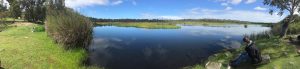
Panorama of Loch McNess (Photography: Roxanne de Vos)
References
Department of Parks and Wildlife. (2016). Swan Coastal Plain south management plan 2016: management plan number 85. (Department of Parks and Wildlife: Perth.)
How, R. A., and Dell, J. (2000). Ground vertebrate fauna of Perth’s vegetation remnants: Impact of 170 years of urbanisation. Pacific Conservation Biology 6(3), 198-217.
Kretschmer, P., and Kelsey, P. (2016). Loch McNess hydrogeology and causes of water level decline (1975–2011). Hydrogeological record series, HG60. (Department of Water: Perth.)
Valentine, L. E., Wilson, B. A., Reaveley, A., Huang, N., Johnson, B., and Brown, P. (2009). Patterns of ground-dwelling vertebrate biodiversity in the Gnangara sustainability strategy study area (Department of Environment and Conservation: Perth.)
Wilson, B. A., and Valentine, L. E. (2009). Biodiversity values and threatening processes of the Gnangara Groundwater System. (Department of Environment and Conservation: Perth.)
Wilson, B. A., Valentine, L. E., Reaveley, A., Isaac, J., and Wolfe K. M. (2012). Terrestrial mammals of the Gnangara Groundwater System, Western Australia: history, status, and the possible impacts of a drying climate. Australian Mammalogy 34(2), 202-216.
Tim Robins