

Many ‘tricks of the trade’ were revealed to us when Gerhard Saueracker took us underwater and then to the wilds of Canada in his search for the perfect photo. Initially, Gerhard focussed on scuba photography and the wonders of the briny – and what wonders! Because of the poor lighting with his benthic photography, a flash was essential – no chance of hovering there for a time exposure! And it worked very well but there were a few troubles with red colours. However, with the event of children on the scene, land-based photography had to be undertaken and a different photographic approach sorted out. Flash maybe, but Gerhard’s wish was to take pictures as ‘naturally’ as possible, i.e. without flash even if it meant being flat out on the turf for considerable times waiting for the perfect lighting and the perfect lack of breeze. A very different story.
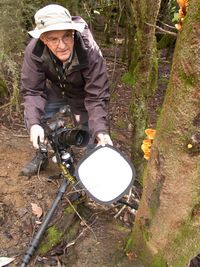
So we were then transported to British Columbia on fungi forays. Flash was abandoned, exposure times became very important and tripods that brought the camera down to ground level became the norm along with remote release to absolutely minimise target movement.
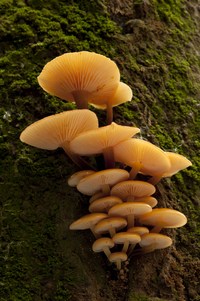
Mirrors were utilised to give light to the underparts of fungi and came into much of Gerhard’s shots along with other reflectors for full lighting of the subject. To illustrate the upside of this technology, we were shown shots taken with and without the gear – point made! Rear lighting by the use of a mirror was used to give a lovely transparency to a beautiful Honey Fungus. An umbrella was brought into play to block unwanted light on the other hand – another trick of the trade. Showing the underside of fungi, especially for identification, was illustrated, for Gerhard put names on his specimens where possible to give them more meaning. Backgrounds or not? Sometimes these need to be faded out to highlight a fungus and so the ‘F’ number had to be adjusted – wide aperture in this case but where the background/foreground added to the story of a fungus-associated understory for example – then a quite small aperture came into play. Using one or the other apertures on the camera for required effects was nicely illustrated for us to appreciate. HDR or photo-stacking was another computer technique that Gerhard uses to great advantage to enhance some of his pictures.
So it all boiled down to firstly watch the weather, balance of settings v/s auto, slow release or use of timers, reflectors and a good dose of patience if one is to get that PERFECT shot along with a 15 kg backpack as we were shown in Gerhard’s final shot! A really great show and plenty for we raw amateurs to contemplate.
Kevn Griffiths