

Although showers were forecast, the morning was beautifully warm and sunny, allowing about 30 members and visitors to enjoy a leisurely walk along the slope of the Darling Scarp above Lesmurdie Falls. Many people were surprised to see how many of the shrubs in the heath land were already in flower. As we walked up the path from the stream, the vegetation changed sharply from riverine to Jarrah-Marri trees, then to heath as the soil depth decreased.
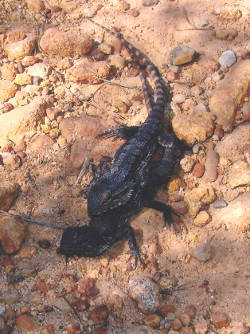
Ornate dragons mating Mating season (ornate dragons, Lesmurdie). Photographer: Edwin Dell
Trymalium ledifolium and Petrophile biloba were particularly noticeable at first. The beautiful Astroloma foliosum was in flower, as were Cryptandra arbutiflora and Hovea pungens. These, together with the flowers of Hibbertia hypericoides, made a spectacular show. Several species of Hakea were also in flower, H. trifurcata, H. erinacea, H. lissopcarpa.
As we approached a granite outcrop we found Verticordia acerosa just starting to open its buds and Davesia horrida was covered in orange flowers and attracting native bees. Here some Darwinia citriodora shrubs were covered in spectacularly large flower bracts.
As we sat on some rocks enjoying the display and a view from the escarpment, Judy explained some of the strategies that the plants use to obtain nutrients from the poor soils. Many of the plants have associations with fungi on their roots. These are known as mycorrhiza. Some have ectomycorrhiza in which the fungi form encasements around the root ends. Others have arbuscular mycorrhiza in which the fungi penetrate further into the cells of the roots. The fungal hyphae extend throughout the soil increasing the surface area from which nutrients can be absorbed and passed to the plant. The plant reciprocates by passing sugars to the fungus.
Other plants such as Macrozamia and Acacia have root nodules containing nitrogen fixing bacteria and supply the plants with nitrates.
Proteaceae have cluster roots which form dense mats close to the surface where organic matter is present, allowing them to have access to vital nutrients, especially phosphorus.
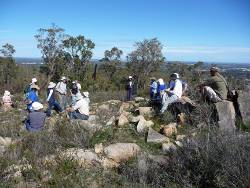
DRB group at Lesmurdie scarp being addressed by Judy du Plessis on the survival strategies of native plants in this harsh environment. Photographer: Arthur Conacher
The sundews trap insects to obtain their nutrients, while the parasitic plants such as dodder and the Christmas tree, Nuytsia floribunda, invade the tissues of plant hosts using haustoria to obtain what they need.
Andre discussed the formation of the Darling Scarp and pointed out the world distribution of Proteaceae is related to the break up of Gondwana with species occurring in South Africa, Australia, South America, Asia and some Pacific islands.
Eighteen species of bird were encountered including the black tailed cockatoo, brown honeyeater, white cheeked honeyeater, striated pardalotte, western gerygone, golden whistler and red capped parrot.
We did not see much animal life, but a pair of ornate dragons were seen mating and Glassert’s froglet and the red thighed froglet were heard croaking by the stream.
Finally, those people who were interested went down to see the falls which were in full spate after the recent rains. As we sat down at a picnic table to enjoy our lunches, all agreed that it had been a very pleasant and informative outing.
Judy and Andre du Plessis