

Some 20 intrepid DRB members and visitors travelled to Twink Smurthwaite’s ‘Topsy’ garden in Boya on Sunday September 18th – ‘intrepid’ because the day promised to be truly equinoxal. About half of those people continued to inspect rehabilitation work by the Helena River Catchment Group (HRCG) along the Scott Street/Pumpback Dam section of the river. The following account draws heavily from written material provided by Twink and Craig Wansbrough, Deputy Chair of the HRCG.
Twink’s garden
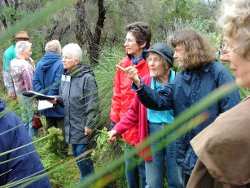
The group was impressed with the variety of plants in the garden, which has become established over 45 years. Twink said that the garden had been hit hard by the previous exceptionally dry winter and hot summer, although virtually all plants were showing renewed growth after the welcome rains this winter. Unfortunately weeds have also thrived.
DRB members in Twink’s garden. Twink 3rd from right. Photo by Andre du Plessis
Twink noted that when she settled there in 1963 the garden contained some non-native plants, including a Fiddlewood tree (retained for its shade), Hibiscus, Bougainvillea, Cotoneasters (mostly gone), an Olive tree (also removed, but seedlings reappear from time to time), Irish Strawberry trees and a Lemon-scented gum.
Naturally-occurring natives include Allocasuarina huegelliana, Wandoo, Eucalyptus rudis, Hakea prostrata, H. petiolaris, Xanthorrea, Marri (happy in one part of the garden but will not survive in another) and Zamias (one with a very large base and two grown from seed).
Plants which have appeared voluntarily over time include Phyllanthus calycinus, Stypandra grandiflora, Daviesia horrida, Trymalium floribunda, Thomasia foliosa, Orthrosanthus laxus, Acacia pulchella, Rulingia cygnorum, Grevillea pilulifera, Haemodorum Orchids and several grasses, including Kangaroo grass, Wallaby grass, Spear grass, Astrostipa elegantissima, Neurachne alopecuroides and Microlaena stipoides. Seeds have washed down from upslope, including Hibbertia serrata, Darwiniia citriodora, Verticordia plumosa and Melaleuca radula.
Trees planted include E. kruseana, Allocasuarina, Melaleuca and Corymbia species.
Birds thrive in this inspirational garden, which strongly reflects the character of its owner and carer.
Helena valley
The second part of the excursion took in an inspection of the restoration work being carried out by the HRCG along the lower Helena river. Funds were obtained from Swan Alcoa Landcare Program grants and an Australian Government Natural Heritage Trust Envirofund grant.
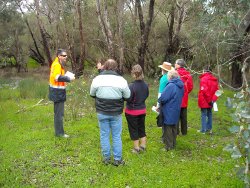
Craig Wansbrough led the group to the four sections of the project. The ten-year project was initiated in 2005 and is aimed principally at weed control followed by revegetation, on both banks of the river from Scott Street to the Pumpback Dam. Following the disastrous 2010 winter, the group was encouraged by the strong flow of the Helena.
Craig Wansbrough showing Helena rehabilitation.
Photo: John Abbott
Section 1 of the project extends from the Scott Street bridge to Fyfe Street. No work has been done here as yet. The objective was to show the group the nature of the extensive weed infestation, primarily Blackberries, Watsonia, Giant Reed, Figs and Buckthorn, prior to their removal.
Section 2 comprises the Fyfe Street Flats and also illustrates the fuse break/habitat island concept. Twelve landholders and the Shire of Mundaring were involved in the work. The Flats had been excavated for alluvium (sold as ‘garden soil’ in the landholder’s garden centre) between 1940 and the 1960s, with some 2 m of alluvium being removed. As a result it is now very susceptible to flooding. After two years (2005-2007) of weed control, planting of Juncus subsecundus was undertaken, but there are still problems. Craig also demonstrated the fuse break/habitat island concept, where clumps or islands of shrubs are replanted as fauna habitat, leaving some areas with relatively bare understorey to act as ‘fuse breaks’ to help in fire fighting. He noted that fires (usually lit by arsonists) are a major problem in this area, and that the river vegetation can act as a wick, carrying the fire rapidly through the valley.
Along Helena Valley Road Craig pointed out the effectiveness of four-year-old direct seeding by the Water Corporation on the upslope side. Weed control works were achieved in 2007- 2010.
Section 3, Victor Road revegetation, has had two years of weed control and was planted by community members and 13 landholders in July 2010, using the same species as in the Fyfe Street section.
Section 4 includes the picnic ground at the end of Helena Valley Road and continues towards the Pumpback Dam. There are many problems in this area, including some very steep slopes (abseiling had to be used to access some of the Watsonias) and the widespread occurrence of annual weed species. Adjacent to the picnic ground the DRB viewed the Western Power Offset Project, which includes weed control and revegetation. Water Corporation weed control was completed on the eastern side of the river from 2006/2007. On the western side Watsonia control was completed from 2008 to 2010.
Members of the group were most impressed by what they saw and were highly appreciative of Craig’s explanation of the project – which won the 2010 WA Environment Award (Bush, Land and Waterways category). Nevertheless, controlling annual weeds, which have proliferated following the removal of the perennial weeds and the wet winter, will prove challenging; and ongoing maintenance will be required.
Arthur Conacher