

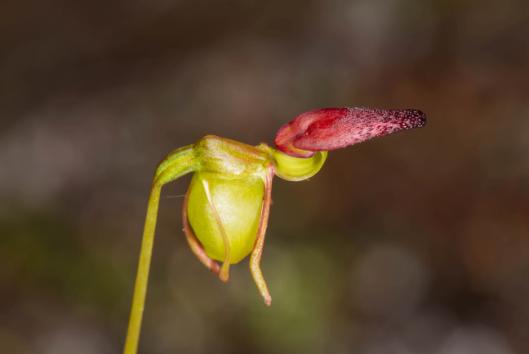
 Hort’s Duck Orchid, C. Prickett
On a morning that started out mainly sunny with a threat of showers later, seven members joined hosts Bob and Lynette Goodale for our September 24 visit to Goodale Sanctuary. We commenced with a walk to the main lake, which had water levels as high as some of us had seen over the years we have been visiting. There were not many birds to be seen on the lake itself—just a few Eurasian Coots swimming in and out of the Swamp Paperbarks at the far side. From the boardwalk we made our way to an area where Hammer Orchids and Duck Orchids were in flower. All but one or two of the Warty Hammer Orchids (Drakaea livida) had been pollinated—as had most of the Flying Duck Orchids (Paracaleana nigrita). Good numbers of the Glossy-leafed Hammer Orchid (Drakaea elastica), which is Declared Rare Flora, were in bud and a few weeks off being fully open. Bob and Lynette have to go to great lengths to protect these plants from the many kangaroos in the area, installing mesh guards and even upturned waste paper baskets (made from an open mesh material) These are taken off during the day when the flowers are open, to allow access for the pollinating male Thinnyd wasps. A Duck Orchid that was in flower was identified as Hort’s Duck Orchid (Paracaleana hortiorum), which until recently had not been recognised as a different species to the Flying Duck Orchid which is also present in the same area. Other orchids in flower included Cowslip Orchids (Caladenia flava), Common Donkey Orchid (Diuris corymbosa) and Purple Enamel Orchid (Elythranthera brunonis). Common Mignonettes and Blue Lady Orchids were in bud. Other plants in flower included Holly Leaf Banksia (Banksia ilicifolia), Cow Kicks (Stylidium schoenoides), Conostylis sp., and Banksia attenuata.
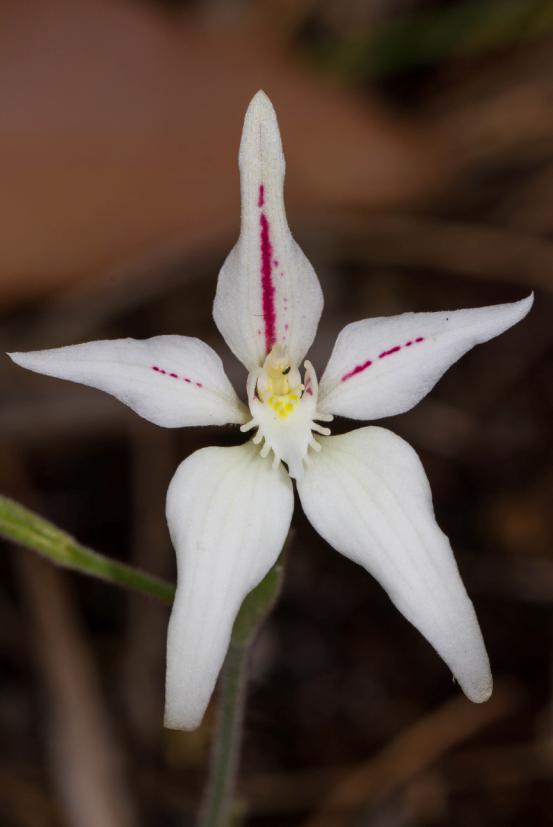

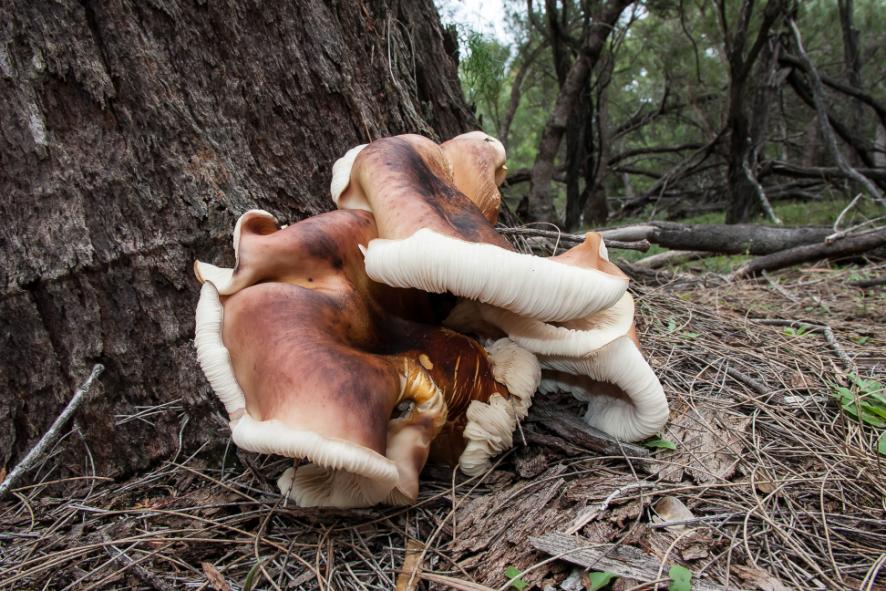
After a break for morning tea we set off for another walk, with Bob and Lynette keen to show us some white Cowslip Orchids. Bob commented to me that the recent rains had not resulted in a new spurt of fungi sightings, other than a few Scarlet Bracket fungi. As if on cue we were called to come and look at two magnificent specimens of Ghost Fungus at the base of a Jarrah—some of the largest we have seen (below). We soon found the white Cowslip Orchids (above left, C Prickett) plus some hybridised Cowslips (above right, C Prickett) that showed varying shades of pink and red.
We found more plant species in flower including Hemiandra pungens, Dampiera linearis, Twining Fringed Lily and Common Brown Pea (Bossiaea eriocarpa). We also found a Prickly Moses (Acacia pulchella var. pulchella) with lots of Green Scarab Beetles (Diphucephala sp.) piled on top of each other on its flowers (below, C Prickett)
 Daniel Heald had come armed with two umbrellas that we soon discovered were not for use only if it rained. He sought out eucalypts where he would place an open umbrella upside down below a branch then shake the branch in order to find out what beetles and other invertebrates were feeding on the eucalypt leaves, to contribute to a study a colleague of his is conducting. Not many were found, despite the evidence of leaf damage that suggested some had been busy. He did find a very small Crab Spider (Cambacha sp.) and a small beetle in one shrub and an Oxyops sp. Eucalyptus Weevil in another. He found a Green Scarab Beetle near the boardwalk to the lake lookout. While Daniel was photographing it, Bob Goodale found three beetle larvae (believed to be Ecnolagria sp.) and a Red-legged Weevil (Catasarcus sp.) in one shrub near the boardwalk. Daniel also found the caterpillars of four different species of Case Moth (Psychidae sp.) and a Green Lacewing (Chrysopidae). Western Grass Orb Weaver Spiders (Plebs cyphoxis) were common, as were Crane Flies. Reptile sightings included a Southern Heath Monitor (Varanus rosenbergi) on Birchmont Road and Fence Skinks (Cryptoblepharus plagiocephalus).
Birds seen or heard included Australian Raven, Australian Magpie, Australian Ringneck, Brown Goshawk, Brown Honeyeater, Eurasian Coot, Fan-tailed Cuckoo, Rufous Whistler, Scarlet Robin, Splendid Fairy Wren, Square-tailed Kite, Striated Pardalote, Western Gerygone and Yellow-rumped Thornbill.
We finally arrived back at the house as the first drops of rain started to fall. There was a heavy shower while we had lunch under the verandah and discussed our discoveries. It had been a great morning—thanks again to Bob and Lynette for allowing us to visit.
Colin Prickett