

Twenty two Naturalists met at the Hill Street entrance to the high, western portion of Kalamunda National Park on Sunday May 22nd, where they were spoilt by pre-walk scones, jam and cream kindly prepared by Judy and Andre du Plessis. A gentle circuit introduced participants to this section of the Park. At the end of a long, hot summer which had been preceded by the driest winter on record, not surprisingly there was significant evidence of stress in the jarrah-marri forest, particularly amongst the banksias. Evidence of dieback was also apparent. On the other hand recent rain of more than 30 mm had freshened the vegetation dramatically.
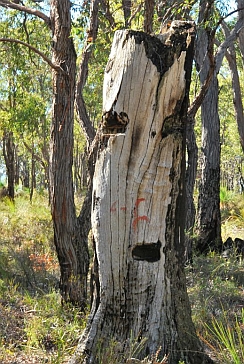
Axeman’s Marks. Photo: Ken Patterson
Several plants in flower were observed, including Eriochilus dilatatus (White Bunny Orchid), Stylidium repens (Matted triggerplant), white daisy (maybe Olearia sp ?paucidentata), and Calothamnus sp (?rupestris); and the marri were starting to flower. John Abbott noted an unidentified, small, orange fungus on a banksia pod (not in Kevn Griffiths’ book). Ken Patterson commented that from his regular walks in the Park over several years, studying plants for his ‘Photographic Guide to the Flora of Kalamunda National Park’, he has logged 450 plant species, both native and introduced.
A relatively small number of birds was identified: green 28 parrots, galahs, weebills, the ubiquitous magpies, yellow rump thornbill, redwinged wren, grey fantail, rufus whistler, and an unidentified raptor (flying low and fast just above the canopy). Several kangaroo tracks were noted and two animals seen towards the end of the walk.
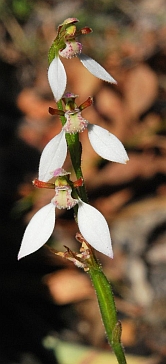
White Bunny Orchid. Photo: Ken Patterson
Jeanette Conacher commented on some of the area’s history. Logging in the Kalamunda area dates from the 1860s with the release of big jarrah timber concessions around Canning Mills. Logging in the Gooseberry Hill and Kalamunda National Park area probably took place several decades later with the extension of the Canning Mills railway line down the Zig Zag to Midland, and thence to Fremantle port. Evidence of timber-getting was seen in loggers’ tree markings, the numerous remains of large tree stumps, coppicing, and spindly re-growth. These, along with the effects of fire, have opened up the forest to resemble more of a woodland than a forest. However, it was noted that this part of the Park was relatively weed-free.
The Aboriginal history of the area has been linked to the practice of the coastal Beeloo group (also known as the Nectar People or Mungyt) moving into the Hills during winter to seek shelter from winter gales and floods. Kangaroo skins provided warm cloaks, and a range of native plants and animals of the valleys, forest and scarp offered rich food sources. Adjacent to the National Park, the Helena Valley had strong associations with Wagyl, the Rainbow Serpent, who was an important mythical being around whom Aboriginals constructed their Dreamtime stories. More than 100 Aboriginal heritage sites have been identified In the Kalamunda area.
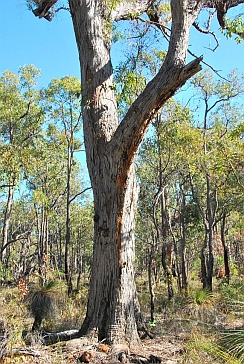
Possum Tree. Photo: Ken Patterson
The group considered the range of stresses on the Park, including logging, dieback, climate change, fire, invasions by alien species (cats and foxes especially), offroad vehicles, erosion of steep fire breaks and vandalism. They were then asked what they would do if they were put in the position of managing the Park. ‘Tear our hair out’, was an immediate response. More constructively, suggestions ranged from improved signage (not only identifying the Park’s boundaries and the need to keep animals and vehicles out, but also explaining why this is necessary), rationalising and improving track layouts, community education in schools, friends groups, visitor centres, Shire offices and elsewhere, and an improved ranger presence — recognising the financial limitations.
Arthur Conacher briefly summarised the geomorphological history of the area, referring to the emplacement of the granitic rocks around 3 billion years ago and the later intrusion by dolerite (600 million years), our last glaciation (250 million years), the break up of Gondwanaland (150 million years), valley incision and the formation and nature of the duricrust (aka ‘laterite’) in relation to deep weathering (around 60 million years), Aboriginal influence on the ecology (over some 40 thousand years), European impacts (over more than 150 years) and the long-term and continuing roles of ants and termites (amongst other soil and litter fauna) in soil formation and nutrient cycling; in the context of long-term climatic fluctuations.
Arthur and Jeanette Conacher