

Trip to Dairy Wells, Cue from the 10th August 2012
From the 10th August for about a week seven of us spent varying amounts of time at Dairy Wells, a leased property near Cue, belonging to Rosalie and Geoffe Barritt.. Unfortunately flu and funerals depleted the numbers and shortened the length of stay for some.
Dairy Wells was the second dairy to supply the Cue area, the first being the Vickery Dairy. The house was moved from Mainland on Lake Austin in the 1930s and the dairy was most likely set up by Harold and Biddy Parker (nee Ryan, from an old pastoral family in the area) and they stayed until 1958. They flood-irrigated an area near the house to grow lucerne for the cattle. Mr Parker also did some slaughtering, there is an old piggery on the property and eggs from their chooks were sold. The dairy finished when the Parkers left.
Mr Sheedy, the next occupant, planted a reputedly very good orchard and provided fruit and vegetables for the Cue area. Next came the Turner family and, coincidentally, one of the sons later worked for Geoffe at Alcoa. The Turners ran horses and built horse yards but did not stay long. The property was then taken by John Guise, Harold Parker’s grand-son-in-law, who wanted to run goats but was not permitted. Mr Guise lived in the house but did not use the land, spending his time looking after his many mining leases.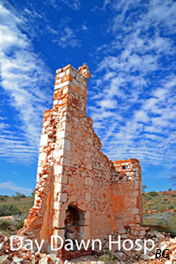
Then Barritts took over the lease and made improvements including the installation of a good power supply based on wind and solar with a back-up generator. The house was let for a number of years but after the local mines closed and Big Bell was FIFO the town went into decline and the house was not let. So the vandals and thieves came along, taking what they wanted and destroying much of that which remained. Copper was removed, the caravan was wrecked, sleepers, cabinets and tools were stolen. The main line for the turbine was cut and the generator taken, along with such things as the shower-head down at the camp.
 Six weeks before we arrived a new, large donga village was opened in Cue and a lease just east of Cue is now being mined. A new café is opening soon and mine workers are seen around town so we hope things are getting better for Cue.
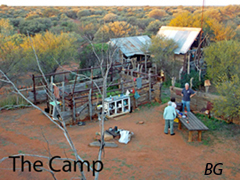
We happy campers, caravanners, and swaggies stayed at the camp which is a couple of hundred metres from the house and situated between creek beds that run through the property. While the creeks were not running there are signs that they do so quite quickly with rain and, being on clay, the track into the camp gets quite boggy. There is a windmill that fills a large, raised tank with very good water. The top has been removed from the flushing toilet but a tap and bucket just beside provides a solution to that problem. The removal of the shower head and some of the copper piping resulted in a little inventiveness so that we could use lots of hot-water from the donkey, and we did. The centre of the camp is enclosed by walls of sleepers, made with hard work by the Barritts, and has a large lovely wooden table (fortunately thieves could not get the top off the legs even though they obviously tried hard), a fire pit, and a barbecue made from a 44 gallon drum. There are a sink, a cupboard and hooks. A very cosy and welcoming area and it is where we all gathered for meals, relaxation and discussion.
There are so many things to do around Cue and exploring the natural world around us was the highest priority. We walked much of the property of about 10 acres and wandered onto the surrounding bushland. There are lots of tracks and signs of old Aboriginal as well as prospectors’ camp sites. We visited structures from earlier days such as the piggery, horse yards and abandoned tanks around Dairy Wells.
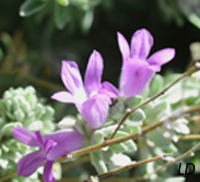
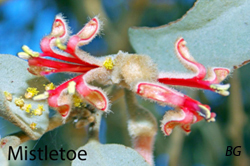
This has been quite a dry year for the area and we did not have the swathes of everlastings we saw driving on the way up but we did see a lot of Acacias, Chenopods and Eremophilas in flower, along with different Ptilotus, Sennas, Solanum and Sidas. There is a beautiful Santalum lanceolatum tree (Nothern Sandalwood or Bush Plum). A lot of mulgas had a lovely pink-flowered Mistletoe growing in them.
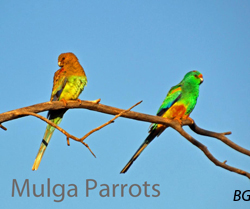
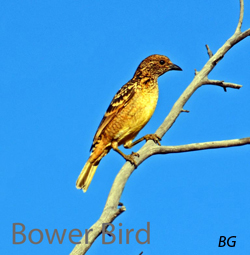
Every morning we were entertained by the Mulga Parrots and Bower Birds coming into the camp and posing for us on the trees before they went to drink at the trough. Other shyer birds hid in bushes near the water before they ventured to drink. There were two Whistling Kites in the area and we were in the territory of a Black-Breasted Buzzard. On our first walk we saw a small snake, very pretty grey with a black and yellow band behin>d its head and a couple of black bands down its body.
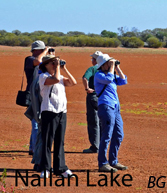
 Visits were made to places around the district: Day Dawn Hospital ruins, Nallan Lake with its water birds, Millie Soak on Nallan Station with its three graves from the 1893 typhoid epidemic, and Garden Rock. The rock is large and granite with interesting exfoliations and a depression that holds water and may give the rock its name as there is a wild garden with trees and a variety of plants, many in flower, growing in there. Another trip was to the Great Fingal Mine Office, well we got as far as a tall wire fence with a locked gate to keep us about 100 metres from the lovely brick building. Nearby is the Railway Dam where there were lots of birds drinking.
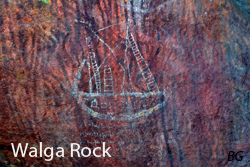
A couple of us who could stay for a longer time went out to the fascinating Walga Rock which we drove right round, very worthwhile. We saw more Red-capped Robins, they are quite common in the area. Big Bell was another place we visited, and noted that it is disappearing as time goes by.
The days were mostly sunny with very cold mornings. A couple of days were very hot around noon, the rest were comfortable but we did have some cloud and 5 minutes of drizzle one morning. The nights were moonless so we were covered by a magical glittering starry sky. Rosalie made us feel very welcome, was a considerate host and excellent guide. We all agree that it is a place to re-visit (one of us was there for his third time) and hope to do so.
Some of the birds. Over 50 including the following were seen: Western Bower Bird, Black-breasted Buzzard, Bower Bird, Whistling Kite, Spiny-cheeked Honeyeater, Red-capped Robin, Hooded Robin, Zebra Finch, White-plumed Honeyeater, Crested Bellbird, Diamond Dove, Wedge-tailed Eagle, Chestnut-rumped and Inland Thornbills, White-browed Babbler, Mulga Parrot, Budgerigar, Cockatiel, Chiming Wedgebill, Avocet.
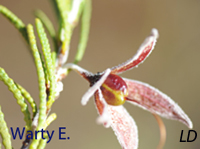
Some of the flowering plants. Many we could not identify precisely. Androcalva luteiflora (previously Rulingia luteiflora), Crumbweed, Dead Finish, Eremophila compacta ssp. Compacta, E. fraseri, jucunda ssp. Jucunda, E. latrobei ssp. Warty leaves, E. Mackinlayi ssp. Spathulata, E. punicea, Exocarpus sparteus, Gunniopsis, Gastrolobium laytonii, several Marieana, Hop and Red Mulgas, Podolepis capillaris, Pterocaulon sphacelatum, Ptilotus exaltus, P. obovatus, several Sclerolaena, Senna artemisioides, Sida calyxhymenia.
Rosalie Barritt and Lynette Davies Photos: Bob Goodale and Lynette Davies