

Seventeen Naturalists settled themselves comfortably in two cottages at Governor’s Circle Kingstown on the Friday. We organized ourselves into a fairly relaxed program. We started each day with a bird walk and then a snorkeling session and mostly in the afternoon we had a botany walk which tended to double up as a history lesson as well.
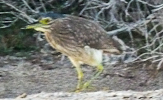
Young Nankeen Night Heron
Our first bird walk was to Bickley Swamp and was very productive. One of our party had Michael Morcombe’s eGuide to Australian Birds on his iPhone which had information on each bird and the various races, as well as its call. This did prove a bit disconcerting at times, but as our bird books were sadly out of date, it was extremely useful. We did see a Nankeen Night Heron which was a surprise but not unexpected. Also a Spotless Crake, which we believe has been at Rottnest for the last 2-3 years and there have been reports of breeding.
The next morning we walked to Government House Lake which was not so productive with just a few Ruddy Turnstones and Red-necked Stints. We continued our bird count over the whole weekend and we managed to see 37 birds in total.
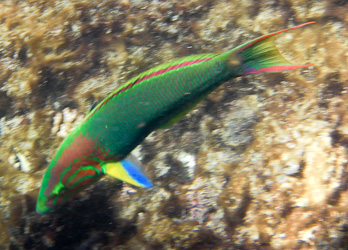
Green Moon Wrasse
Our first snorkeling session was at Salmon Bay which was excellent, we saw over twenty fish and Loisette Marsh was very happy with the big Acropora that was growing well and thePocillopora that was much bigger than normal.
The next day we went to the northern side of the island to Little Armstrong Bay which had deeper reefs which were quite fascinating with plenty of overhangs and holes to explore. The marine life on and around the reef, also looked very healthy. We managed to meet up with a dugite before we entered the water. Loisette said she had heard mention of coral bleaching at Jeannies Lookout mainly in the Montipora species there, which was not good news.
A plant foray was conducted on Sunday afternoon in the area to the west of the Kingstown/Settlement Road across to Government House Lake. Two areas of interest were and an old and a new reforested area. Both showed the Rottnest Island Authroity’s policy of local plants being used such as Melaleuca lanceolata (Rottnest Teatree),Callitris preissii (Rottnest Pine), Coastal Mort (not local), Acacia rostellifera (Summer-scented Wattle). The old area had plenty of decayed material with plenty of active insects and spiders which attracted the birds The newer areas showed plenty of Quokka activity grazing on very limited vegetation. This was especially noticeable near the samphires and sedges around the Government House Lake where the Quokkas resided. Another aspect was the unsuccessful attempts to eradicate the noxious oleander one plants on the RIA target list.
Star gazing was carried out on both Saturday and Sunday Nights. Due to the full Moon period, stars weren’t prominent. However the constellations Orion, Southern Cross and Gemini created some discussion. Sunday night proved fantastic viewing of the Moon rising in the East about 6.30pm with an enlarged orange ball. Because Jupiter, Saturn and Sun all in the west at sunset with only Venus as ‘Morning Star’ meant gravity has brought the Moon closer to the Earth and appears 1% bigger than usual. The change in colour from orange to a white or more ghostly shade of yellow over a two hour period rising over Thompson’s Bay was spectacular. (see Jonica Foss’s photos in the Gallery showing the comparison).
Other Highlights were a ramble along the Bickley Heritage Trail on Saturday afternoon, Listening to the MLC Students Choir final rehearsal at Kingstown Barracks Sunday Lunchtime and a History Walk of the Settlement on Monday morning.
The weekend proved to be very enjoyable for all and a good break from life on the mainland.
More photos are in the Gallery.
Maureen and John Gardner