

Main Club May 2017
Our speaker for May, Julianne Waldock, is a technical officer at the WA Museum, working with spiders and myriapods (centipedes, millipedes etc.). The majority of her research has been on spider taxonomy, as well as some centipede taxonomy.
Julianne began with four uncommon and unusual spiders of the south west. The first was the Assassin Spider, which preys on other spiders by sneaking up on them. They are very cryptic: less than 5mm long, and they don’t look like a living creature, let alone a spider. To find them, an experienced arachnologist has to stare for long periods into a tray of leaf litter and look for movement. They were first named from fossils in Baltic amber, before living specimens were found in Madagascar. Now they are also known from Australia and South Africa; recent work has revealed six species occurring in WA.
Then there are the peacock spiders (genus Maratus), in which the male dances and shows off his brilliantly-coloured abdomen to the female. The dances include whirring and tapping sounds. Each species has a unique mating performance to ensure the female selects the appropriate species and the best mate. Peacock spiders have become something of a YouTube sensation on the internet—see user Peacockspiderman on YouTube which is hosted by entomologist Jurgen Otto.

The Carpet Wolf Spider could be mistaken for a Huntsman Spider because of its flattened shape, but it belongs in the Lycosid family with the other wolf spiders. It hides under rocks and is well camouflaged on the granite rocks of the wheatbelt by the tapestry-like pattern on its back. These were first noted by Barbara Main in the 1970s but were not named until 2009 after a male specimen was found.
We are familiar with ground-dwelling trapdoor spiders, but we also have seven species of tree-living, miniature trapdoor spiders in WA. They build their lidded tunnel-nests in the bark of trees, and are very cryptic.
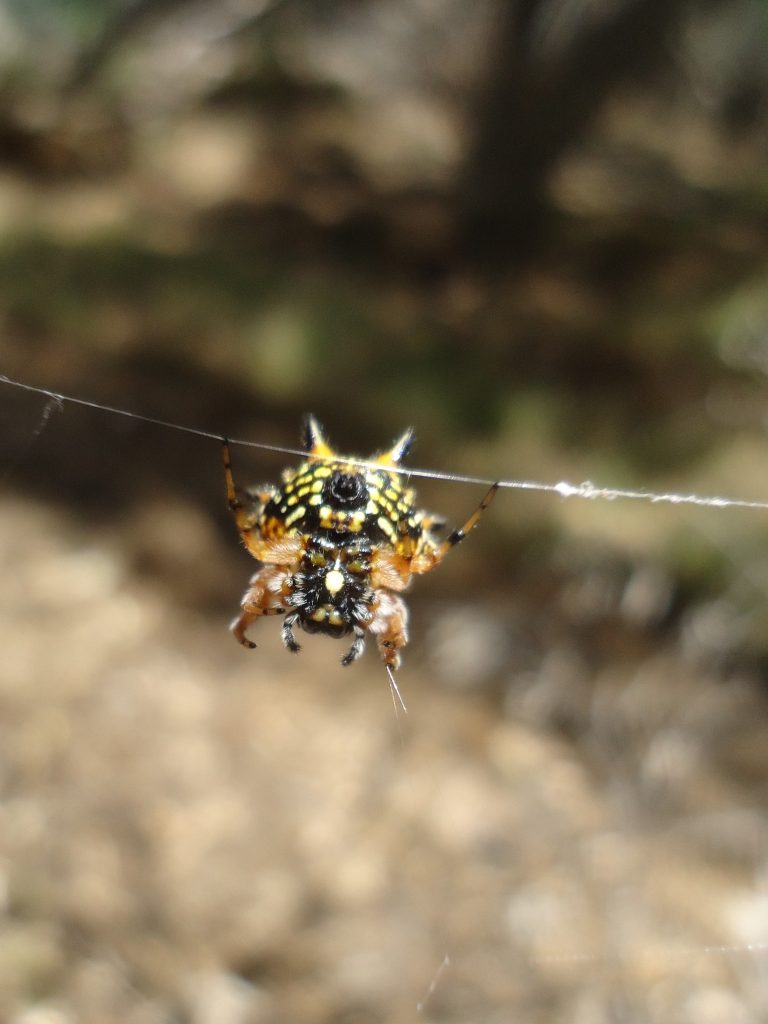
Julianne went on to discuss other, more common local spiders. There is the semi-communal black-and-yellow Christmas Spider (left, J Waldock). It is very common, but rarely seen in domestic gardens.
Another, larger spider with the same colours—but in stripes—is the Banded Orb Weaver. Despite its bright colours, it blends into the dappled shade in the tall grasses and shrubs. The female remains in her web all the time, as distinct from the Garden Orb Weaver (Eriophora spp.), that packs up her web each morning and hides nearby. Another is the Bird-dropping Spider, which hangs from a leaf at night catching insects with its front legs. Because of its camouflage, it is rarely seen but the egg sacks are often noticed in gardens.
The Scorpion-tailed Spider uses its tail, together with a line of droppings on the web, to detract from its spidery shape in the eyes of predators. Julianne said that changing climate may be the reason that reports of this spider now only come from south of Perth, where formerly they were reported from the metro region. The Leaf-curling Spider sits unnoticed inside its curled leaf, with only its feet protruding slightly, testing the web for vibrations. Phryganoporus genus, which constructs a thick silken tube in low shrubs, is related to the Black House Spider (Badumna genus). These spiders do not produce sticky silk. Instead, they tangle the threads with special structures on the last legs and above the spinnerets. The Swift Spider (Nyssus coloripes) is a very widespread black-and-white spider that is an extremely fast runner on the ground.
The Common Garden Orb-weaving Spider (Eriophora spp.) relies on the foliate pattern and dark grey coloration in order to hide during the day. Variations from this theme include yellow colours and white spots or crosses. The Net-casting Spider (Deinopis) uses its huge eyes to focus on prey in low light and constructs a small net of tangled silk to throw over prey. The Black Wishbone Spider (Aname spp.) is a Mygalomorph, and so is sometimes confused with the Funnel-web Spiders. However, although they rear up, they very rarely bite and no serious reactions have been recorded; we have no Funnel-webs in WA.
There are several families of trapdoor spider in WA. These are also Mygalomorphs—the primitive spiders that use their fangs vertically and in parallel rather than pincer-like as in the Araneomorphs. Barbara Main has found that some trapdoor spiders can live for twenty years or more. But there are threats to their survival. One is that they do not survive in disturbed areas. Another is that many species have small distributions. Whereas some Araneomorphs such as the Garden Orb Weavers distribute themselves widely as spiderlings on silken ‘parachutes’ (known as ‘ballooning’), in most trapdoor species it appears that the newly emerged spiderlings only move a short distance from the mother burrow initially and a female may remain in this area her entire life. The males vacate their burrow and search out females at the appropriate species-specific season.
Julianne’s talk aroused great interest, which was evident from the number of questions. In response to some discussion on the supposed dangers of the White-tailed Spider, she said that this was a media fiction and that the Red-back Spider was the only dangerous spider in WA. She concluded by reminding us of our biodiversity here in WA, and how lucky we are to have such an abundance of spider species and a current ‘explosion’ of new finds.
Mike Gregson