

Five members and a visitor who had travelled all the way from Beaconsfield spent the morning exploring the beach and cliffs north of Trigg Island. Unfortunately, by the time we returned from this foray the wind had swung to the southwest. So despite the shelter of the island the sea conditions made snorkelling less appealing than it might have been. As a result, only two people ventured out.
The morning started with Alex Saar telling us that the sand spit connecting the island to the mainland is called a tombolo. Alex explained that the spit is formed when waves carrying sand lose their energy as they wrap around the island, thereby allowing the sand to drop out of suspension.
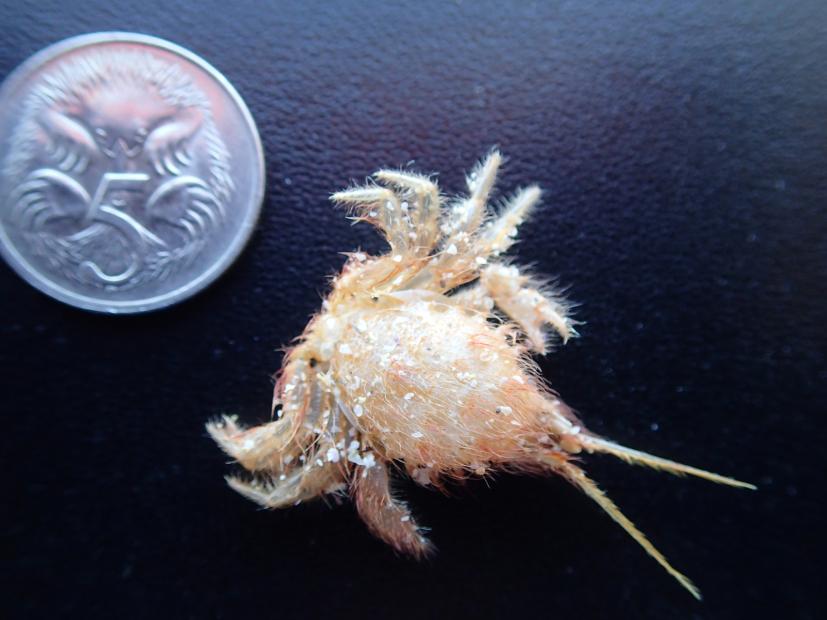
Among our finds on the beach were several tiny crabs. The first one, found by Willy Dadour, was a 30mm juvenile Masked Burrowing Crab (Gomeza bicornis) (above). It wasn’t until all the sand had been removed that we were able to separate its 10mm antennae and establish anterior from posterior. Andrew Hosie, Curator Crustacea & Worms at the WA Museum, has since informed us the crab uses the long antennae as an inhalant siphon when it buries itself in sand. He also mentioned that the crab is not often seen.
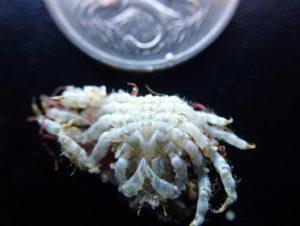
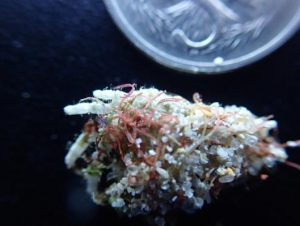
Soon after, Willy found another tiny crab (less than 10mm) which had covered itself in seaweed. We presumed this was the Seaweed Crab (Naxia tumidia) (above–left, ventral surface; right, dorsal surface) which is common in rocky intertidal and sub-tidal pools.
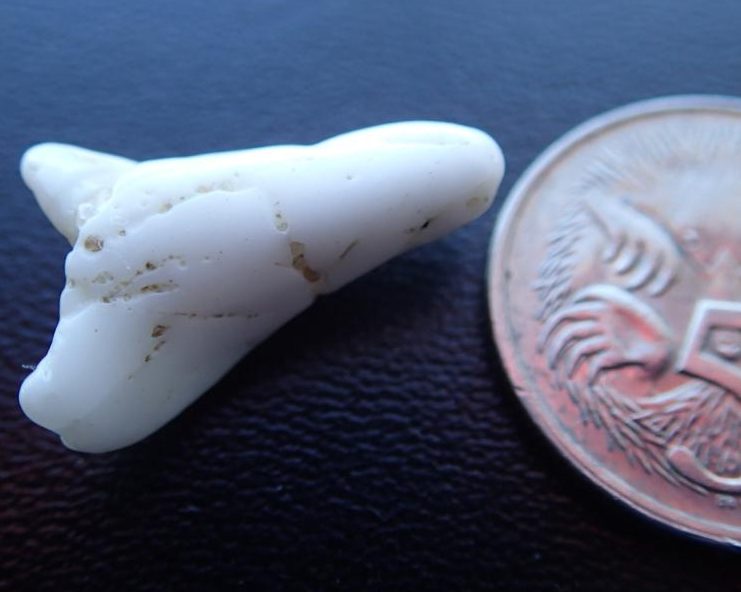
“GOLLY, look what I have found!” exclaimed Don, holding up what appeared (at least to him) to be a 20mm long ‘tooth’ (above). Its conical shape and rounded end suggested it was from a dolphin or a sea lion. However a search on the internet indicated both these animals have conical or cylindrical teeth without an enlarged root so did not fit the specimen. Photos sent to the WA Museum also resulted in a negative response from Dr Kenny Travouillon, Curator of Mammalogy, as there was “(no) dentine starting and enamel ending somewhere on the tooth, to separate the crown from the roots.” So what is it? Suggestions ranged from polished coral to part of the hinge of a large mollusc. Further suggestions are welcome. Just enter in the comments section at end of report or click on author name for contact details.
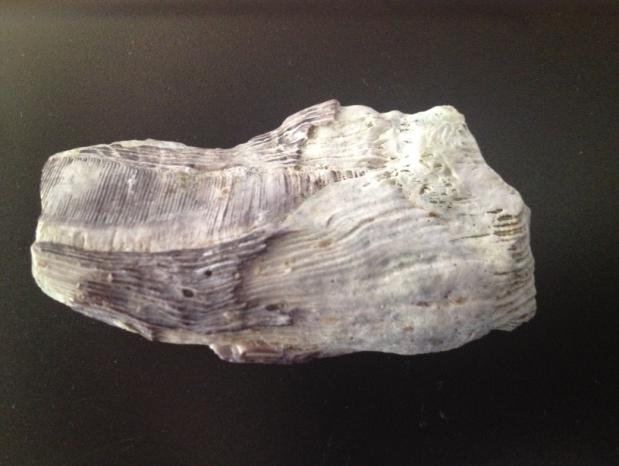
Our last find was a large (55mm long) piece of barnacle (above) showing the characteristic alternating lateral and radial striping or structural ridges. Barnacles grow in height by depositing shell at the base, thus pushing the shell ‘up’. Andrew Hosie identified this fragment as part of a Giant Rock Barnacle (Austromegabalanus nigrescens), an Australian endemic species. They can get to 70 mm tall and are found on exposed rocks along the southern half of Australia but not usually north of Geographe Bay. Don mentioned he had seen similar giant barnacles, but probably from the Pleistocene, on rocks hundreds of metres above sea level on uplifted marine terraces in Timor.
Our thanks to WA Museum staff, Jane Fromont, Kenny Travouillon and Andrew Hosie for assisting with identification and providing additional information.