

Twenty-seven naturalists enjoyed a beautiful warm and sunny Sunday morning on the short Weir View loop walk from the Perth Hills Centre at Mundaring Weir. Several welcome members from main club, including President Roz Hart, made the journey to the Hills in the hope of seeing some fungi. Unfortunately the dry weather rendered that objective rather futile, and only one fungus was found.
Jeanette Conacher presented the group with a handout she had prepared on the Weir walk area. This included reference to the Beelu group, the early Aboriginal occupants after whom the former Mundaring National Park has been named. A mia-mia constructed by the Department of Environment and Conservation (DEC) was examined, and its function and design described by Alan Compton (a DRB member and also a long-term volunteer for the Nearer to Nature Program at the Perth Hills Centre). Further information about the Beelu in the Helena River valley and surrounds can be read in Debra Hughes-Hallett compilation entitled Indigenous History of the Swan and Canning Rivers. This is available as a PDF download from DPAW website.
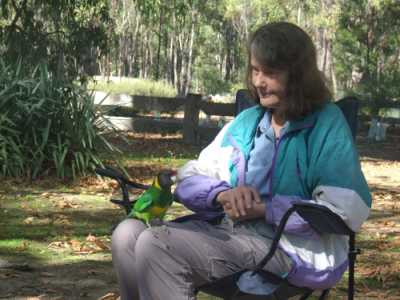
Judy du Plessis and friend. Photo by Pam Dell.
Jeanette also drew attention to some of the activities organised by the Perth Hills Centre, run by DEC. These include camping, walks and educational programs centring on environmental education and Aboriginal culture. The Centre is a popular destination for school groups and for teacher professional development. See further on DEC (now DPAW) website. Jeanette also commented on the numerous walks, trails lookouts and picnic sites in the National Park. Information on these is available from the Visitor Centres in Mundaring, Hills Forest and Kalamunda, or on-line.
It was noted that construction of Mundaring Weir took place between 1895 and 1903 (with the capacity increased in the 1950s to 63.6 million cubic metres), designed to provide the northern and central wheatbelt and goldfields with a regular water supply. The Weir’s catchment extends over 1500 square km. The reservoir was less than 40% full at the time of the excursion.
At several stops along the walk Arthur Conacher outlined the geomorphology of the area and the nature and ages of the underlying granites and dolerite intrusions, and their associated soils. The Darling Range is essentially an undulating, uplifted plateau incised by a number of river valleys, including the Helena River valley in which Mundaring Weir is located. Lateritic duricrust was observed and discussed on the upper part of the ridge, noting that the extensive outcrop was by no means level.
The jarrah forest has been intensively logged, and the trees in the area are virtually all coppiced stems growing from stumps or lignotubers. Wandoo is distinctively associated with dolerite outcrops. Conifers were observed in the (primarily) jarrah forest. The pines had been planted after some of the slopes around the Mundaring reservoir had been ringbarked early in the 20th century with the objective of increasing runoff into the dam. That clearing had the unintended consequence of increasing the salt concentration in the water of the reservoir, and the program was hastily reversed. The group noted with concern that the native vegetation in part of the Wungong catchment to the south is currently being thinned, in a trial also aimed at increasing runoff into the dam.
Birds, insects and flowering plants were observed by Eric McCrum and others along the way. The few flowering plants seen included Acacia alata, Olearia paucidentata, Persoonia elliptica (in fruit), Styphelia tenuiflora and Leucopogon nutans. Animals included the Leaf-curling spider (Phonognatha sp.), Trampoline spider (Corasoides sp.), Crab spider (Rebilus sp.), Orb weaver (Eriophora sp.) and Millipedes. Of the birds observed were the ubiquitous Magpie, Raven, Kookaburra, and Ringneck Parrot, as well as the Spotted Pardalote, Little Wattle Bird, Golden Whistler, Wood Duck, New Holland Honeyeater, Brown Honeyeater, Western Spinebill, Inland Thornbill, Red Capped Parrot, Western Gerygone, Grey Currawong, Grey Fantail, Mistletoebird and White Tailed Warbler. Several nesting boxes for birds, bats and other creatures have been placed in tall trees.
Arthur and Jeanette Conacher