

Darling Range Branch
Kulin, in the Eastern Wheatbelt, approximately 280 km from Perth, was home to twenty-four eager DRB Naturalists and visitors over the June Western Australia Day long weekend. The rich flora and fauna in the region had us entranced. 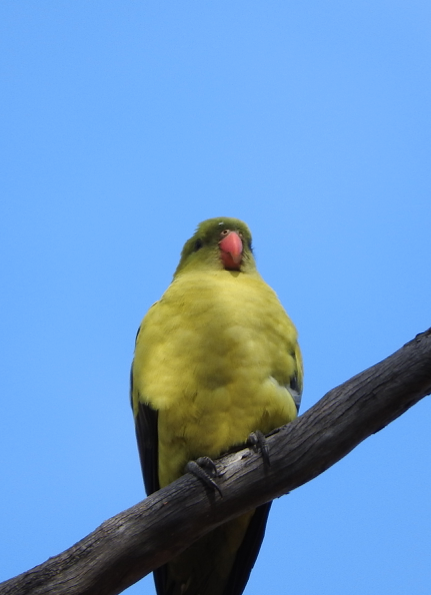 We started on Friday with bird walks and were immediately rewarded by seeing Regent Parrots (Polytelis anthopeplus) (left above, V. Jokovic) close to Camp Kulin, where we stayed. This was only the start though, as we saw fifty-seven bird species in total, surely a DRB record? Others included Elegant Parrots, (Neophema elegans), several different honeyeaters including the Spiny-cheeked (Acanthagenys rufogularis), Tawny-crowned (Gliciphila melanops), White-cheeked (Phylidonyris niger), and White-eared (Nesoptilotis leucotis).
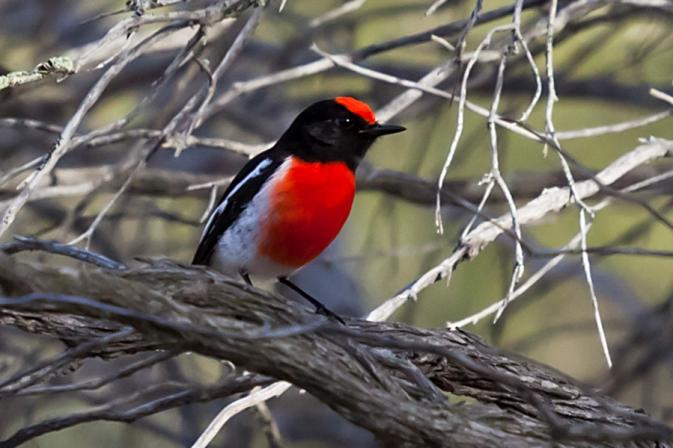
Also, in the midst of a desolate landscape affected by both drought and fire at Paperbark Swamp, was a brilliant Red-capped Robin, (Petroica goodenovii), (above, A Graham) and on the Monday we added a Chestnut-rumped Thornbill (Acanthiza uropygialis) to the list. We saw plenty of water birds at the Corrigin dam, such as the Pink-eared Duck (Malacorhynchus membranaceus) and the Chestnut Teal (Anas castanea). We were told there’d been no other recorded sightings of this bird at the dam for over 20 years. A full bird list can be found on the website.
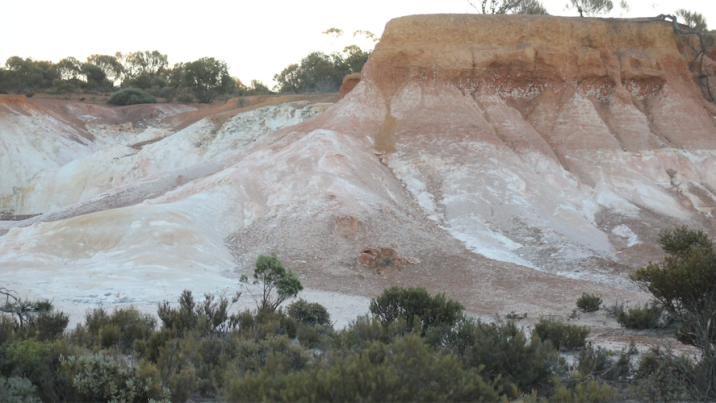
We visited many places including the Macrocarpa Trail with its thousands of Eucalyptus macrocarpa which, although not in flower, were still stunning. They were surrounded by Banksia sphaerocarpa in full flower. We also visited the Buckley’s Breakaway (below, R Green) and found the lunar-like landscape a photographer’s delight. At the base were piles of quartz and bright white kaolinite, and at the top a deep orange cap-rock of laterite.
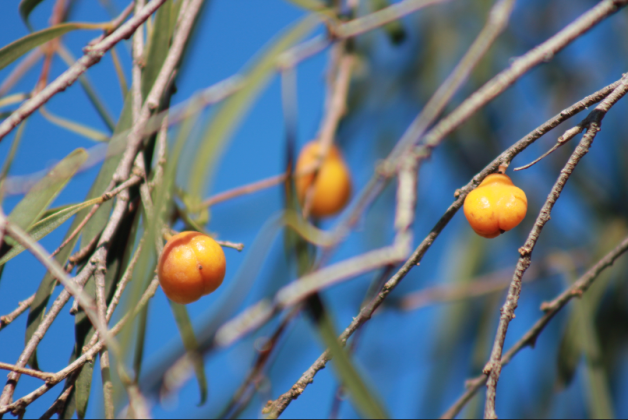
Led by local naturalist Robin Campbell, we visited the Rifle Range in Corrigin and Jilakin Rock too, where we saw a Wild Apricot tree (Pittosporum phillyraeoides) (below, R Green) complete with inedible fruits. Robin was incredibly knowledgeable on the local flora and fauna, for which we were immensely thankful.
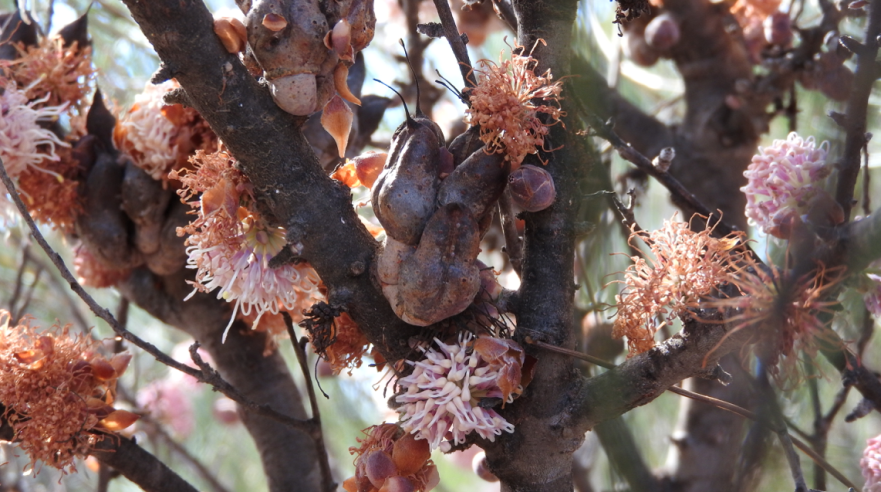
Flowering plants of special interest included a Hakea meisneriana (below, V Jokovic), and Hakea incrassata with large fruits on it, and four flowering wattles: Acacia cowaniana, A. stenoptera, A. neorigida and A. erinacea. In the main street were two abundantly flowering Hakea laurina and a Hakea scoparia.
Late on Sunday we took time to admire a forest of Gimlets (Eucalyptus salubris) (below, R McDougall) and learnt how the fluted trunk made it strong enough for the wood to be used as building material. The deep brown of the trunks glowed in the setting sun.
And we saw so much more: frogs, fresh fungi including the Woody Layered Bracket Fungus (Fomitiporia robusta), lichen, butterflies, spiders, even a native bee—but with limited words it’s hard to do it justice. Needless to say, many of us will return. 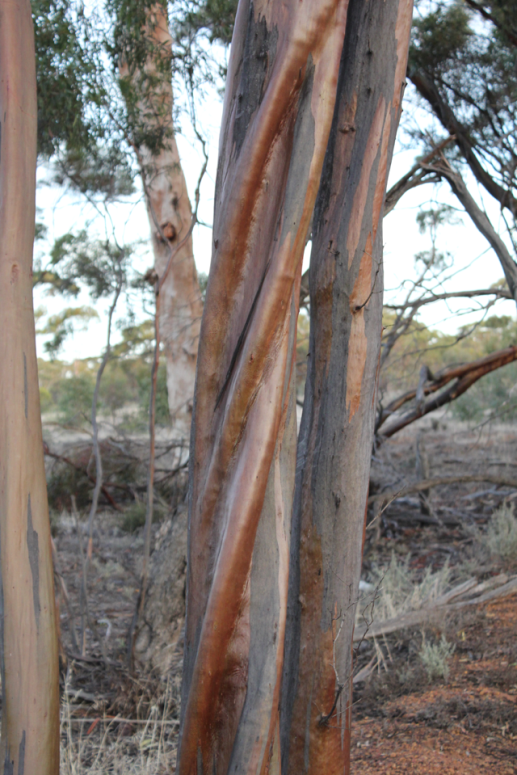 Our thanks go to all the farmers who took time out especially to speak to us—you added a depth and richness to our visit for which we are truly grateful: Harold Proud, Michael Lucchesi, Allen Smoker and Barry West, thank you. It was a superb weekend; thank you to everyone involved. Kulin rocks!
Rachel Green