

Northern Suburbs Branch
Lake Goollelal is the southernmost water body of a chain of lakes and swamps that make up the wetlands in the Yellagonga Regional Park. It is surrounded by remnants of fringing paperbark woodland, Jarrah-Marri-Banksia open woodland and scattered Tuart.
The lake, although shallow by world standards, is relatively deep (1.82m) compared with other lakes on the Swan Coastal Plain and therefore is a haven for waterbirds even during dry summers.
The walk around Lake Goollelal is approximately 4.5 km and is listed as taking one hour. Anyone aiming to meet that goal is not going to have time to stop and appreciate the large variety of flora and fauna that can be seen in the woodlands and on the lake. We needed two and a half hours. Even longer is required if you want to spend more than a few minutes at the bird observation area. See the website for a full list of birds we observed.
Fortunately our walk on May 23 took place the day before the drought–ending rain. The numerous glittering Golden Orb Weaver webs strung across bushes and the fences around the old Luisini winery certainly would not have been as golden if it had been raining. Bob Ruscoe had told us to look out for them and he was not wrong when he said the fence was “covered” with them.
The only other invertebrate we saw was a lone butterfly, probably a Monarch but it was too far away to positively identify.
Despite being a warm day and lots of signs warning us about snakes, the only reptile we came across was a small skink.
 One of the features of a walk around Lake Goollelal is the birdlife. Rod Smith (who helped Brice Wells with his raptor presentation last month) conducted bird surveys with children from a nearby school a few years ago. They recorded 65 species. We managed 20 positive identifications (see list below) with several more small birds that couldn’t be identified seen or heard in the trees.
Many of the trees away from the banks of the lake are not native to the area but a few large Flooded Gum (Eucalyptus rudis) and Swamp Paperbark (Melaleuca rhaphiophylla) provide an idea of what the original vegetation would have looked like.
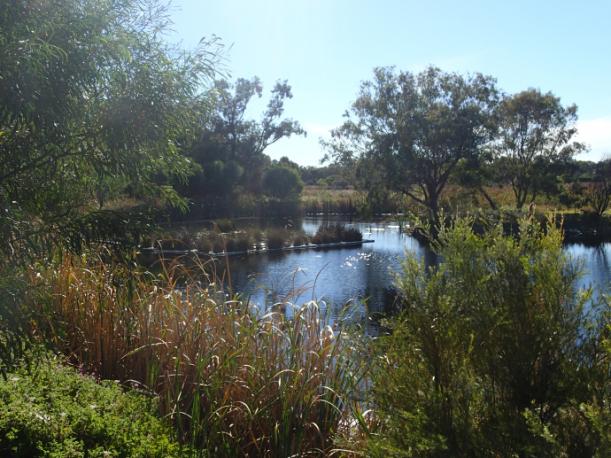
One man-made feature caught our eye: the floating islands in a small pond on the western side of the lake (right, D Poynton). The Friends of Yellagonga have planted the specially constructed cages with local sedges Baumea articulata, B.preissii and Juncus krausii. Bacteria attached to their roots break down nitrates and phosphates in water that has been pumped from the lake before it seeps back through a permeable sand bed several metres thick. The reduction in nitrates and phosphates is being trialled as an alternative to chemical control of midges and mosquitoes.
Don Poynton