

Northern Suburbs Branch, 23 July 2025
Golly, we were lucky! Just a light sprinkle of rain as we neared the car park – and they had forecast thunderstorms.
Lake Gnangara is the most southerly of the Wanneroo wetlands. The surrounding terrain consists of low dunes and undulating sand plains of the Bassendean Dunes.
After a reconnaissance walk the day before, Don changed the planned route to avoid having to walk on soft sand for the first 1.5km. The new route still took us through banksia woodland on the outward leg and back along the riparian zone as planned.
We were fortunate to have Cate Tauss along for the morning, and she was soon explaining to us that we were walking through a prime example of *FCT 20a – Banksia attenuata woodlands over species-rich dense shrubland of the Supergroup 3- Uplands centred on Bassendean Dunes and Dandaragan Plateau. This FCT is very species-rich with an average of around 65 species per 10m x 10m quadrat having been recorded.
We made a short foray into the bush to look at some typical FCT 20a species. While Candlestick Banksia was not abundant, there were plenty of Firewood Banksia, WA Christmas tree and Marri making up the upper story. Dwarf She-oak, Grey Stinkwood and Woolly bush dominated the middle story. In contrast, Blueboy, Pearl flower, Pineapple bush, Davesia sp, and Leucucopogon sp were common in the understorey along with several herbs and sedge species, including large patches of Loxocarya cinerea.
On returning to the path which took us closer to the lake, we observed Stout Paperbark and Swamp Banksia. Also, of note was Blue Boronia, and Cate was particularly pleased to find several bushes of Balbak’s White Myrtle (Hypocalymma balbackiae), which is a new species she described in 2023.
Our path back to the car park was on part of the trail that circumnavigates the lake. As we approached the lake, we came across Regelia ciliata, Juncus sp. and the wetland variety of Purple Flag (Patersonia occidentalis var. angustifolia).
The lake was “full” although the black rim around the numerous Pygmy Drosera we found suggested the water level had been higher recently.
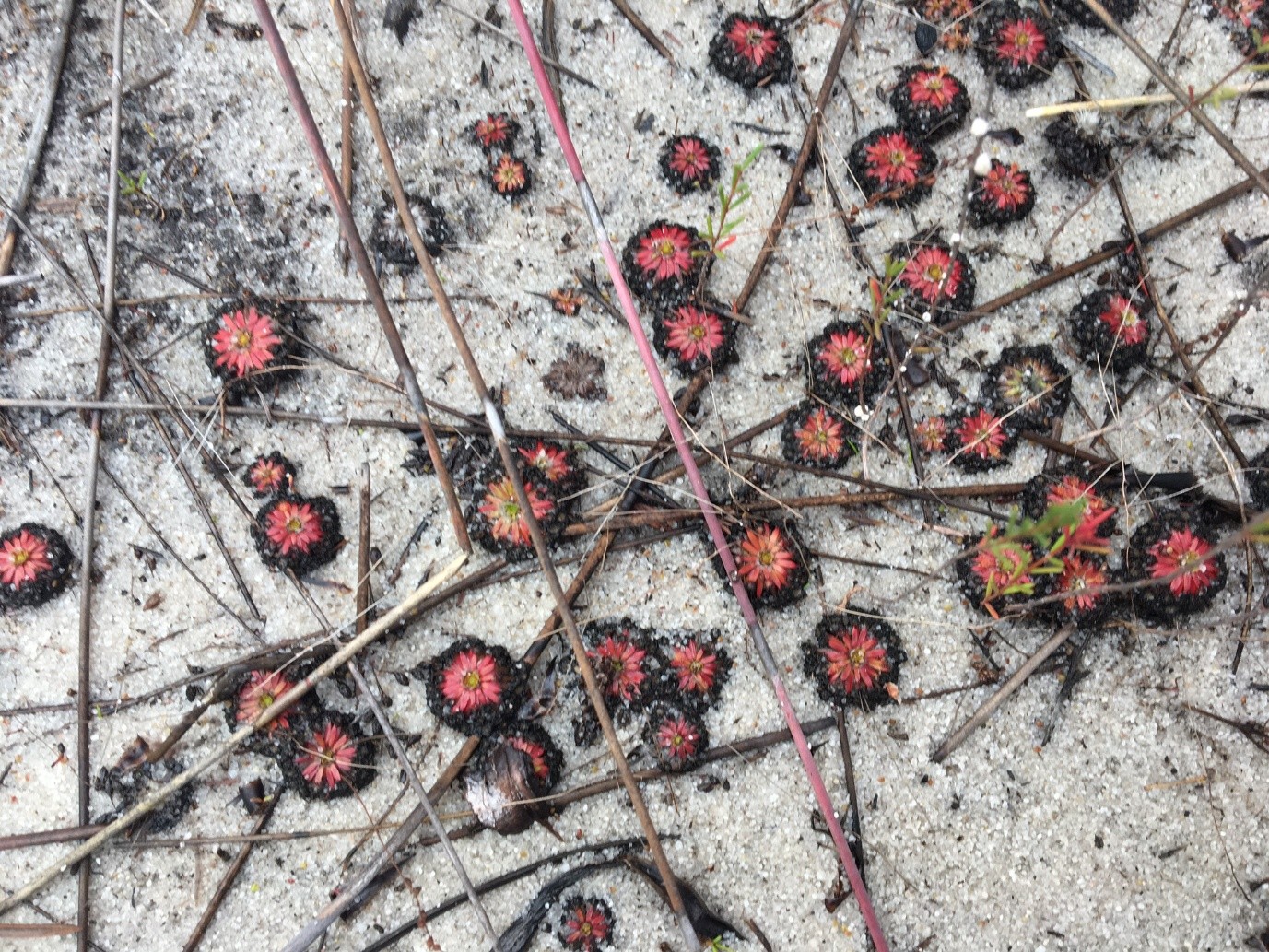
The Drosera was growing in gaps between masses of Velvet Rush (Leptocarpus scariosus). Cate pointed out the difference between the female and male plants, with the former having an upright flower while the male flower droops.
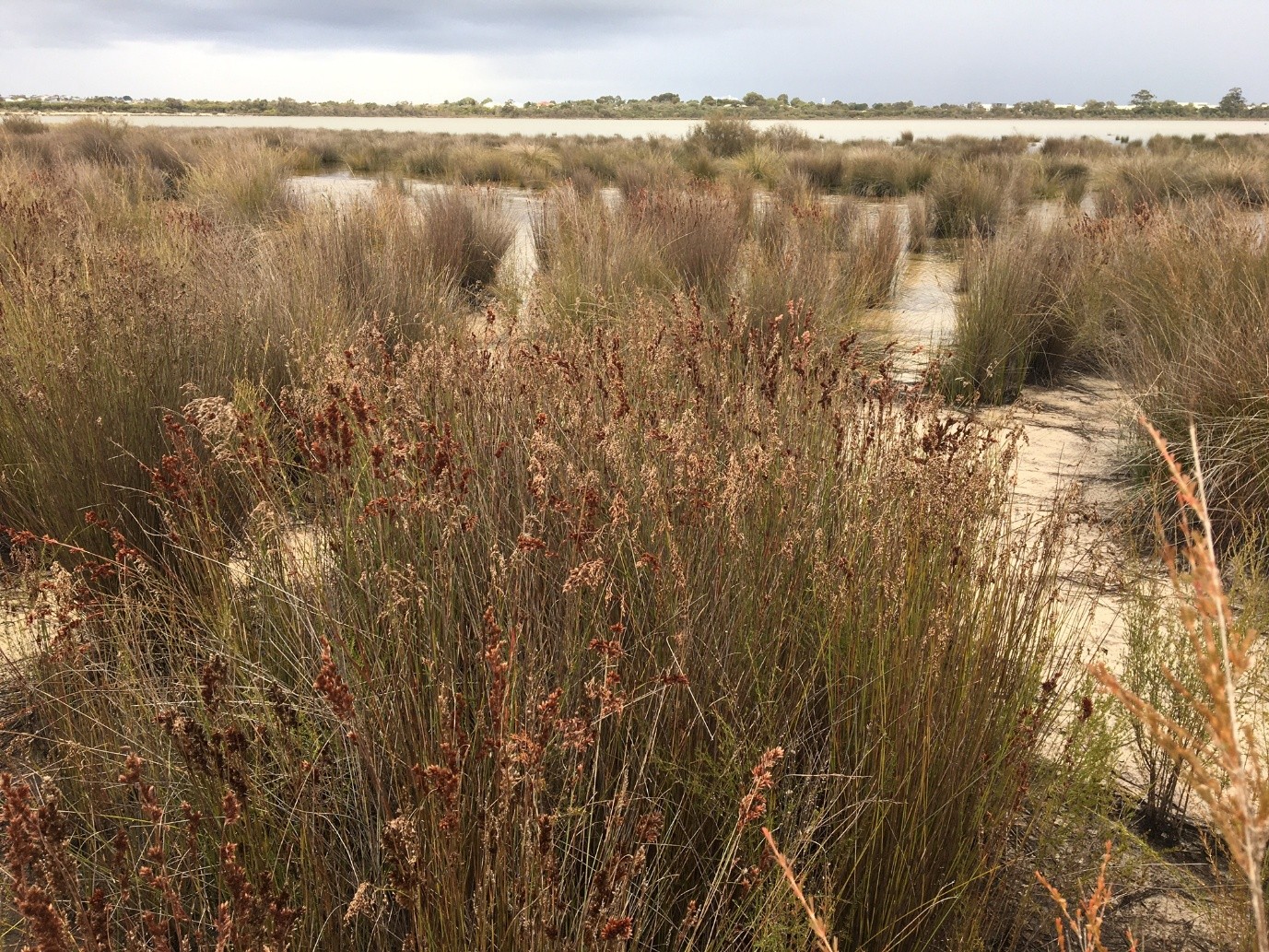
Although we couldn’t see them, we heard a choir of Sandplain Frogs (Crinia insignifera) amongst the rushes.
We saw where a Quenda had been digging quite close to the lake, but did not spot the little digger.
We recorded only 15 bird species, which was surprisingly low given the variety of habitats. The threat of thunderstorms probably had them seeking shelter.
A benefit of these walks is that you often meet locals who can tell you about things that you would otherwise be unaware of. On this occasion, we met a local who recommended a walk on another part of the circular trail. It’s now on next year’s programme.
Don Poynton