
Kit Prendergast’s great talk underlined the evolution of the bee and the mutual relationship (win-win) that drove the diversification of the most successful plant group (Angiosperms: flowering plants) over the past 125 million years. Kit is a PhD student at Curtin University where her study involves looking at European Honeybee and native bee interactions in urban habitat fragments in southwest WA. In 2016 she was named as one of the two prestigious Forrest Research Foundation Scholars for 2017.
Her PhD project is on “Determinants of native bee communities, and how interactions of Honeybees (Apis mellifera) affect native plant-pollinator assemblages, in urban habitat fragments in the southwest Australian biodiversity hotspot”.
The best known bee in Australia is the yellow-brown commercial European Honeybee (Apis mellifera). This was introduced to Australia from Europe in about 1822 and in 1840s to the southwest to produce honey for our pioneers. WA is renowned for healthy honeybee colonies. Australia’s honeybee industry is estimated to be worth $90 million per year (hive products) and $4-6 billion per year in pollination services.
The presentation and question time highlighted outcomes from Kit’s research to date in relation to the following questions: What native bee species occur in urbanised southwest WA? How do honeybees and native bees interact whilst foraging? Do honeybees out-compete native bees?
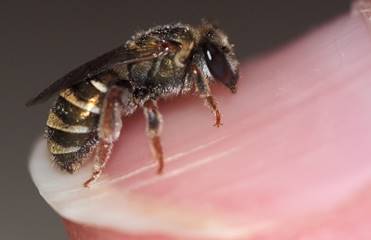
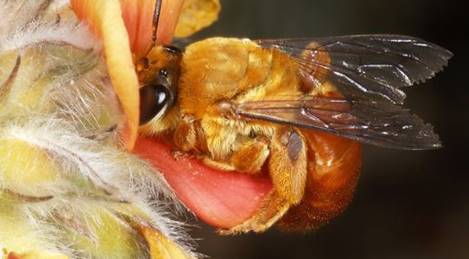
There are approximately 2000 species of Australian native bees (800 in WA, many of them endemic), which represent five out of seven global bee families (we have no Andrenidae or Mellitidae). Colletidae is the most speciose family in Australia and Stenotritidae is endemic to Australia. Australian native bees are mainly solitary (forming no colonies) and do not care for their offspring. Many Euryglossinae (Colletidae) are mere millimetres in size while the Giant Carpenter bees Xylocopa (Koptortosoma) spp. are 25mm long.
How can we help native bees? One way is to provide food and nesting resources. Plant a diversity of flowering plants, especially natives, to provide pollen and nectar that cover a range of flowering seasons.
- Myrtaceae: Callistemon, Corymbia, Eucalyptus, Thryptomene
- Fabaceae (pea plants): Hardenbergia, Jacksonia
- Asteraceae (daisies): Olearia, Brachyscome, Xerochrysum
- Non-natives: Salvia, Duranta repens, Gazania.
For the cavity-nesting bees (reed bees, carpenter bees, Megachilidae, Hylaeus) the nesting resource might include:
- Retaining old dead trees and fence posts
- Installing ‘bee hotels’ with 4mm, 7mm & 10mm diameter and 100mm length holes.
Earlier this year Kit published the book Bee Hotels for Australian Bees (available for purchase through the Club.)
For ground-nesting bees you need to leave patches of bare soil and do not till garden beds (and no fake grass!) Also do not use pesticides—many are harmful not only to ‘so-called’ pests, but also beneficial insects, including bees, as well as insects that prey on ‘pests’.
To follow Kit’s work and improve our knowledge of native bees you could join the
Bees in the ‘burbs’ in a biodiversity hotspot Facebook group
Become a ‘Citizen Scientist’ and record sightings of bees you observe in parks and reserves or your backyard in the group’s spreadsheets, and share photos you capture of bees.
Graham Ezzy