

The November meeting began with a short presentation on Arctic terns by Kevn Griffiths. These long-lived birds migrate from high latitudes of the Arctic regions to breed in Antarctica annually, travels that can account for more than two million kilometres over a lifetime that can be thirty years.
The focus of the meeting was our speaker Joy McGilvray, coordinator of the Friends of Jorgensen Park Group, who presented us with a guided tour of this local amenity that borders Kalamunda National Park.
The park’s history as a community area dates to 1972 when the former golf club at the site, relocated. The land was redesignated and leased to the Shire (now City) of Kalamunda to be managed as a bushland reserve and was declared a dog walking and picnic amenity. The former golf course with its clubhouse buildings was set up by Hedley Jorgensen, who with a group of persons purchased a portion of land in 1928 from Jacob Schmitt who from 1895 had established orchards on his land.
Jorgensen Park is now an area of 26 hectares (65acres) of remnant Marri and Jarrah bushland interspersed by open areas that comprised some of the former golf course fairways and other pathways.
In 1977 the Kalamunda Learning Centre was established in the old golf clubhouse: it is now the meeting place of the DRB. Various groups have also made use of the land: it was used for equestrian events and bridle paths were established. The Orienteering Association established an orienteering map of the area which was revised in 2015.
Jorgensen Park overlooks Piesse Brook and is the southern boundary to Kalamunda National Park. The Bibbulmun Track realignment in 1998 now passes through a short section of the Park from its northern terminal in Kalamunda town area and follows a section of Spring Creek. Plans are in place to try and eradicate invasive weed species along this zone.
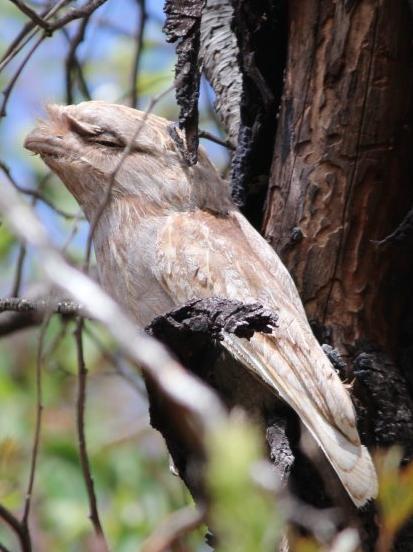
An array of wildlife can be observed in Jorgensen Park and Joy’s images included many mammals, reptiles and birds, including Brush-tailed Possums, Echidnas, Bandicoots and Bobtails, a large bird species population that includes endangered cockatoos and several predatory birds, amongst which is an albino Tawny Frogmouth (below, Glynn Tomazin). The images shown of the colourful and diverse array of wintertime wildflowers included a large range of orchid species, an inducement to take a walk in this local Hills amenity.
The Friends Group started with an initiative by a small number of local dog walkers and by 2012 was registered with the Shire in Kalamunda. Their work, all by volunteers, together with Shire officials, is important in trying to maintain the native flora of the Park along the wooded strips, and with that the habitat for the many fauna species. Aerial images of the Park over a number of years show how the tree canopy has greatly improved and developed. “Before and after” images following fire destruction showed how the woodland native species zones have benefitted from seed germination of local species and lack of competition with weed species. Invasive vegetation targeted for removal include notably: Tagastase ( Cytisus proiferus), and two Eastern States wattles, Acacia longifolia and A pycnantha .
The Friends Group are involved with the planting of native species (over 2,000 seedlings have been established), weed control, organising wild flower walks and managing dieback. Bird and wildflower counts are ongoing with other groups.
In 2014 remedial work by the City of Kalamunda was carried out to reduce the impact from storm water and, together with the Friends group, work is planned for 2018 to rehabilitate the Spring Road creek line.
The archival photos show how the area has always been place for outdoor recreation and what was originally a sporting facility has grown into an important local amenity for naturalists to come and enjoy.
Susan Stocklmayer