

What a great night this was (Friday 8 December 2017). More than 80 people turned up to hear Simon Cherriman speak to the DRB about his research into the ecology of Wedge-tailed Eagles, and it was obvious from the start that this was no passing interest on the way to other things; this is a life-long passion.
Simon began by relating how he liked to climb trees as a boy, and how his parents—unlike most parents—did not discourage him but instead bought him some serious climbing apparatus. This proved to be a great thing, for Simon now spends a large part of his time climbing and sitting atop enormous eucalyptus trees in his study of Australia’s top avian predator, the Wedge-tailed Eagle.
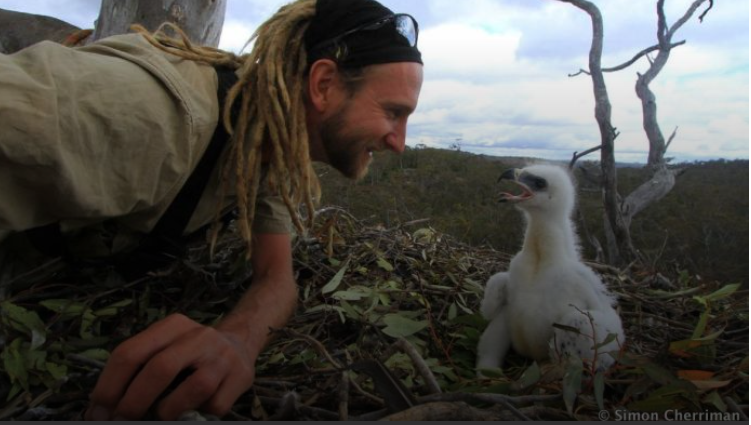
We saw stunning close-up photographs and fascinating video clips of eagles and their offspring in their nests—often with Simon in the frame (above)—while Simon entertained us with stories (laced with a few “Dad” jokes) of what the eagle chicks (eaglets) were eating, and about his long hours on dark windy nights as he waited for sunrise in a rickety bird-hide about 30 metres above ground.
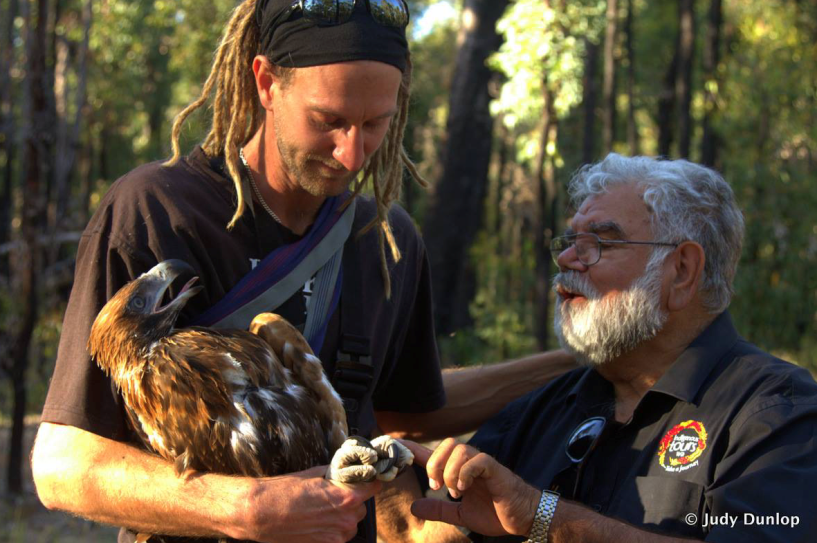
Simon with Dr Noel Nannup naming this eagle Yirrabiddi
We learnt many interesting things: normally two rather different looking eggs are laid; usually only one hatchling survives to adulthood; breeding pairs are usually older adults (6 years plus?), though sometimes the male can be younger, and Simon has observed that it’s usually the female who very gently feeds the young, even though it may have been the male who brought the food to the nest. When the young fledge they are quite light coloured (Simon called them “blonde”), but they grow much darker as they get older.
For me the most fascinating part of the talk was Simon’s description of the use of technology to track the movements of eagles. Using a technique he learnt in Scotland (during a special trip there to study the related Golden Eagle), Simon uses light-weight, solar powered GPS trackers very carefully attached to near-fledging eaglets. By this means he has been able to show how far, in just a few days, eagles can travel when they choose—and that is basically over the whole of Western Australia and into parts of South Australia!
Simon told us of a surprise he had. He left his major study area of Lorna Glen Station, near Wiluna, (with 100+ nests, over 40 of which are active) to return to his original study area in the Darling Scarp. He set up an eaglet for GPS tracking, and when it finally left the nest, the tracker showed that it flew straight to Lorna Glen and took up residence on a hill where Simon had been just a few days earlier.
Good luck Simon with your further research into these beautiful, iconic Australian birds; your PhD, when it arrives, will be much deserved. A big thank you from the DRB for a fascinating and entertaining evening.
Mike Green