

Karina Knight, our speaker, worked for 36 years at the WA Herbarium and for the last 15 years as Collections Manager and Volunteer Coordinator there. Karina took an interest in myxomycetes (slime moulds) when volunteer Margaret Brims drew them to her attention, and in 2015 began pursuing this as a special interest.
Myxomycetes are a strange form of life. Though long thought to be a type of fungus or animal, they are neither, but they have some characteristics in common. They are classified in the eukaryotic super-group Amoebozoa. Like fungi, they reproduce by spores and occupy a similar habitat, but they have different cell structures and life cycles and play a different role in decomposition. And they can move!
Their life cycle includes a sporangium stage. This produces haploid spores, which disperse once dried. When moistened, these germinate into haploid amoebae, which cruise around and feed on bacteria and protozoa. Then they find a partner and fuse with it to form a diploid cell or zygote. The zygote amoeba also cruises around, feeding on microbes, but then something strange happens – the nucleus divides, but the two nuclei remain within the same cell.
This division keeps occurring until there is a huge, multinuclear cell called a plasmodium. This moves and often branches out, looking for food.

Then in response to an unknown stimulus, the plasmodium can form a sporangium and produce spores to continue the life cycle. At two stages in this life cycle, it can become dormant if conditions are unfavourable.
Unlike fungi, myxomycetes do not decompose their substrate. Conversely, they eat the decomposers – the bacteria and the fungi. In turn, they are eaten by small animals such as springtails, beetles, ants and slugs.
Myxomycetes can be found in most terrestrial habitats, but Karina said that good places to search are in leaf litter, rotting logs, and dark, moist places such as under flaking bark. It is the plasmodium stage which is often visible. It can be quite large, and some are brightly coloured, as are the yellow Dog Vomit Slime Mould Fuligo septica and the Raspberry Slime Mould Tubifera ferruginosa, but in many species, it is very small and hard to find. Karina showed us microscope photos, and many were really beautiful.
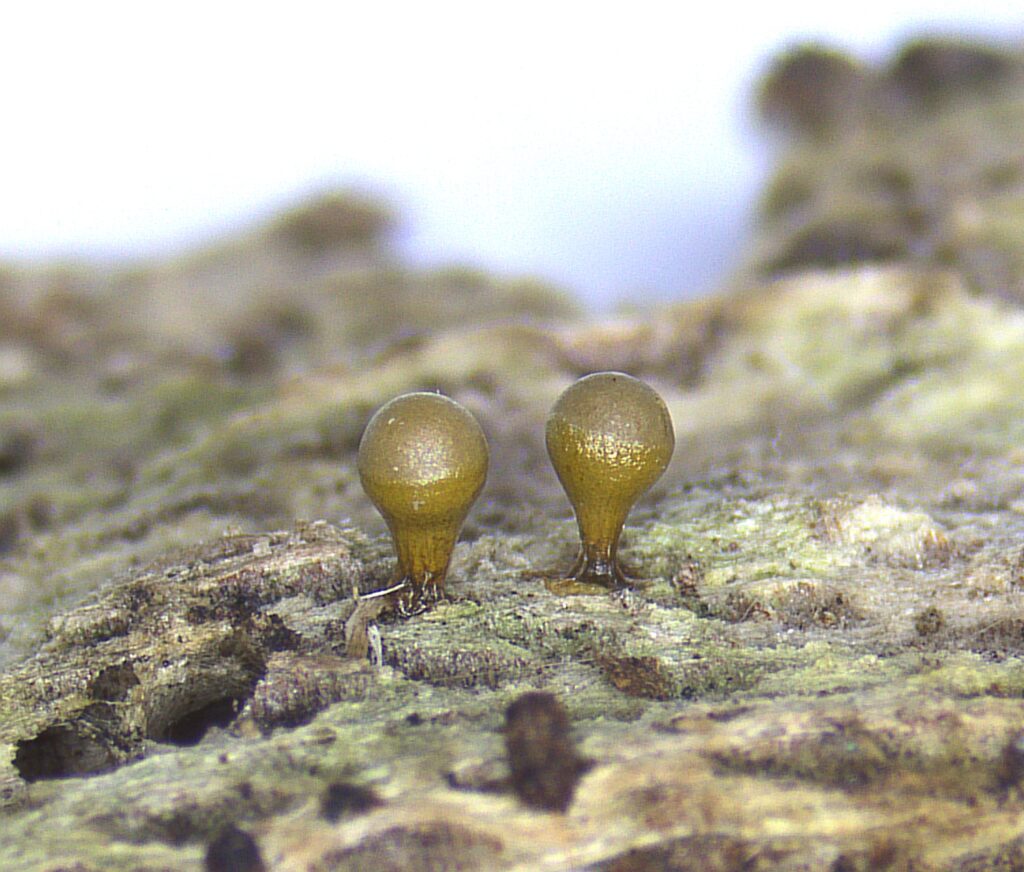
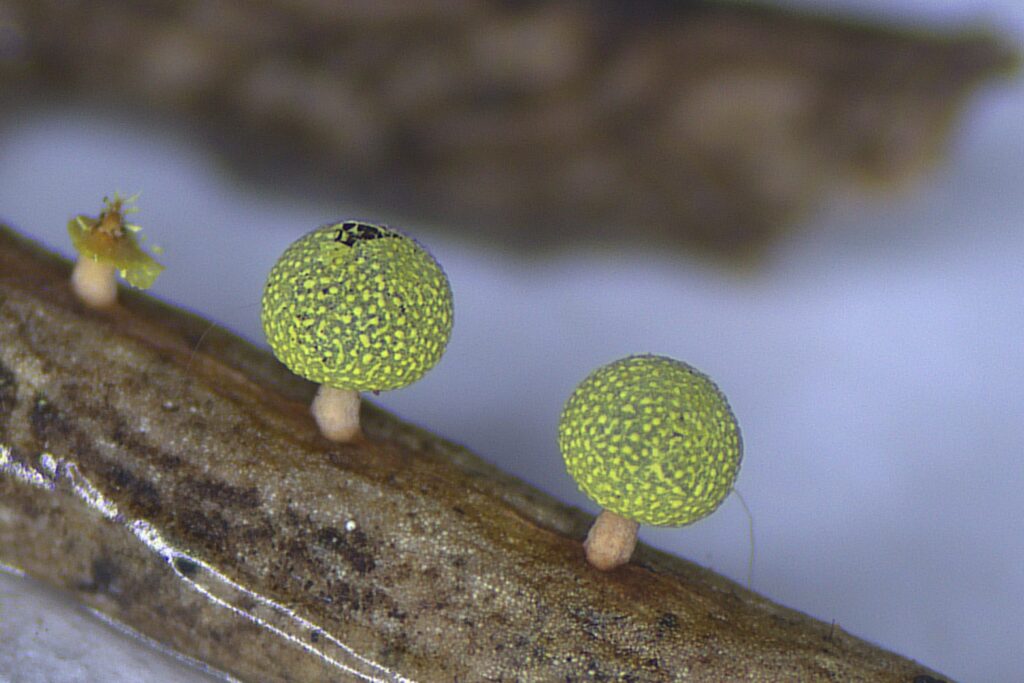
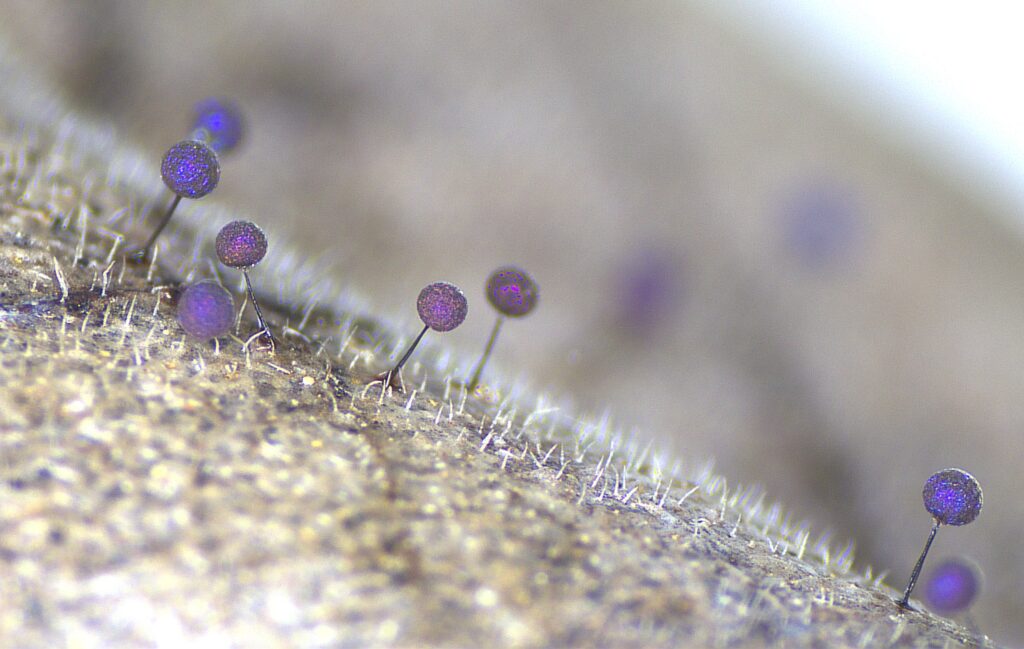
Karina said that myxomycetes could be grown in a moist chamber such as a plastic food box by placing pieces of found specimens on a piece of wet paper in the box with the lid on and waiting to see what emerges. Look in the bush or the backyard after rain.
Before the year 2000, very little was published on myxomycetes in WA. Some of us remember Margaret Brims on Club excursions, collecting specimens for the WA Herbarium. As a self-taught volunteer, Margaret pioneered the research in WA, has co-authored many papers on the subject and inspired Elaine and Peter Davison, who have co-authored a paper and have helped and inspired Karina.
Mike Gregson