

Our speaker, Bob Dixon (ex-BGPA), chose a clever but very apt title for his talk.
As Bob remarked, ‘Prescribed burning is a contentious issue, you are damned if you do and damned if you don’t.’ He also commented that ‘…the general public have no idea what effect burning has on remnant bushland. However, they have been indoctrinated over the years with the message: You have to burn frequently to reduce fuel loads and it’s good for the bushland.’
What does fire do?
- Clears away vegetation, opening up the area i.e. more light and less competition. May also assist in water penetration.
- Releases canopy-held seed.
- Stimulates seed germination by cracking seed coats. Hot fire will stimulate the germination of Acacia pulchella seed often buried at 5cm.
- Produces compounds that stimulate seed germination (smoke/smoke water and karikinolide are used to germinate seed in nurseries.)
- Releases nutrients which will stimulate the growth of seedlings, as well as ‘resprouters’. Increase in flowering and seed production.
- Stimulates the germination of many species only seen after fire: annual Stipa, Fireweed.
What we know from an ecological point of view is:
- If you have to burn, burning in autumn is far better than burning in spring (seedlings will germinate early and establish as soon as heavy rainfall occurs.)
- Frequent burning has a deleterious effect on natural ecosystems.
- Patch burning, especially on the Swan Coastal Plain, is very important to preserve many fauna species (in the long term, no fauna=no plants.)
- There may be less damage to mature trees from cool burns than from hot burns but there’s an increase in litter as not all leaves are burnt.
- If you are a bushland manager you prefer hot burns, which clear out all the dead stuff, produce good clear conditions for restoration activities (planting, weed control) and hot fires can kill perennial Veldt Grass plants and reduce Bridal Creeper biomass.
- Prescribed burning may not significantly reduce wildfire.
- Global warming is resulting in drier conditions, more stress on natural ecosystems and greater risk of increased fire frequency and intensity.
As an example of how continuous burning can alter the vegetation, Bob quoted from a co-authored paper titled ‘Kings Park, an area originally reported to contain eucalypt/Sheoak woodland has been sequentially reduced to a mixed woodland of Sheoak and Banksia, and more recently to a woodland dominated by Sheoaks.’
After a severe fire in January 1989, at the level of species, the Sheoak (Allocasuarina fraseriana) showed slightly better survival compared to the Banksias (B attenuate, B menziesii and B grandis) which, in turn, were better than any remnant eucalypts. Surviving trees tended to be trees of smaller than average diameter or height.
Of the understorey plants, probably the most noticeable plant flowering after fire are the Grass Trees, which flower en-mass, and the Zamia.
After a significant autumn/winter rainfall event, seedling recruitment starts; often the first species to be seen are Running Postman (Kennedia coccinea) and Large-Flowered Bog Rush (Schoenus grandiflorus).
Other early seedlings or quick resprouters include Purple Tassels (Sowerbaea laxiflora), Swan River Myrtle (Hypocalymma robustum), Pearl Flower (Conostephium pendulum), Yellow Leschenaultia, (Leschenaultia linaroides), Blueboy (Stirlingia latifolia), Yellow Buttercups (Hibbertia hypericoides), Yellow Autumn Lily (Tricoryne elatoir) and Daviesia triflora. (below, B. Dixon).
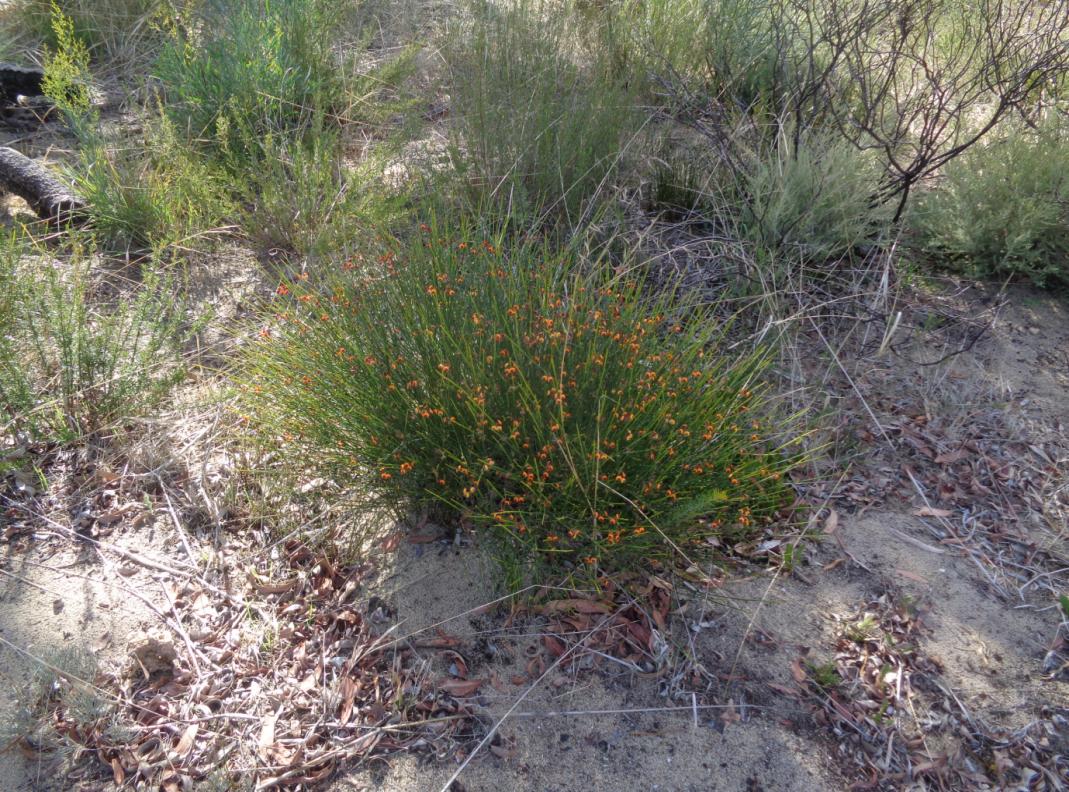
Many resprouters—especially some herbs e.g. Anigozanthos manglesii—produce large amounts of seedlings; other Kangaroo Paw species often produce very few seedlings. One group, the sedges and rushes—many of which are long-lived—rarely produce any seedlings; this may also be due to poor seed production.
Species which rarely flower unless burnt include the aptly named Red Beak Orchid (Pyrorchis nigricans) and the Red Ink Sundew Drosera erythrorhiza with its pure white flowers.
Please refer to the July GOLLY Walk report to see if we were able to confirm Bob’s observations.
Don Poynton