

NS Branch 18 September 2021
Who would have thought thar be so many dragons in WA? Today’s St George, aka Dr Paul Doughty, has forgone his horse and lance for a four-wheel drive and a camera to track and tame his prey.
Paul began his presentation by explaining our Australian agamid lizards belong to the same group as the African Chameleons and New World iguanids as part of the infraorder Iguania, which can be traced back at least 80 million years. However, the fossil record of the Australian dragons, which have been placed in the subfamily Amphibolurinae, only goes back 34 million years with a burst of diversity in the Miocene, 10 to 20 million years ago. Today, there are 108 species of agamids recognised in Australia, although as Paul alluded to, nearly every new publication that is based on genetic studies (DNA) results in changes to the number and relationships. The leader in this field now is Jane Melville at Museums Victoria, who frequently collaborates with Paul.
Basically, Australian agamids, along with other iguanine lineages, share the following common features or traits:
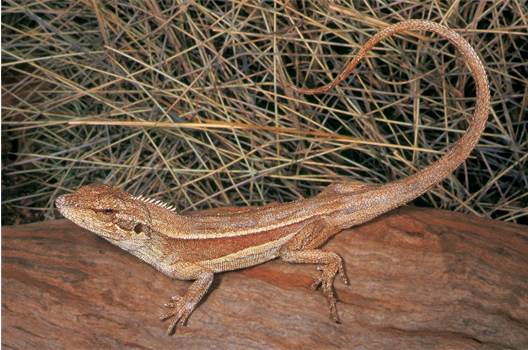
- 4 limbs, 5 fingers + toes, long tails
- Non-reflective scales, often spiny
- Diurnal, heat-loving lizards
- Sit-and-wait predators
- Short thick tongue
An agamid displaying typical characteristics and pose
They are not fussy eaters and will devour invertebrates, other small lizards, and vegetable matter.
Another common trait is their use of visual displays for multiple purposes. They often use their colour for camouflage while their frills and beards can be raised either as a threat or a means of communication. They also communicate by arm waving, tail lashing, head bobbing, or raising and lowering their bodies akin to push-ups.
All Australian dragons are oviparous, usually laying clutches of 3-6 eggs although Bearded Dragons lay clutches exceeding 20 eggs. Unlike birds’ eggs, which have a hard shell from the beginning, dragon eggs are soft like parchment and absorb water during development. Hatching takes place about 2 months after the female has laid her eggs in a shallow burrow.
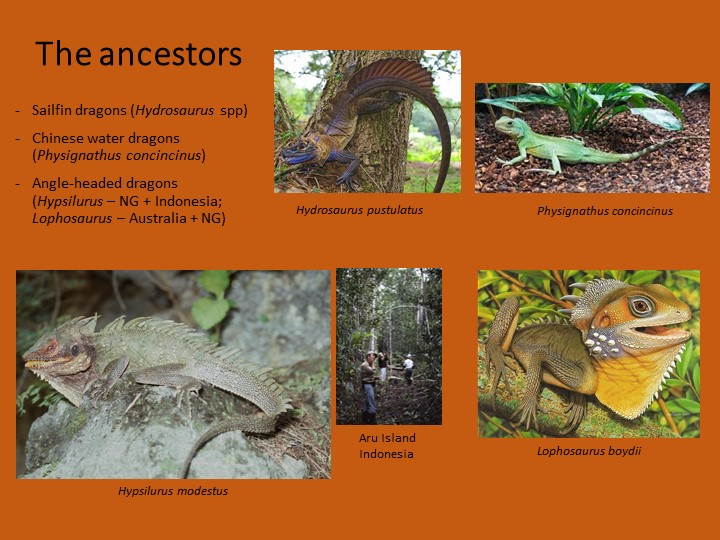
One of the highlights of Paul’s presentation was his colourful photos, often illustrating characteristic features and poses of the many species he introduced us to.
He started with some of the “living ancestors” such as the Sailfin Dragons (Hydrosaurus sp), Chinese Water Dragons (Physignathus concincinus) and Angle-headed Dragons (Hypsilurus from New Guinea and Indonesia, and Lophosaurus from Australia and New Guinea).

WA examples that can be described as “ancient odd-balls” are the Chameleon Dragon (Chelosania brunnea), a slow-moving tree dweller from the Kimberley and Top End,

and the Thorny Devil (Moloch horridus), which is an ant specialist usually found in arid zones and the west coast. The latter can drink dew which has collected on its skin.
For the last half of his talk Paul described and illustrated many of the dragons found in WA which he informally divided into such groups as Tree, Bearded, Pebble-mimic, Two-lined, Comb-eared, Black-collared, Heath, Burrowing, Salt-lake, Rock, Bicycle, and Military Dragons.
Don Poynton
All images by Paul Doughty