Our speaker—club member Kirsten Tullis—commenced work at the WA Museum as a volunteer preparing bird specimens in 1981. Today, as the Museum’s Senior Preparator (Exhibition and Design Department), her job embraces not only taxidermy, but moulding, casting and biological model-making as well as assisting with the preparation and installation of exhibitions.
Taxidermy is the art and science of preserving the skin together with the fur, feathers, and scales of mammals, birds, fish or reptiles and mounting it to look lifelike. As an example, Kirsten illustrated the steps involved in converting a dead bird (in this case a Magpie and a Tawny Frogmouth) to a museum-quality mount.
- Consideration of the final pose—flying, perching, standing
- Skinning and removal of muscle and fat
- Removal of eyes and flesh from skull
- Washing in water with a little detergent, rinsing, then soaking briefly in acetone (this helps remove remaining fat)
- Drying the skin with compressed air (sped up by the acetone which displaces the water)
- Wrapping of a replacement body from plumber’s hemp and thread
- Infilling of skull muscle & eye sockets using papier-mâché, and placement of glass eyes
- Insertion of wire into the legs and replacing leg muscle with hemp
- Inserting the body into the skin and sewing up the incision
- Mounting the bird onto a perch using the leg wires
- Pinning the wings and carefully binding the feathers with thread, and allowing the bird to dry
Kirsten also showed us a photo of one of her most recent efforts, a Western Ground Parrot (donated by Perth Zoo), which will feature in the new museum opening in 2020.
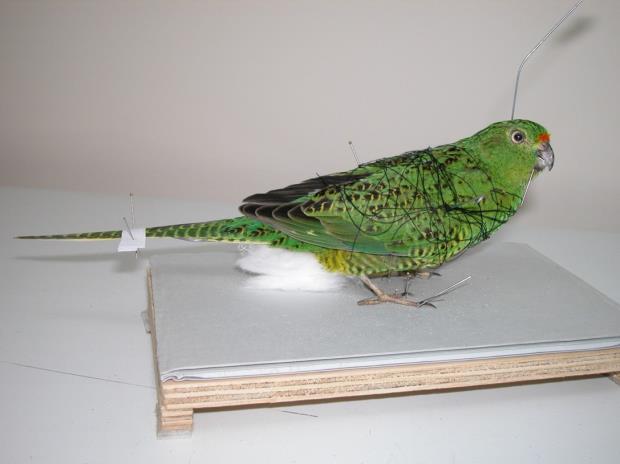
Western Ground Parrot, photo WAM.
We learnt that the sculpture and mounting techniques that are used today for large mammals were developed by Carl Akeley (1864 -1926) an American nature photographer, inventor and conservationist. As Kirsten told us, he was a man of mixed fortune; having survived being attacked by a leopard which he killed by ramming one hand down its throat and on another occasion being pinned to the ground by an infuriated elephant. He died of fever while collecting in the Congo. In Perth we are more likely to be familiar with another of his inventions, “shotcrete” or “gunite” as he termed it at the time, than his work as a taxidermist.
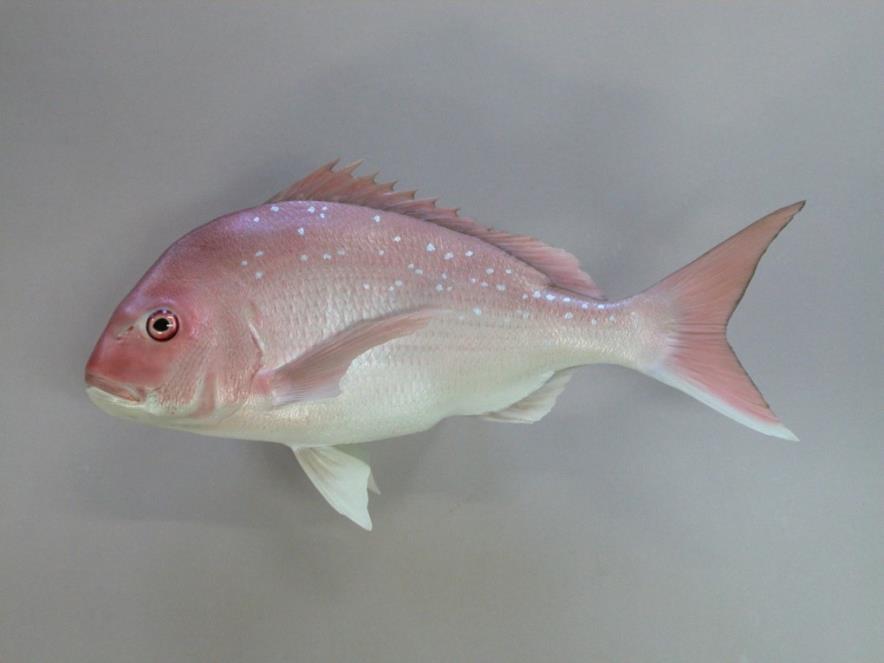
Kirsten admitted her favourite activity was model-making. This can involve plaster, resin or fibreglass. We were shown a photo of a beautiful glossy fibreglass Pink Snapper (above, photo WAM) which Kirsten had spent many hours painting with automobile acrylic paint. Painting the chips for a plate of fish and chips made from resin was not quite so painstaking but did require several layers of coloured resin to achieve the subtle shades of fried chips. Afterwards we were able to handle some of Kirsten’s models, including the chips complete with an extremely life-like slice of lime. Unfortunately the plate of prison food complete with cockroach was not on display.

Not all models are made to scale. Kirsten recently produced an up-scaled polychaete worm (above, photo WAM) based on a photograph. This required a 12-fold enlargement. In this case, Kirsten used plasticine to make the model. Silicone rubber moulds were made before the finished item was cast in resin.
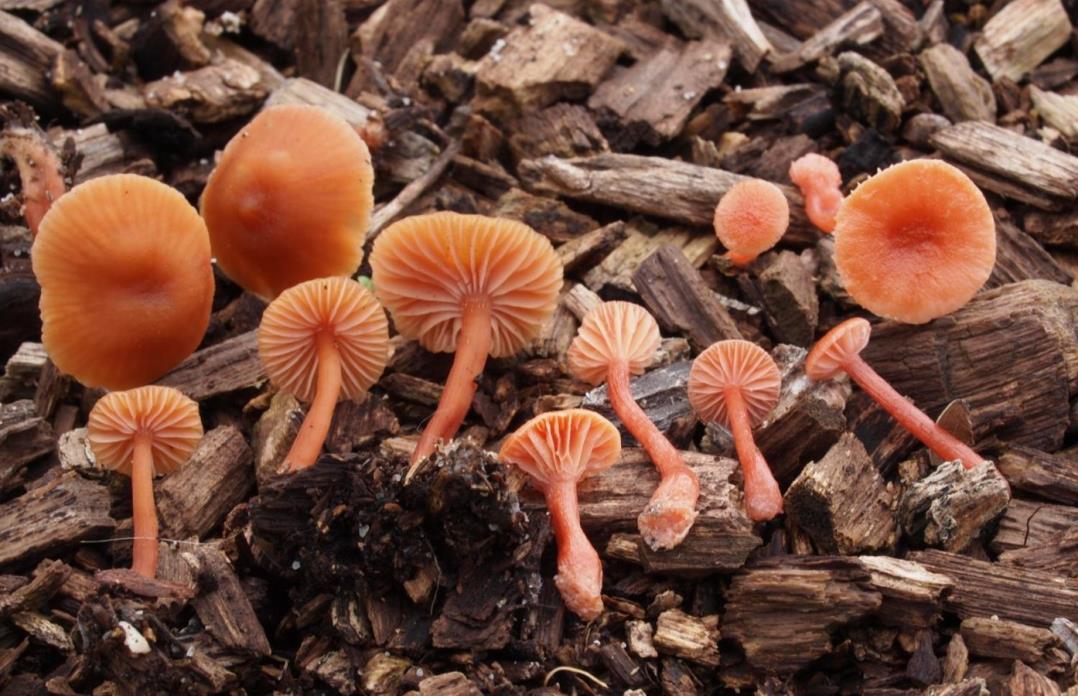
Kirsten’s work also involves preparing background material for composite displays and as an example she showed the preparation of artificial plants for the dinosaur diorama for display in Perth. Carnotaurus featured in the diorama, and is now on display at the Perth Convention Centre. Kirsten works with scientists from many disciplines, including professional mycologists. Thus, to conclude we were challenged to distinguish between real fungi and resin models (below, photo WAM)—an impossible task given Kirsten’s outstanding modelling ability.
Don Poynton