


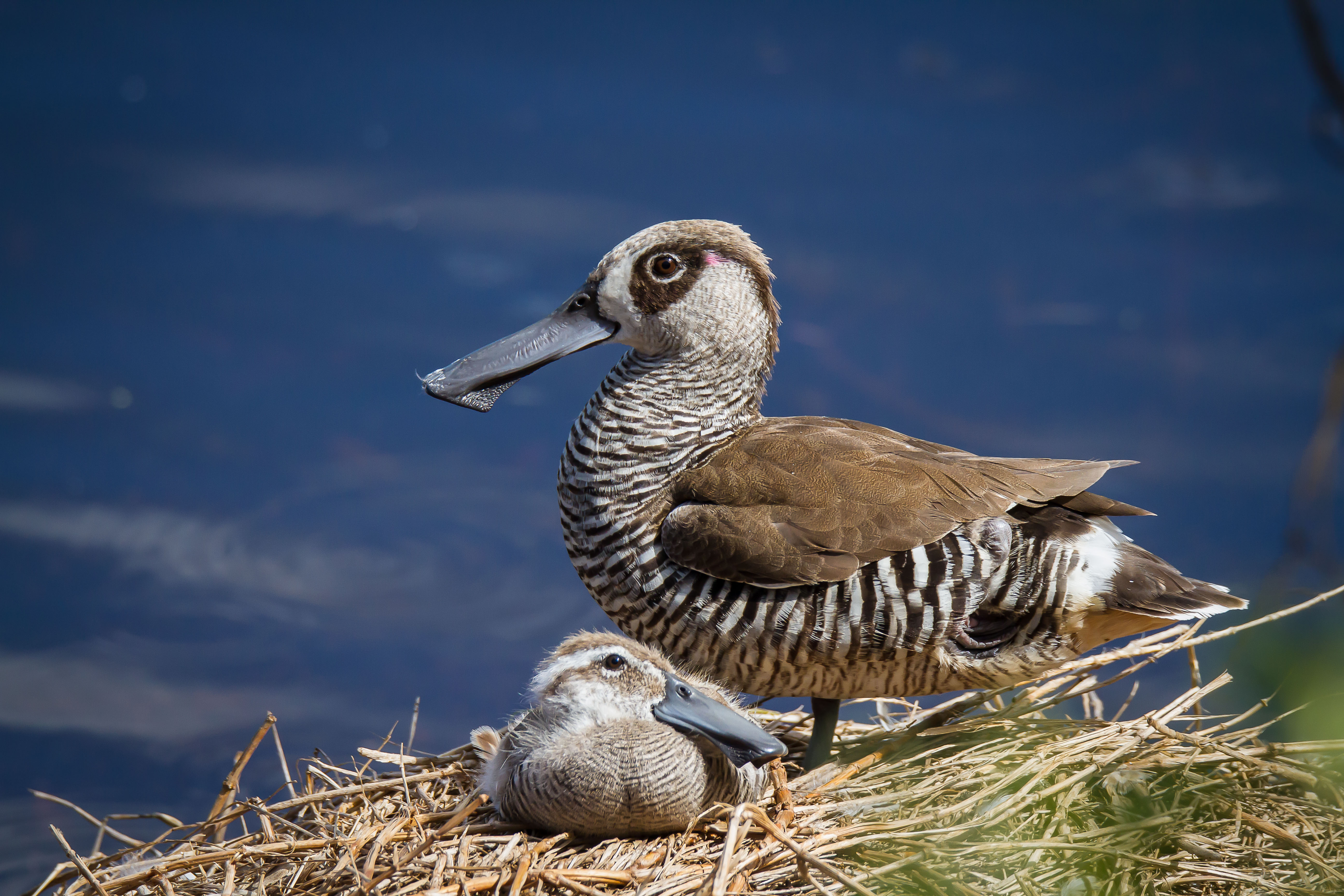
A good turnout of 10 members met at the car park at the southern end of Lake Claremont on 24th October 2017, a partly cloudy but pleasant morning. After a brief introduction to the lake from Bob Goodale we set out along the walking path on the south-eastern side of the lake. Almost immediately we spotted a Purple Swamphen with chicks (above, C Prickett) foraging in the reeds at the edge of the lake. Several White-faced Herons were hunting in the shallows. The water level was quite high so there weren’t any of the smaller waders; several White-headed (previously known as Black-winged) Stilts were present, however, their long legs enabling them to cope with the conditions. Along the track Scaevola crassifolia was growing well and this kept our invertebrate enthusiasts busy looking for insect life in amongst the foliage. A short distance around the track Bob called our attention to an adult Pink-eared Duck on a nest with a single duckling (below, C Prickett). This provided an excellent photo opportunity with one of the more colourful local duck species.
On the lake itself we spotted other species of duck, including Pacific Black Duck, Grey Teal and Hardhead. Eurasian Coots were busy feeding chicks, diving down to the floor of the lake and returning to the surface with pieces of vegetation that were eagerly consumed by the chicks. Australasian Grebes were in breeding plumage and busy attending to nests. Hoary-headed Grebes were also sighted. Motorbike Frogs were heard calling but not sighted.
We came to a gate in the fence that allowed us to take a walkway through a newly rehabilitated area. This provided a close-up view of a thick patch of reeds where Little Grass Birds and Australian Reed Warblers were actively calling, though they were difficult to spot. Blue-billed Ducks swam into a channel between the edge of the lake and the reed bed, giving us a nice view of these lovely ducks. A Dusky Moorhen also swam into this channel as we watched. Two Nankeen Night Herons flew out of the trees a little further around the lake and perched on a dead tree out in the lake in front of us, a rare view of this nocturnal feeder. A White-necked Heron, disturbed by something further around the lake, called raucously as it flew past our position. Further out in the lake, behind the reeds, more
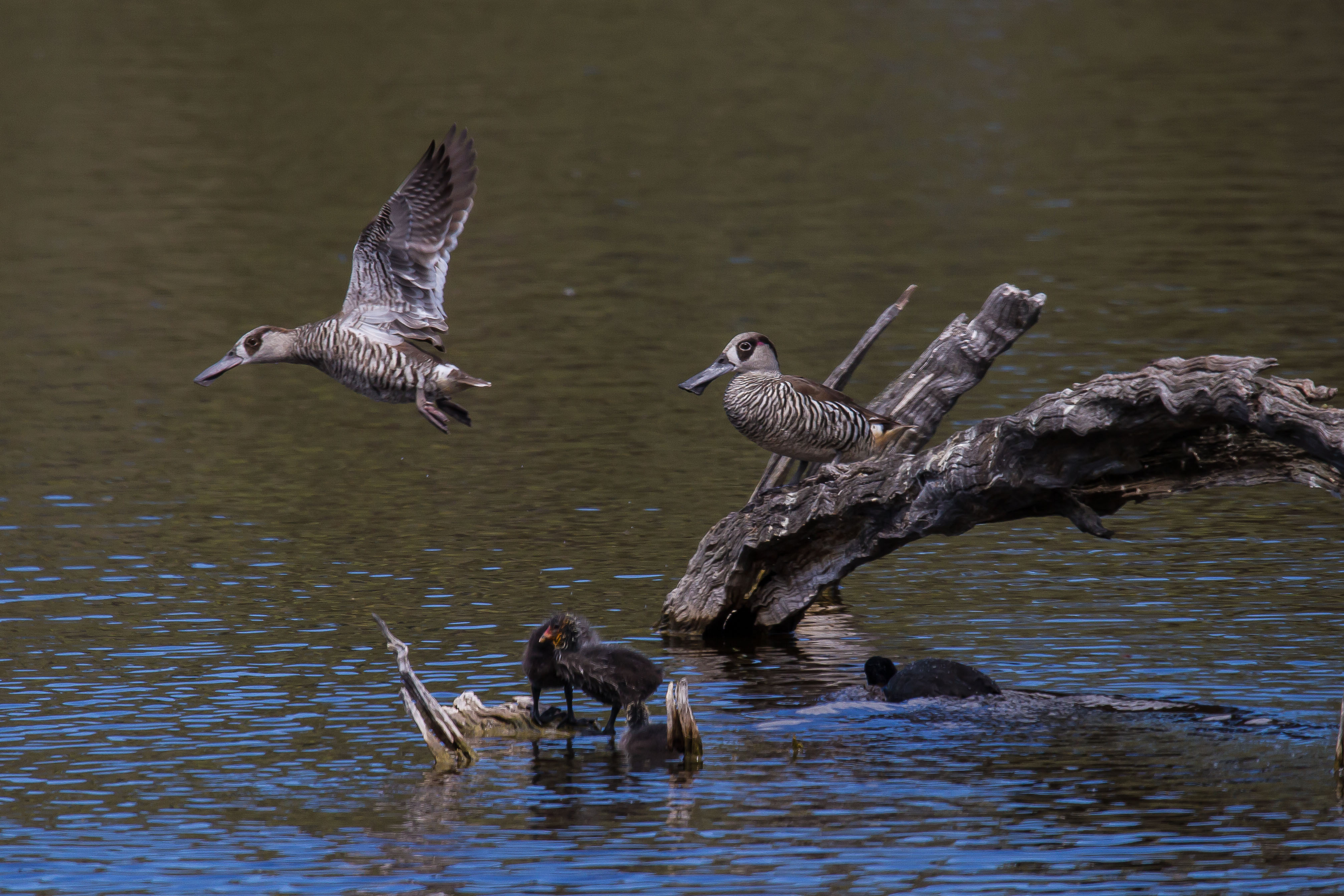
Pink-eared Ducks were perched on dead tree stumps, while a Eurasian Coot family foraged nearby (above, C Prickett).
A bit further around the lake a path through a grove of trees allowed us to get a bit closer to the lake. Here we spotted a group of White-headed Stilts having a break from foraging, as was a single Australian Shoveler in amongst a group of Pacific Black Ducks. A short distance out in the lake a pair of Black Swans had made a nest in the reeds and one of the adults was sitting on the nest with five cygnets (below, C. Prickett).

Above the lake, Welcome Swallows swept low to feed on the swarms of midges. The trees and lawn areas surrounding the lake provided some further bird sightings such as Magpies, Magpie Larks, Willie Wagtails and even a Laughing Kookaburra. While many of us had our eyes on the birdlife, Daniel Heald—with some assistance from Otto Mueller—was busy shaking shrubs and tree branches in a bid to catch any insects that fell, using an up-turned umbrella. Insects that he identified included Small predatory flies (Muscidae and Dolichopodidae), Non-biting Midges (Chironomidae) and Long-horned Caddisflies (Leptoceridae). Small Brown Lacewings Micromus tasmaniae (Hemerobiidae) were found in astonishing profusion, and various Green Lacewing genera (Chrysopidae) were also present. A wide variety of native cockroaches were found in the trees around the lake, along with Sac Spiders (Clubionidae), Long-jawed Spiders (Tetragnatha), Slender Green Orbweavers (Araneus talipedatus), Jumping Spiders including Opisthoncus quadratarius, Simaethula, and an undescribed species of Plexippus of which Rob Whyte would quite like to get a specimen or two. Daniel also found small Concealer Moths (Oecophoridae), and a larger Armyworm Moth being hunted by a Predatory Stink Bug nymph Cermatalus nasalis (Pentatomidae). The lake water was thick with Backswimmers (Notonectidae), and some of the gums had Giant Eucalyptus Galls Apiomorpha sp. (Eriococcidae). For anyone interested, Daniel has posted images of many of his sightings on “Bowerbird”.
It was good to see that there is a considerable amount of rehabilitation being performed around the lake—new planting has occurred over a wide area and new walkways have been put in. Previously planted areas were noted to be doing well. As time was getting on we decided to not continue to circumnavigate the lake and we made our way back to the picnic area near the car park for a well earned cuppa and snack. It had been a great morning and we’d spotted a total of 32 bird species: Australasian Grebe, Australasian Shoveler, Australian Magpie, Australian raven, Australian Reed Warbler, Australian White Ibis, Australian Wood Duck, Black Swan, Blue-billed Duck, Dusky Moorhen, Eurasian Coot, Galah, Grey Teal, Hardhead, Hoary-headed Grebe, Laughing Kookaburra, Little Grassbird, Magpie-lark, Nankeen Night heron, Pacific Black Duck, Pink-eared Duck, Purple Swamphen, Rainbow Lorikeet, Red Wattlebird, Sacred Kingfisher, Singing Honeyeater, Welcome Swallow, Western Corella, White-faced Heron, White-headed (or Black-winged) Stilt, White-necked Heron and Willie Wagtail.
Thanks to Bob Goodale for guiding the walk and to Daniel Heald for compiling the list of invertebrates.
Colin Prickett