

Thanks to the Shire of Mundaring, members of the DRB attended a free, three-hour workshop in November on understanding the birds in their garden. It was presented by DRB Chairperson Rachel Green, and Mike Green (DRB Treasurer and bird enthusiast.) Seventy-two people attended and it fostered a love and knowledge of birds in people from many different backgrounds.
Daytime workshops are an excellent opportunity for DRB members to study subjects in more depth and for those who are frail to still be involved. It also allows the DRB to build relationships with local councils and to become better known to the wider public. As a result of this workshop, the DRB will run an excursion in 2018 with the Shire of Mundaring in one of their reserves. The DRB is keen to facilitate different ways to service its members and to move away from the one talk, one excursion per month model.
Although this workshop has already been run for the Cities of Bayswater and Belmont, each time it is geared specifically to the birds in the local area. Mike and Rachel go to the location beforehand and list and photograph the birds. These birds are included in their talk and the audience are provided with a beginner’s bird-list.
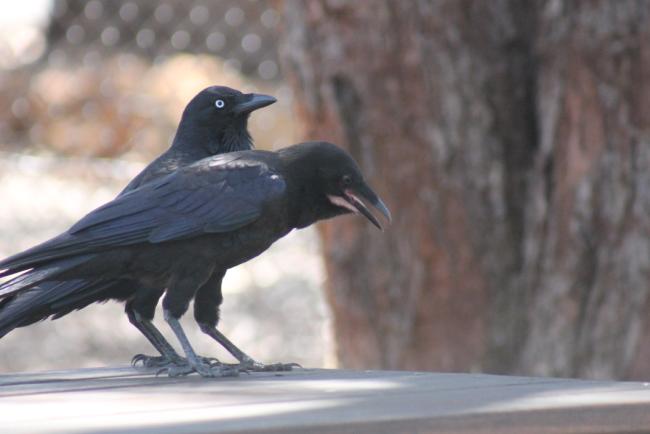
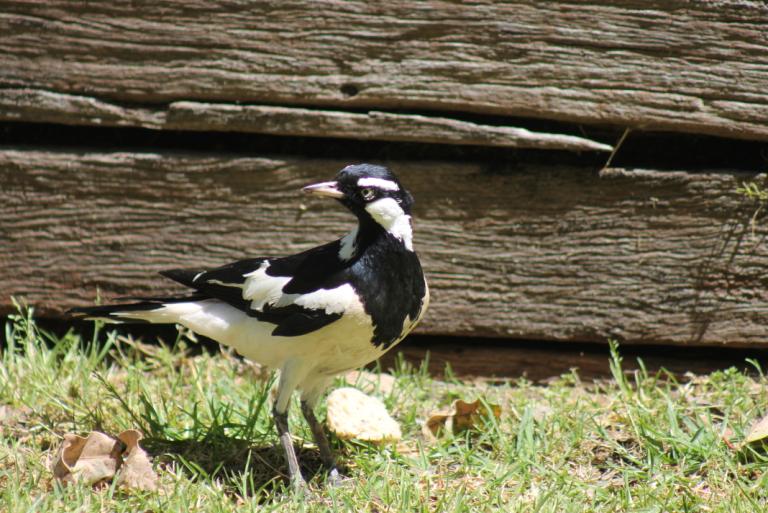
A small number of birds was seen in Mundaring, including a juvenile and adult Australian Raven (Corvus corax) (above, R Green) with the white eye ring clearly visible in the adult. There were also Red Wattle Birds (Anthochaera carunculata), a Magpie Lark (Grallina cyanoleuca) (below, R Green), Tree Martins (Petrochelidon nigricans), and an Australian Ringneck (Barnardius zonarius).
Two key components differed from earlier workshops. Rachel and Mike have realised people don’t know how to identify birds because they don’t know how to use bird books. Mike explained how a bird book is divided into different sections and how to use one. This segment was very well received, as was his segment on how to differentiate between the various ‘LBBs’ – the little brown birds!

Mike Green birdwatching in Shire of Mundaring’s garden, R Green
The second expanded section was on how to develop a garden to attract a variety of birds. Rachel highlighted the need for different food sources. Many people focus on providing honey bearing plants and don’t realise how many types of food birds require. She also emphasised the value of having plants at different heights, of having a small multi-forked tree near birdbaths, and of the need for dense prickly shrubs to protect smaller birds.
People were clearly thirsty for this information and someone offered to pay Rachel to develop their garden. (The answer was ‘no!’) Rachel and Mike have developed their own garden specifically for wildlife and have Land for Wildlife status because of the 67 species of birds identified there.
As usual, Mike showed videos demonstrating how popular various bird perches and bird baths are with birds. Some people who’d never had a birdbath in their garden left determined to get one. It is a simple step we can all take to have more birds in our gardens.
Rachel Green