

The Twin Creeks conservation area, run by the Friends of the Porongurup Ranges, is a stunning area of rich and rare flora and fauna. Thirty-three members of the Darling Range Branch visited it on the September long weekend last year and were bowled over by the number and diversity of flowers (below, R Green).
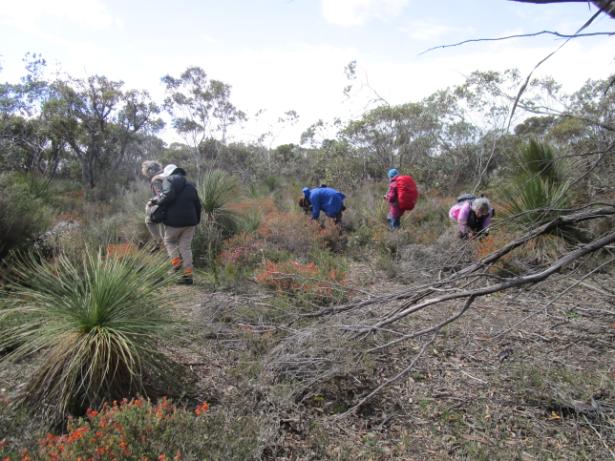
Twin Creeks is a 511 hectare property purchased by the Friends to help develop a wildlife corridor between the Porongurups and Stirling Ranges. It is part of the Gondwana Link project.
It already has a bird list of 67 species. We saw 44 species ourselves (despite some wet and windy conditions) and added four extra to the list: Carnaby’s Cockatoo (Calyptorhynchus latirostris), Golden (Shining) Bronze Cuckoo (Chrysococcyx lucidus), Welcome Swallow (Hirundo neoxena), and the Richard’s Pipit (Anthus novaeseelandiae). There were many Red-tailed Black Cockatoos (Calyptorhynchus banksii), and Baudin’s Black Cockatoo (Calyptorhynchus baudinii).
The diverse and abundant flora were in part due to the reserve’s wide range of landforms. Vegetation types included Mallee heath, Casuarina groves, Balga and Dryandra thickets, unburnt sections of Jarrah and Marri forest, Adenanthos, Melaleuca and Banksia shrublands, and more. For a full description, see the Twin Creeks website: http://www.porongurup.org.au/twin-creeks.html
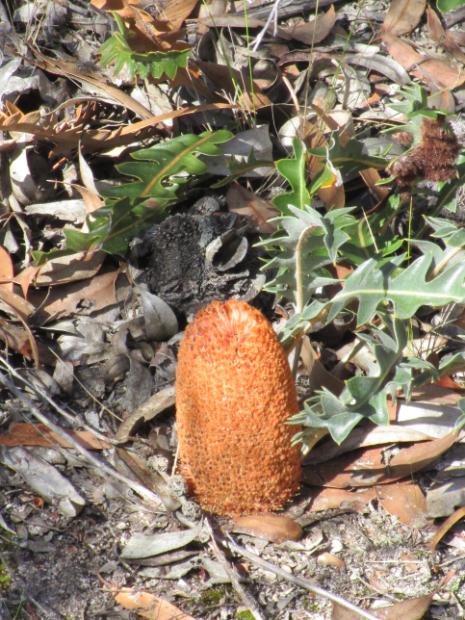
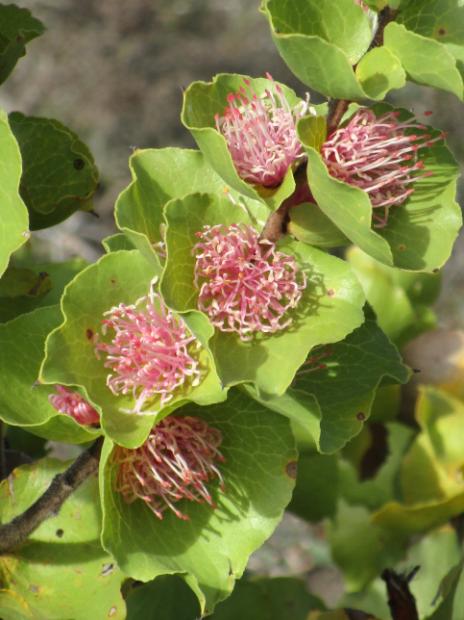
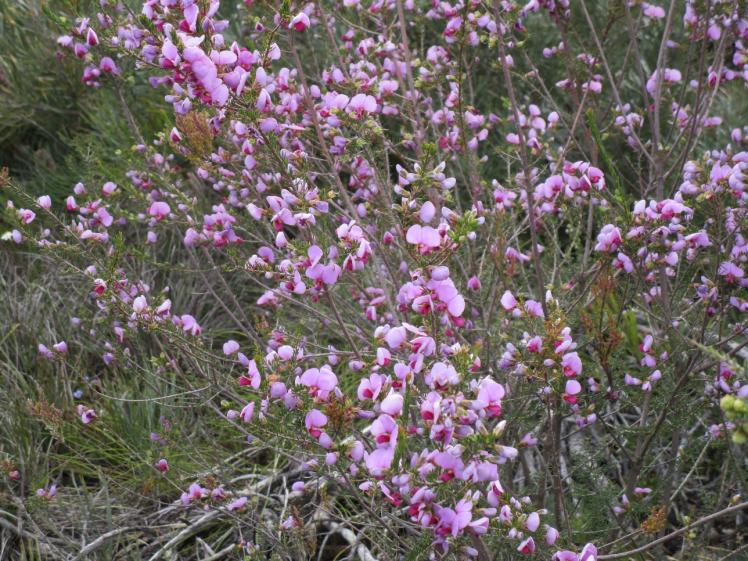
We were surrounded by displays of Kunzea recurva, Kunzea micrantha, Lechenaultia formosa, Petrophile serruriae and Gompholobium villosum (above, M Green). The flowers of Banksia repens (above, left, R Green) arose from the ground frequently, Hakea oldfieldii was seen, a beautiful Scallop Hakea, (Hakea cucullata) (above right, R Green) blossomed by the dam, and the always prickly Cauliflower Hakea, (Hakea corymbosa) was frequent. In one place, a tall Jug Orchid (Pterostylis recurva) had grown between all the prickles, maybe preventing it from being eaten by a kangaroo.
The reserve is renowned for its orchids. We saw many, including Heberle’s Spider Orchid (Caladenia heberleana), King Spider Orchids (Caladenia huegelii), Purple Pansy Orchids, (Diuris longifolia), Rattle-beak Orchids (Lyperanthus serratus) and a Slender Sun Orchid (Thelymitra reflexa).
Insects, mammals, reptiles, fungi, frogs were there too, including a Tiger Snake (Notechis scutatus), a Spotted-thigh Frog (Litoria cyclorhyncha), Crinia glauerti, and lots of mosquitos. The latter were identified as the big, hairy ones!
On Saturday night we crowded into the internationally renowned local Thai restaurant for superb food and friendship. Sunday evening was spent sharing stories at Karribank function centre, our central meeting place. Ross McDougall’s was the best: several of us had driven round a ‘dead’ magpie on the way to the reserve but Ross had found it was two male magpies locked in combat. He separated them and they flew off!
We were honoured to have the hardworking members of the Friends group teach us about the reserve and show us around. Thanks to Maggie, Loxley, Lucia and Judy McKinnon (their Chairperson), who spent so many hours helping us. In addition to preserving the flora and fauna, they work hard to educate the public and have developed many clearly marked trails that we also used. Everyone in our group came away grateful for and inspired by their work. The reserve is a naturalists’ heaven.
Rachel Green