

There is nothing like the announcement of a fungi foray to bring together the hard-core ‘mushroomers’, the curious, and those who just enjoy a day in the bush. Jolanda organised a weekend foray at ‘Cypress Farm’, the property of Kingsley Dixon and Lionel Johnston, on the western scarp between Waroona and the Murray River. This property has the Lane-Poole Reserve (Park Block) on one side, state forest (also Park Block) on two sides, and private property on the other side.
Cypress Farm is largely uncleared and includes dense Jarrah/Marri forest with Swan River Blackbutt in the creek lines. It is one of the wettest places in the northern Jarrah forest, which is just as well in such a dry year. The aim of the weekend was to provide Kingsley and Lionel with a list (and images) of what we had seen.
Nine of us stayed in the ‘barn’ at Cypress Farm, two commuted from Waroona, and there were several day visitors—including a group from the Kwinana/Rockingham/Mandurah branch of the club who came on Sunday (see KRMB report).
For those readers who have never taken part in a fungi foray, let me explain that it is not for those who enjoy covering a lot of ground. There is a lot of looking closely at the leaf litter to see whether there are any mushrooms lurking beneath; there is log and branch turning to see whether there are skin fungi fruiting on the underside; close attention is paid to Marri nuts and kangaroo dung because there are often tiny cup fungi or minute mushrooms fruiting on them; and if all else fails, there is always scratching around with a truffle rake to see whether there are truffles in the litter or mineral soil. As a result, if collecting is good, some forays move no further than 100 m from the starting point.
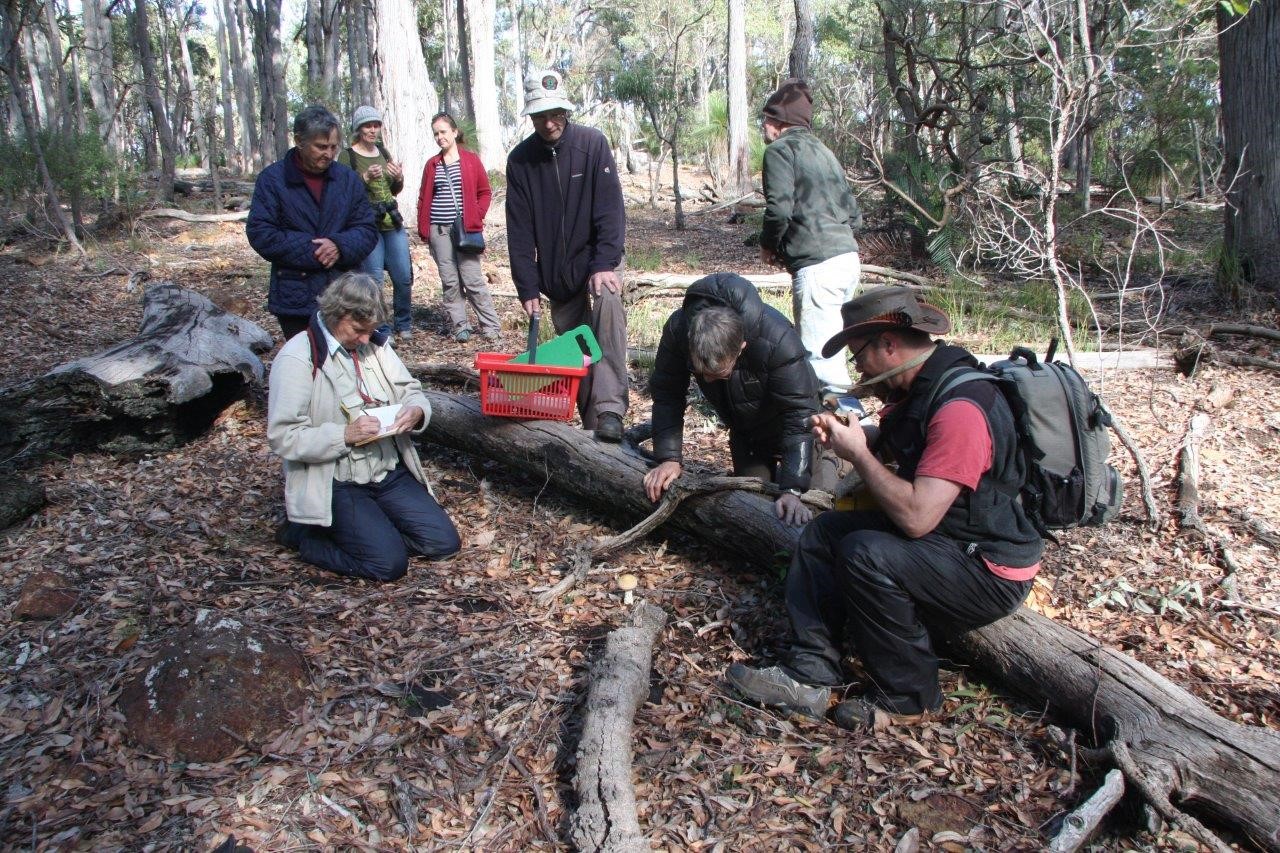
On Saturday morning we split up into two groups, each tackling a different habitat. One group headed for an upland slope with fairly open forest, whilst the other recorded in a wetter, lowland area. On the Sunday we all walked to nearby Park Block in the Lane-Poole Reserve, recording what we saw in this Jarrah/Marri forest with almost no understorey.
Altogether we saw over 75 different species of fungi. There were large conspicuous mushrooms like Austroboletus occidentalis (identity not certain), Cortinarius archeri, and Amanita hiltonii (identity not certain), although not all were easy to see unless the leaf litter was removed. There were smaller mushrooms too, like some species of Inocybe and Mycena.
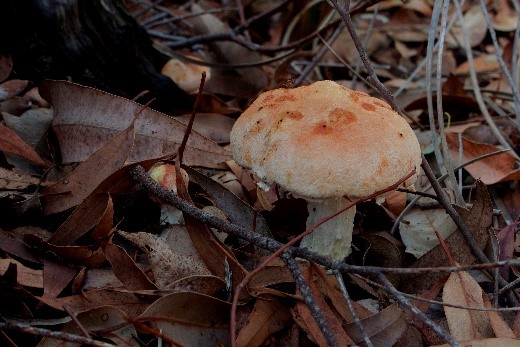
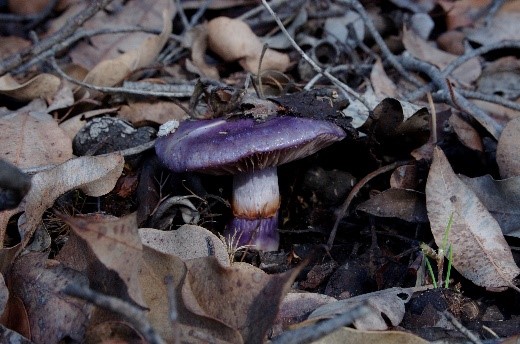
Austroboletus ?occidentalis (Russ Chambers) Cortinarius archeri (Russ Chambers)
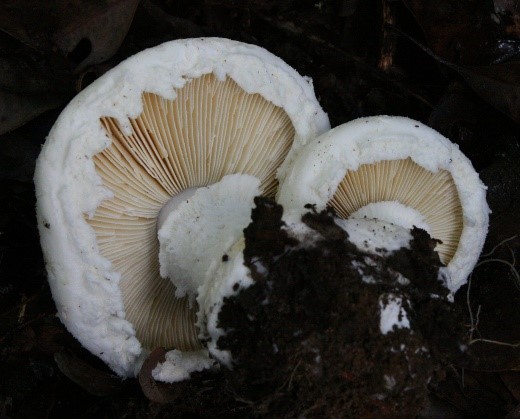
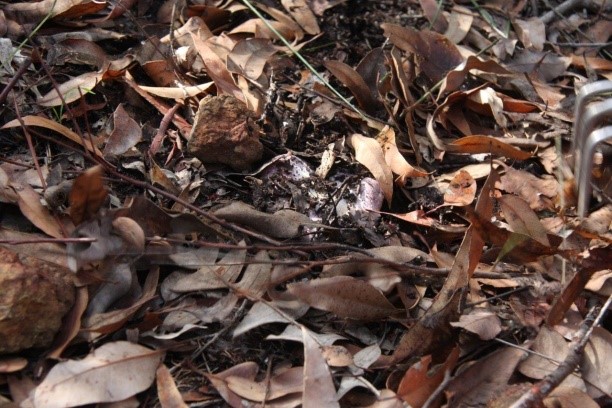
Amanita ?hiltonii (Elaine Davison) Leucopaxillus lilacinus hiding under leaves (Jolanda Keeble)
And then there were the little ones: tiny stalked cup fungi such as Hymenoscyphus (or was it Lanzia?) and the skin and crust fungi such as Peniophora.
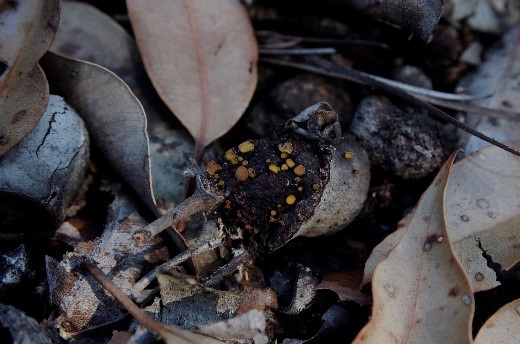

Hymenoscyphus or is it Lanzia? (Russ Chambers) Peniophora ?cinerea, image: Russ Chambers
Putting names to fungi in the field is usually very difficult. There are a few fungi that are easily recognised, but the majority of species need to be examined microscopically in order to be confidently identified at the species level—that is assuming that it is a described species. As we are finding, there are a large number of common, conspicuous, local species that are still undescribed.
During our forays at Cypress Farm we saw fungi that occupy different ecological niches. There were mycorrhizal fungi such as Austroboletus, Cortinarius, Inocybe, Amanita and Russula which grow in association with the local trees. There were saprophytes like Mycena, Fistulina and Agaricus, and we even noticed the parasitic Phyllachora causing tar spots on Hakea amplexicaulis leaves.
So what was the most exciting thing we saw during the weekend? Was it the most colourful mushroom, the ugliest fungus, the smelliest? No: it was a phascogale that danced across the woodpile outside the barn, and then posed on a nearby tree!
Elaine Davison
