

The GOLLY Walk on June 28th was our first in the Star Swamp Bushland, despite our monthly meeting place (the Henderson Environment Centre) being located at its entrance.
Star Swamp Bushland is a 96 hectare Class-A reserve comprising four hectares of semi-permanent freshwater lake with paperbark trees and 92 hectares of Banksia, Tuart, Jarrah and Marri woodlands, and areas of low heath.
“GOLLY, is that a good sign or a bad sign?” It was difficult to decide, as a small flock of Red-tailed Black-cockatoos flew over before we started. While exciting to see, they are now being sighted in many coastal suburbs for the first time as they desperately seek new sources of food.
Later during our walk we saw or heard Australian Ringneck (28s), Rainbow Lorikeet, several honeyeaters, White-breasted Robin, Kookaburra and a Grey Fantail who was happy to pose for photos.
Our first find was a large white fungus growing on the base of a dead Tuart. It could have been a Ghost Fungus (Omphalotus nidiformis) but no one has been back to check it at night to see if it glows.


GhostFungus? (Omphalotus nidiformis) (Hakea trifurcata) D Poynton
Star Swamp has a magnificent stand of Acorn Banksia (Banksia prionotes) which has been in full bloom for the last few months. Other Banksias in flower were the Parrot Bush (B. sessilis) and the ground-covering Couch Honeypot (B. dallanneyi).
The purple Common Hovea (Hovea trisperma), Native Violet (Hybanthus calycinus) and Native Wisteria (Harbenbergia comptoniana) were just starting to flower.
The white flowers of Two-leaf Hakea (Hakea trifurcata) and Grevillea lissocarpha were attracting plenty of European honey-bees, while closer to the ground we saw the white-flowered Matt Rush (Lomandra preissii), Pearl Flower (Conostephium pendulum) and Kick Bush (Astroloma pallidum).
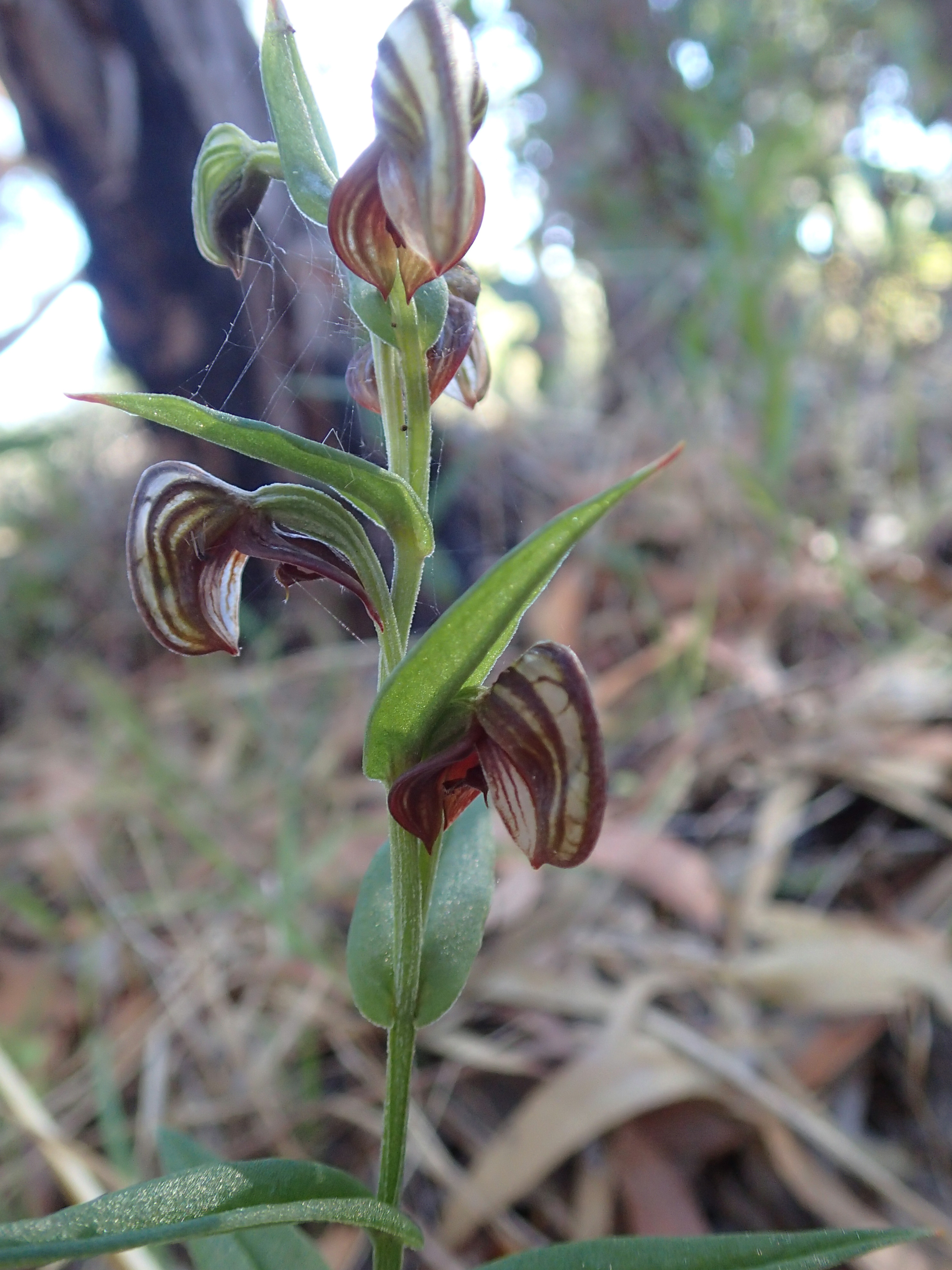
We had almost given up on finding any orchids when a clump of eleven Dark Banded Greenhood Orchids (Pterostylis sanguinea) were spotted by someone investigating one of the pit traps which are scatted throughout the reserve.
Eleven members enjoyed a very pleasant walk; our thanks to member Christine Curry OAM for leading us.
Don Poynton