

The Club led a 4WD excursion to the Helena and Aurora Range (HAR), Mt Manning and Die Hardy ranges between 19 September and 25 October 2017.
Eleven club members in five cars met up at Southern Cross to travel in convoy to the HAR where we spent two-and-a-half days and three nights exploring the banded ironstone formations (BIFs) and surrounding vegetation.

We climbed up Bungalbin Hill (above) at the southern end of the range and drove up to the hilltop campsite on the northern end of the range, from where we had magnificent views of the Great Western Woodlands spreading around us to the far distance. Except for the occasional mine-site scar, the views were of an undisturbed woodland landscape that makes you feel humbled by its size. On the eastern side of the HAR we explored some of the eroded valleys and disused tracks. The colours and sculptural quality of the rocks were very impressive. We had many discussions about the flora and birds encountered in this area. The most commonly heard bird was the Purple-crowned Lorikeet (Parvipsitta porphyrocephala).
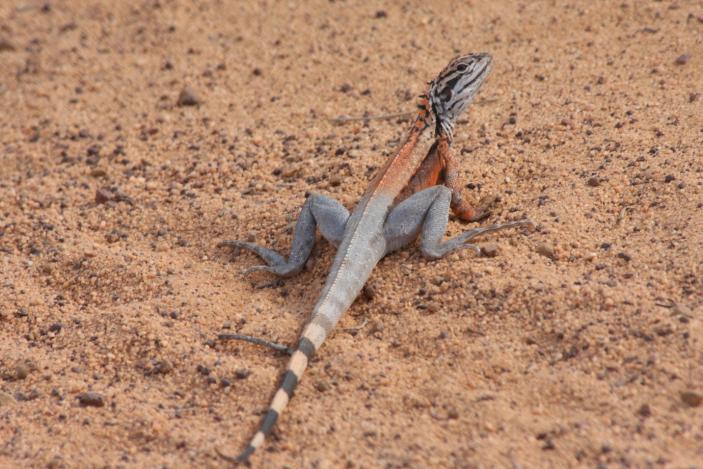
Crested Dragon (Ctenophorus cristatus)
We then travelled on to the Mount Manning Range, which is also a BIF. Leaving the HAR, we soon travelled out of the Great Western Woodlands through a sandplain and on to Pittosporum Rocks—a low granite outcrop—then across the greenstones of the Hunts Range and the granite outcrop of Kurrajong Rockhole, where we turned west-north-west on the track to Mount Manning. The wind was picking up during the day and it threatened to rain, which made camping a less pleasant experience.
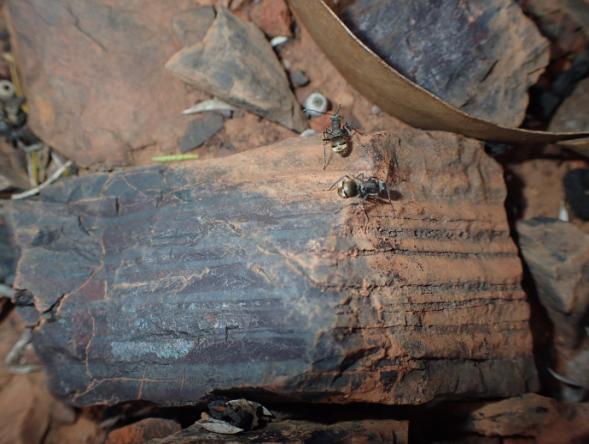
Golden-tailed Spiny Ants (Polyrhachis ammon) on Banded Ironstone
Between Mount Manning and Die Hardy ranges, we again travelled through a sand plain; however there were not many flowering species to be seen. We noticed a very fine-leaved Eucalyptus (Eucalyptus formanii), large Quandong trees (Santalum acuminatum), our first Red-capped Robin and a Scarlet Kingfisher amongst others. Arriving at Die Hardy Range, another BIF, we attempted to travel around one of the ridges but had to admit defeat as the track deteriorated to such an extent that we had to turn around. We spent the night at Pigeon Rocks, a granite outcrop with good views of the surrounding landscape.
After climbing the rock the next morning, we travelled on to Mount Jackson Homestead via the old Mt Jackson track. A new mining haul-road was being graded, dissecting the track and forcing us to get hands-on getting over the windrow to get back on the track. Travelling through the woodland area we glimpsed and heard a Spotted Harrier. Major Mitchel Cockatoos were feeding in old paddocks before we arrived at the old homestead. We spend our last wet and cold night at Trough Well campsite (granite outcrop) before heading home.
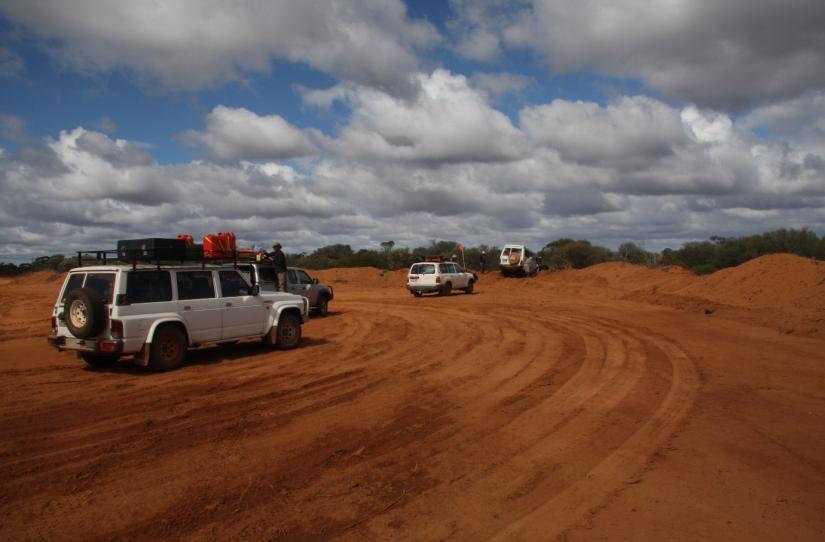
On the road to Mt Jackson crossing the haul-road windrow
During this trip we recorded 144 flowering flora species of which there were two ‘Threatened’ and six ‘Priority’ species. We recorded 39 bird species but heard many more unidentified species. We saw few mammals but recorded scats and tracks of Emus, macropods and canines (likely Dingos). We also recorded six reptile species, two bats, various invertebrates and three fungi species. A full list of the records is available at the Club.
Many thanks go to Brian Moyle who provided valuable details for this trip.
Jolanda Keeble (Excursion Leader)