

Kwinana Rockingham Mandurah Branch, 27 August 2023
Eleven members attended the excursion to Karnup Nature Reserve on a fine late winter’s morning. We headed off along the Don Shepherd Nature Walk, named after one of the founding members of KRMB.
Just inside the gate, we spotted Cockies’ Tongues (Templetonia retusa) still in flower.
It didn’t take long to spot the first of many Donkey Orchids (Diuris sp.– possibly a mix of D. magnifica and D. corymbosa) that we would find spread out throughout the reserve.
Donkey Orchid, possibly Diuris magnifica
– Photo Credit: Colin Prickett

Many of the small shrubs were also in flower, especially Pepper and Salt (Philotheca spicata), Grey Scaevola (Scaevola canescens), Pearl Flower (Conostephium pendulum), Blue Tinsel Lily or Star of Bethlehem (Calectasia grandiflora subsp. southern), False Boronia (Phyllanthus calycinus), Rose Banjine (Pimelia rosea subsp. rosea) and Hibbertia hypericoides.
Along the edge of the limestone path, Conostylis sp. were in flower, as was Semaphore Sedge (Mesomelaena tetragona). Lomandra sp. (at least three species are known to be present) also grow on the side of tracks. Though not in flower, they did attract our attention as they are the preferred habitat of Maratus gemmifer, a Peacock Jumping Spider only found in this reserve.

It wasn’t long before we spotted the first of many brightly coloured males moving around in search of the drab, by comparison, females. The males were seen raising and waving their legs in partial mating display, but none were seen in full display, at which times they would arch their coloured fans as well.
♂ Maratus gemmifer Peacock Jumping Spider
– Photo Credit: Colin Prickett
This was the first time most of our group had seen these spiders, so it was nice to find so many males.
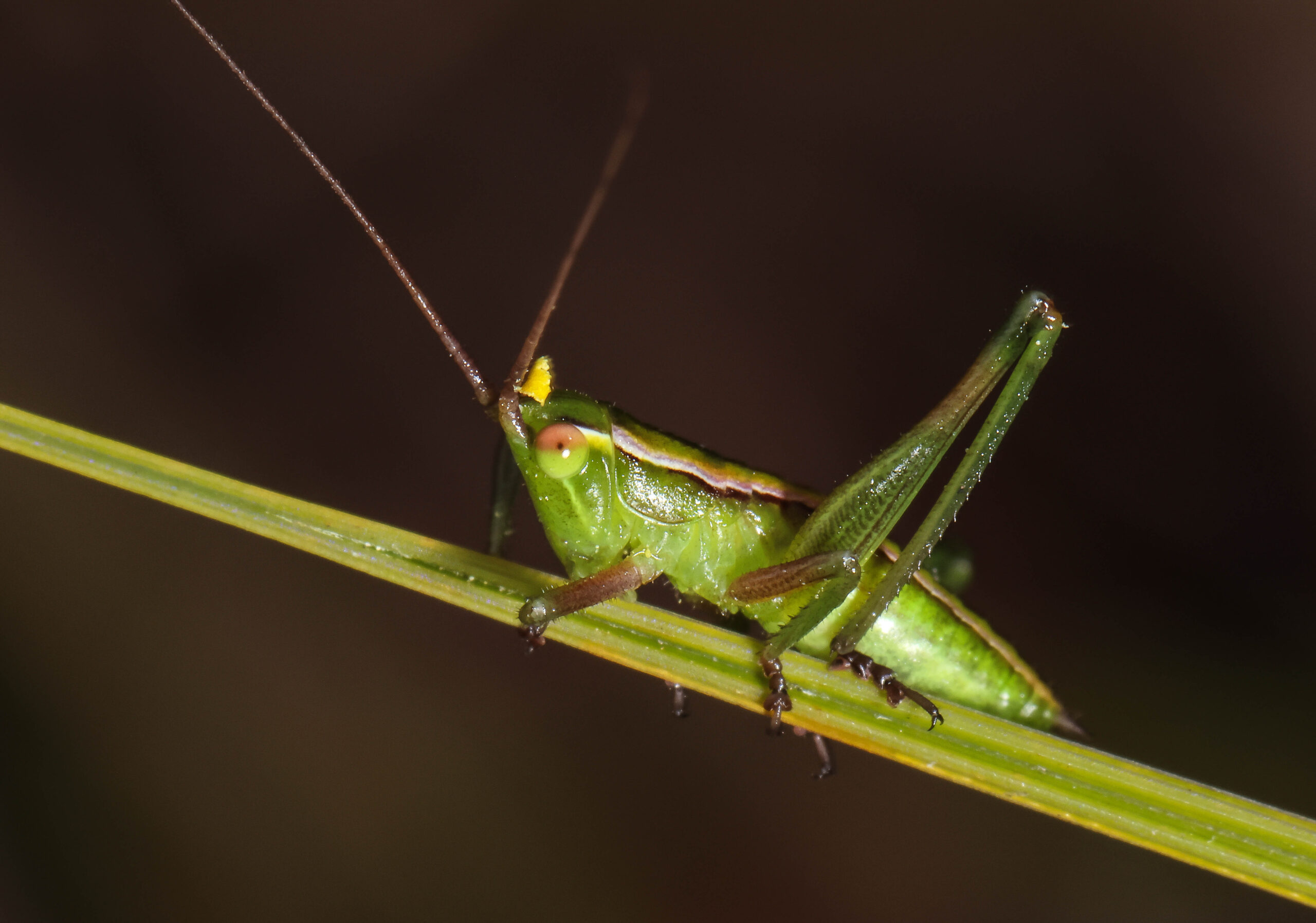
While continuing our walk we found several orchid species in flower, including Dancing Spider Orchid (Caladenia discoidea), Jug Orchid (Pterostylis recurva), Cowslip Orchid (Caladenia flava), Rattle Beaks (Lyperanthus serratus), Red Beaks (Pyrorchis nigricans), some large groups of Snail Orchids (Pterostylis sp.) and some fine specimens of the Dark-banded Greenhood (Pterostylis sanguinea). Other invertebrate sightings would include numerous hairy caterpillars, small Forester Moths, Katydid nymphs, a Matchstick Grasshopper (Swanea laticornis), tiny Plebs sp. Orb-weaver Spiders and a Western Web Dasher Spider (Corasoides sp.), the spider responsible for the trampoline-like webs built horizontally close to the ground.
Our bird list was very short, with our attention directed downward for most of the walk. A few nice sightings were two Carnaby’s Black Cockatoos at the top of one of the large dead trees, a male Rufous Whistler and a Red-capped Parrot. All too soon, it was time to return to the car park for a well-earned cuppa and snacks. It had been a great morning in this special nature reserve, and although it was not our original choice as the destination for this month’s excursion, everyone agreed that it had been a great ‘Plan B’.
Colin Prickett