

Main Club, 7 August 2026
Our speaker was Lou Scampoli, an active member and volunteer with Birdlife WA. He has also been active on the Executive Committee of the Conservation Council. He spoke about the amazing voyages that birds take.
Scientific studies have told us a great deal about how and why birds migrate, and that it is changing and evolving, especially now with climate change.
Bird migration began 66 – 50 million years ago, when birds responded to big seasonal differences in food availability, temperature and hours of daylight. It helps them access abundant food, avoid extreme weather, reduce competition and increase breeding opportunities. It commonly takes the form of seasonal, large-scale movements that aid their survival and reproduction.
Lou outlined the chemical changes that occur in a bird’s brain and body that trigger and regulate migratory behaviour. There are photoreceptors in the hypothalamus that regulate photoperiodic responses to light, thereby influencing other glands, such as the pituitary. These, in turn, cause the birds to put on weight, moult, strengthen their wing muscles, and experience migratory restlessness, or Zugunruhe. Prolactin causes them to develop a brood patch to warm their eggs. Thyroid hormones stimulate moulting, and the adrenal gland releases stress response hormones. Then, during the journey, the hunger hormone ghrelin prompts them to stop at specific places to feed.
Experiments have shown that birds use a combination of navigation methods: Young birds in the breeding grounds develop a cognitive map of the stars. There is scent-mapping using olfactory cues. There is orientation to the Earth’s magnetic field via photosensitive proteins in the eyes. There is a sun-compass that involves melatonin and the pineal gland, which links the sun’s position to the body clock. And sometimes the young follow the elders.
The East Asian – Australasian Flyway is a major migratory route for shorebirds, stretching from Arctic Russia and Alaska to Australia and New Zealand. This includes about 900 wetlands, such as the crucial Yellow Sea Wetlands, with their vast intertidal mudflats and other suitable habitats. China has significantly tightened coastal reclamation and introduced new national migratory bird protection measures. A juvenile Bar-tailed Godwit completed an extraordinary non-stop migration of more than 13,000 km from Alaska to Tasmania. The Arctic Tern, “champion of migration”, flies for 60-80,000 km, taking about 18 stops. This is the longest distance travelled by any animal, and it experiences more daylight than any other.
But not only shorebirds migrate. The Sacred Kingfisher shows a seasonal north-south movement across Australia, as do the Australian cuckoos. Rainbow Bee-eaters migrate north to over-winter in northern Australia and parts of Indonesia. The Bar-headed Goose flies over the Himalayas, needing special haemoglobin to cope with high altitudes.
There are migration patterns other than the well-known latitudinal migration. The Flame Robin exhibits altitudinal migration, and some species do longitudinal migration. Then there is nomadic and irruptive movement, and vagrancy.
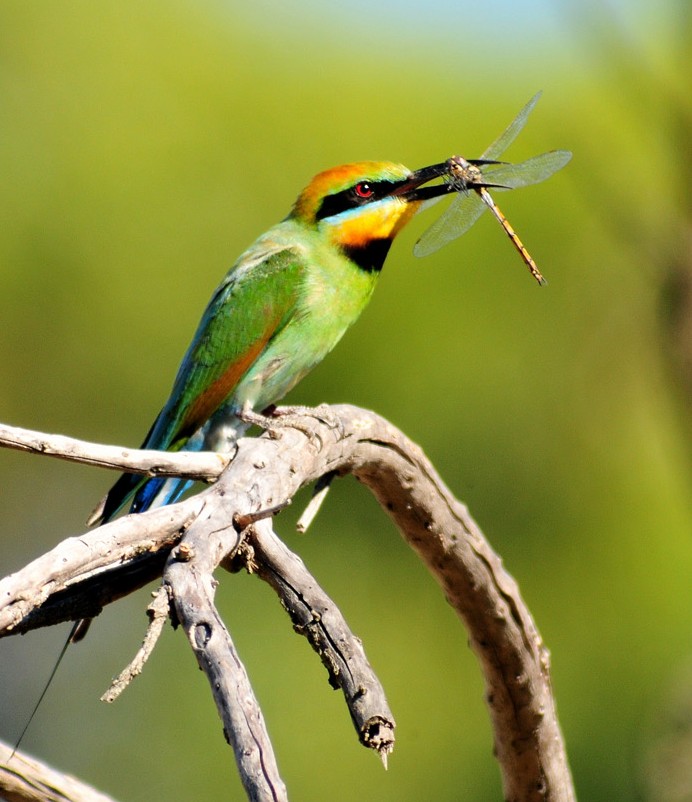
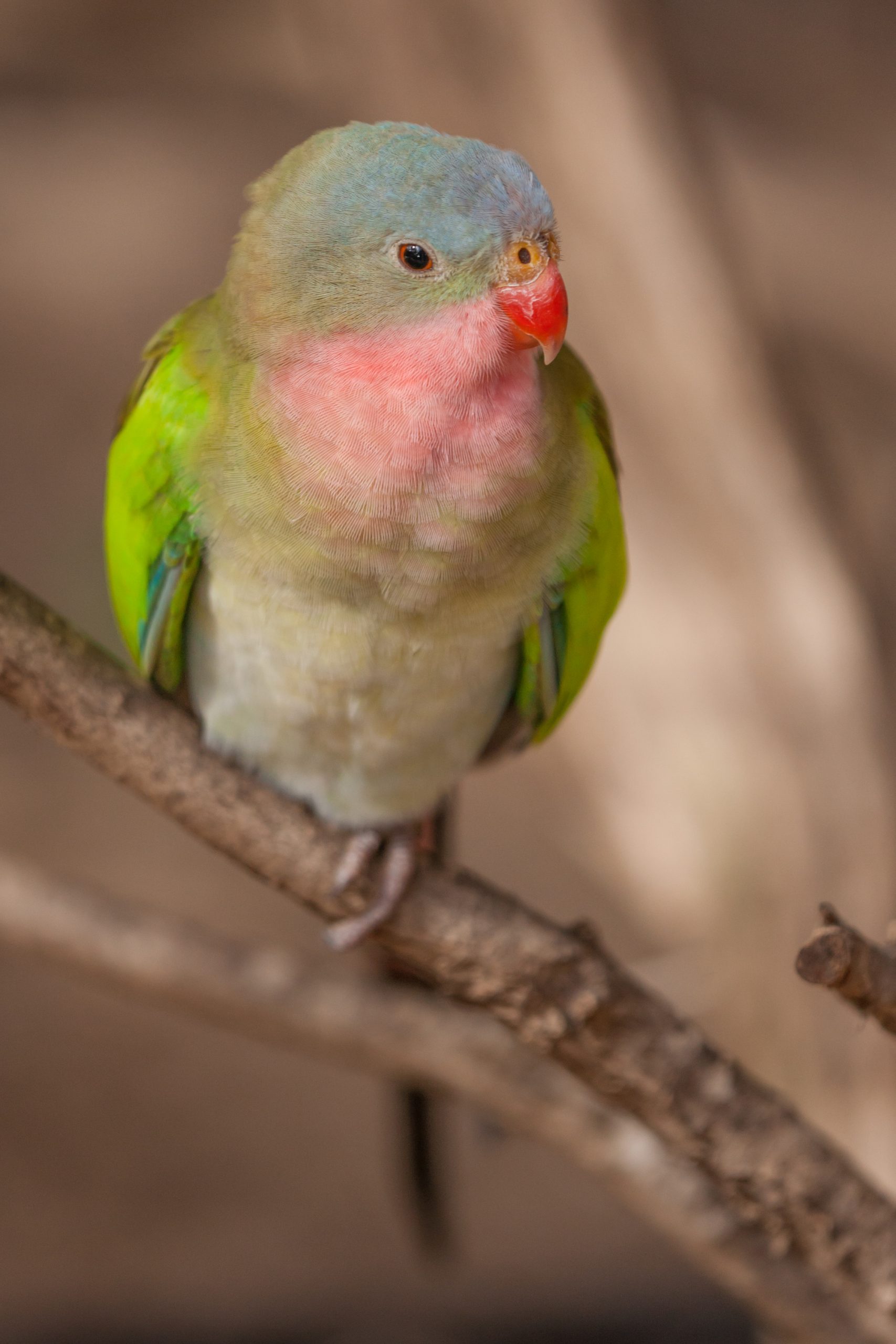
Left to right: Rainbow Bee-eater, Princess Parrot.
Image by Lou Scampoli
Lou finished by talking about threats to migratory birds, such as the loss of feeding grounds, pollution, lit-up skyscrapers, and Climate Change.
Mike Gregson