

Main Club, 4 September 2026
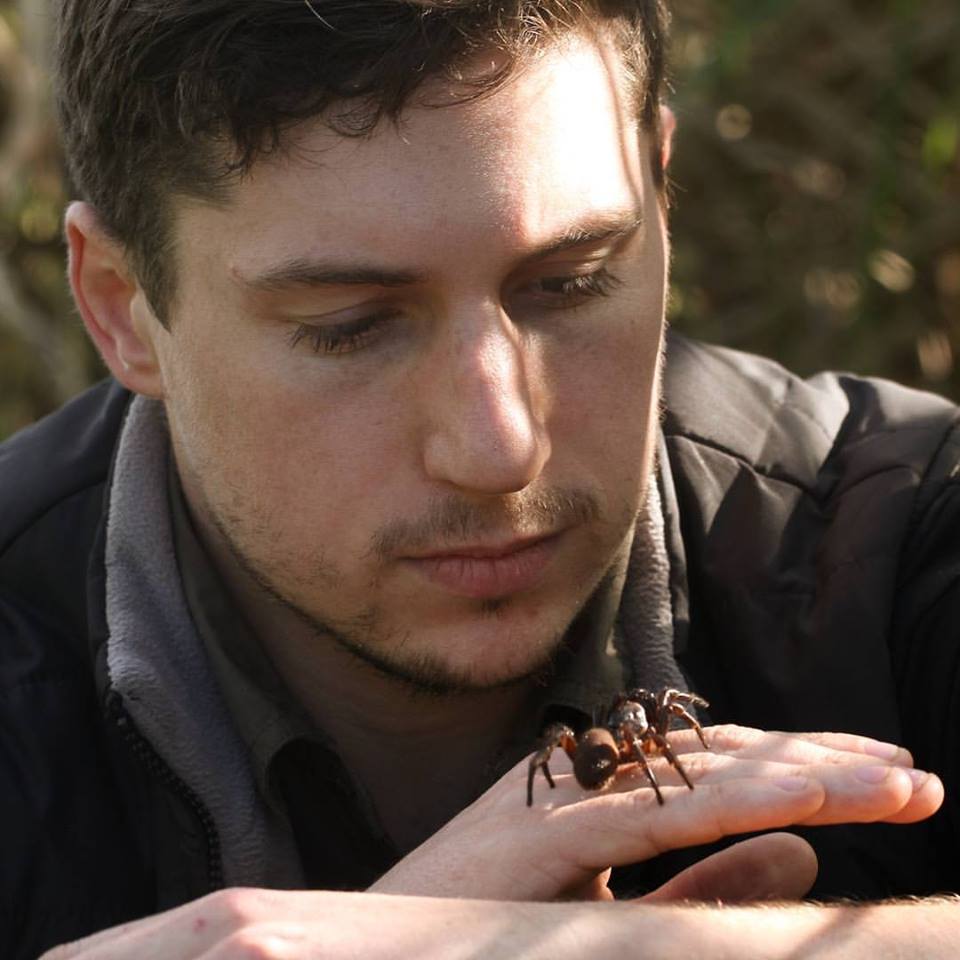
Our speaker was Jeremy Wilson, Curator of Arachnids and Myriapods at the WA Museum. He focuses on mygalomorphs, which include trapdoor and wishbone spiders. Jeremy acknowledged his two chief mentors at the museum – Mark Harvey and Mike Rix, as well as the late Barbara York Main, who was a former co-patron of our Club and made an enormous contribution to our knowledge of these spiders.
Jeremy Wilson with Trapdoor Spider Image by Bryan Lessard
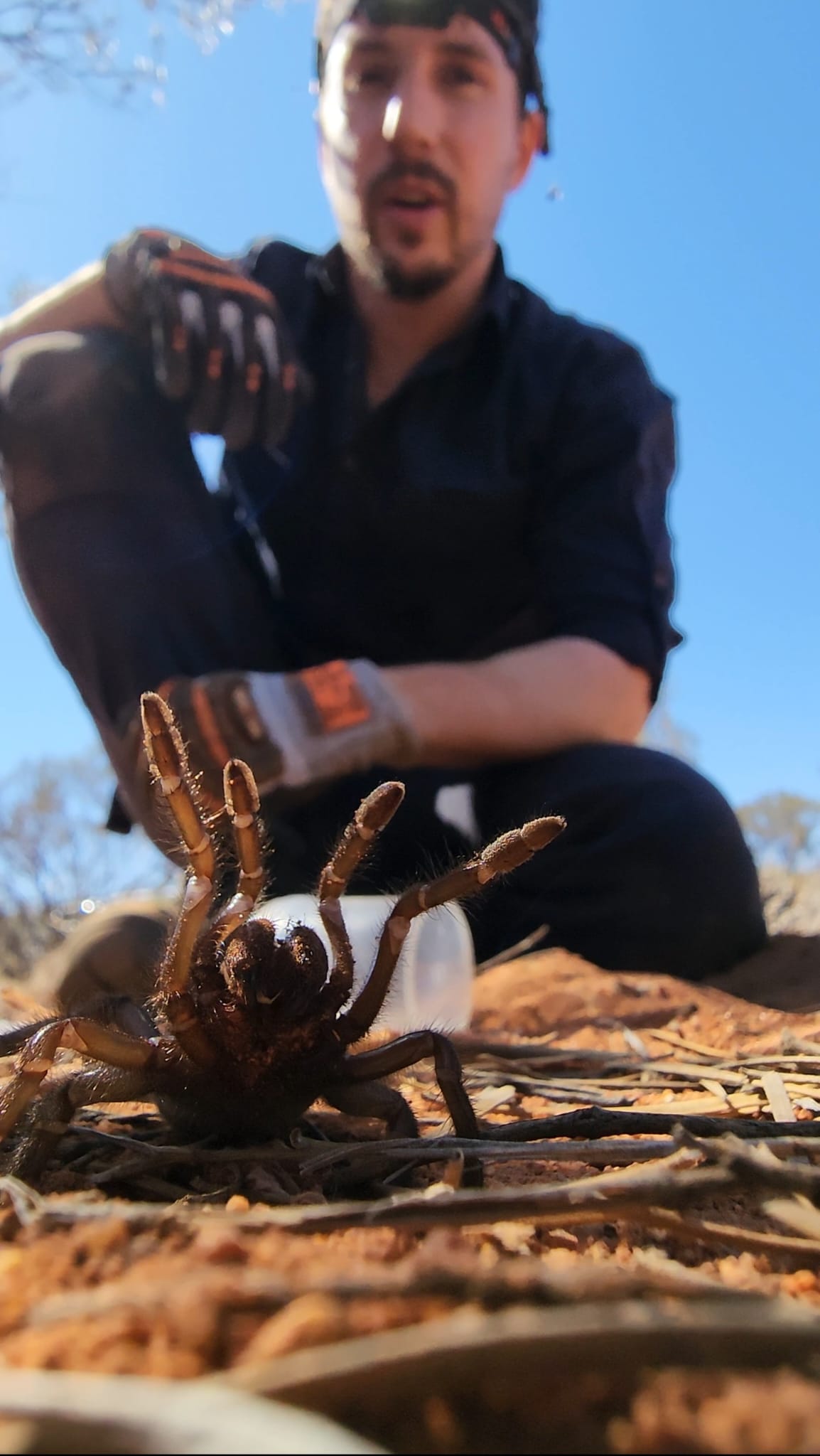
Mygalomorphs are a primitive group of related spider families. They are larger, chunkier and longer-lived than the more advanced araneomorphs, and they build retreats or burrows or inhabit small spaces rather than spinning webs. They catch prey by ambush near their burrow, and the young disperse on foot rather than on a web thread. They use their fangs downward instead of in a pincer movement. They live for decades and have a long generation time. They do not disperse far, and their species distribution areas are small, so they are very sensitive to habitat disturbance.
Different species are adapted to different conditions. Those that make nests under logs and rocks build sheets of web to drag prey into the nest. Obligate burrowers can hold the lid closed against predators. Some species surround their burrows with twigs in a radial pattern so they can feel when potential prey comes close.
The diversity of mygalomorph spiders in WA’s ancient landscapes is extraordinary, Jeremy says. However, most remain undescribed, very few specimens have been collected, and many exist in threatened habitats. WA has nine families of mygalomorphs, including spiny, wishbone, mouse, brush-footed, and saddle-legged spiders. Some of these are restricted to the wetter SW areas. Out of about 900 species, only a quarter of them have been described. In the SW agricultural area, one genus has 34 species, of which 29 are undescribed. Jeremy says that we are still “scratching the surface” in describing these short-range endemic spiders.
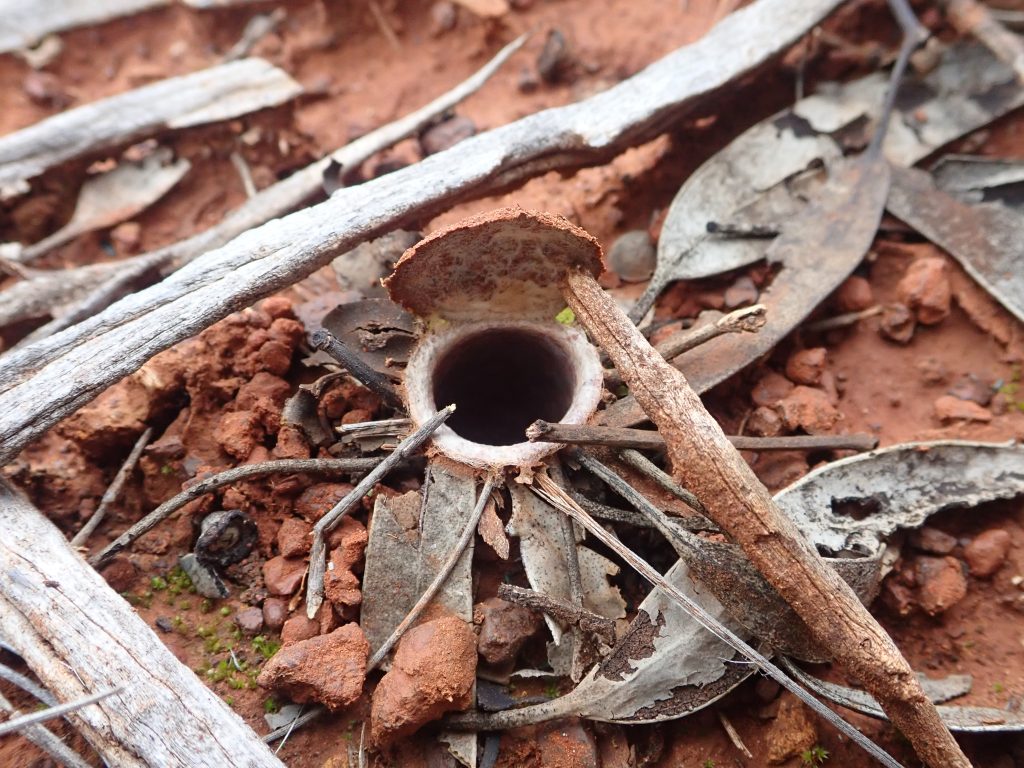
example door open – Image by Jeremy Wilson
Jeremy talked about the difficulty of dealing with this huge diversity. To work out how to classify them, he and his team at the WA Museum have been using “integrated taxonomy”, which means combining different types of evidence such as fieldwork, morphology and molecular data to find relationships and construct phylogenetic trees. Fieldwork is needed to understand how they have diversified. This might include observations such as mating behaviour, defence behaviour, and the appearance of egg sacs. He says we need to know where these spiders are to understand how to conserve them and protect them from extinction.
Mike Gregson