

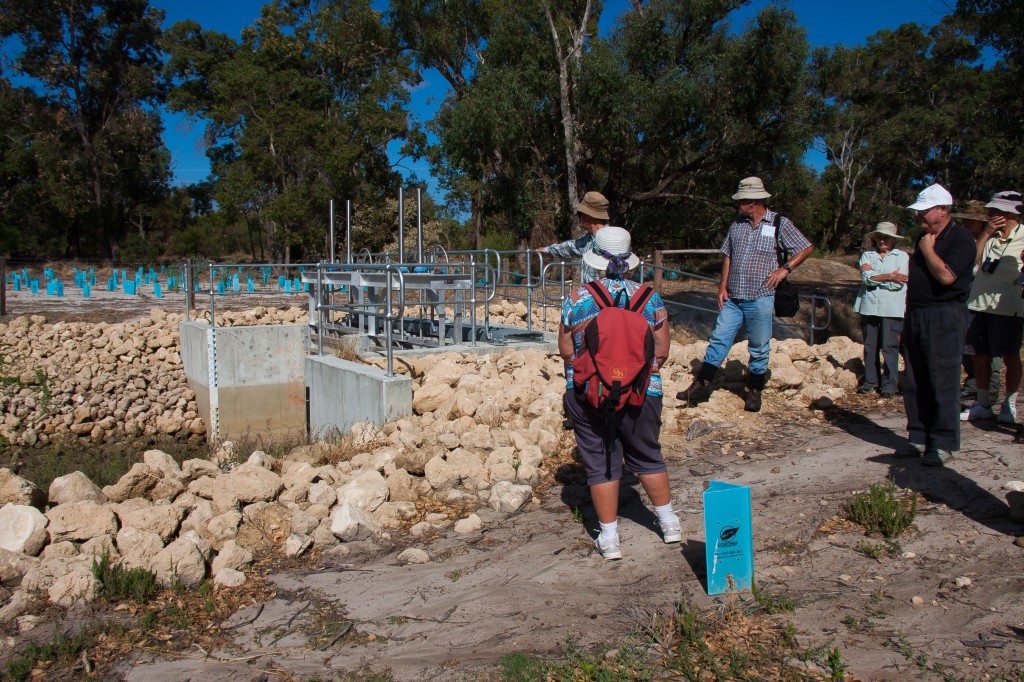
As a follow up to the presentation at the March general meeting, on Sunday 17th March ten KRMB members joined Peter Wilmot for a visit to Lake Mealup to view the results of the recovery project. For many of us this was our first visit to Lake Mealup so we had not experienced the period of poor ecosystem health associated with the lake drying out each summer. The visit started with an inspection of the weir on the Mealup Main Drain. Peter explained how it worked and showed us the channel that delivered the water to the lake. The weir is operated manually and has two gates that allow the level to be adjusted in order to get the required flow rate into the lake.
We then drove into the visitors’ area at the lake and made our way down to the bird hide viewing platform. The water level in the lake was still quite high; much of the fringing vegetation was in the water, with no beach area evident. The typha has not returned and the lake was a wide expanse of open water.
Water birds were present in good numbers and with a good spread of species. We saw six of the duck species (Blue Billed Duck, Musk Duck, Grey Teal, Australian Shoveler, Pink Eared Duck and Australian Shelduck), Eurasian Coot, Hoary-headed Grebes, Darters, Black Swans and a lone Pelican.
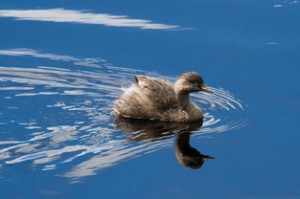
Hoary-headed Grebe
Also sighted from the hide were Great Egret, Yellow-billed Spoonbill, White-faced Heron, and Australian White Ibis. Periodic flurries of activity on the lake hinted to the presence of raptors and sure enough when we cast our eyes skywards we spotted Whistling Kites, a Wedge Tailed Eagle and a White-bellied Sea Eagle soaring past at one time or another.
After morning tea we headed off on a tour of the woodland, led by Stan and Margaret Telford who are also active members of LMPS. The woodland is a mix of Banksia Jarrah, Marri and Tuart with Melaleuca and Flooded Gum.
Banksia littoralis was in flower as was the Marri. Several magnificent specimens of Woody Pear were seen, many with unopened fruit together with those that had split open. Our bird list continued to grow during our walk through the woodland with Red-capped Parrot, Australian Ringneck, Golden and Rufous Whistlers, Grey Butcherbird, Black-Faced Cuckoo-shrike, Inland Thornbill and Scarlet Robin amongst the sightings. The only reptiles spotted were little Fence Skinks.
Our walk took us to the site of an old orchard, but the only evidence left is a single orange tree surrounded by Banksias and Woody Pears, the result of rehabilitation initiatives of LMPS. Then it was back to the visitor centre for a light lunch followed by some more bird watching from the hide. Several flights of Black Swans provided a nice spectacle as they flew in to land on the lake. Hoary-headed Grebes and a couple of Black Swans came in close to the hide providing us with our best opportunity for water bird photographs. Peter explained that the level in the lake was perhaps a bit too high for this time of the year, which means that it does not suit the smaller waders that require a beach zone. It will take a bit of trial and error to get it right, though the current level has been affected by two heavy rainfall events during summer.
Back at the visitor centre we recorded the bird list – a total of 33 species at Lake Mealup itself, with another 5 species sighted on the drive in. All too soon we had to bid our hosts farewell and thank them for allowing us to visit. It was great to be able to view the results of the recovery project. It is early days but it was easy to see that the water birds have considered it to be a success. We will certainly be keeping in touch with Peter in order to keep track of the recovery of Lake Mealup.
Colin Prickett