

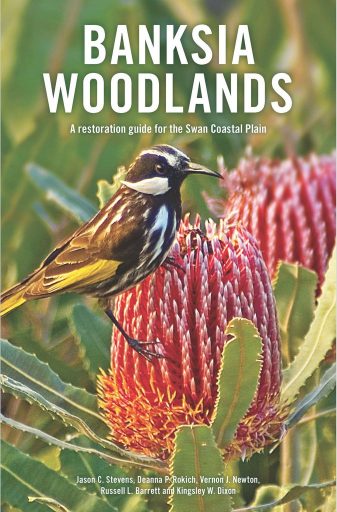
 UWA Publishing. RRP $45
Authors: Jason C. Stevens, Deanna P. Rokich, Vernon J. Newton, Russell L. Barrett and Kingsley W. Dixon
With Commonwealth Government proclaiming the Banksia woodlands of the Swan Coastal Plain as a threatened ecological community, any study of this community is welcome. This book looks specifically at restoration but starts at the basics of understanding the floristics and a description of the ecology of ten dominant trees. These woodlands have been reduced by two thirds and much that is remaining is highly degraded and still under threat of further clearing. This community has high diversity of shrubs, shrubs, sedges and grasses comprising around 600 taxa but, in addition, there is considerable variation between sites so restoration needs to be site specific.
The book looks at restoration, the scientific basis of what it means and how targets can be set and evaluated. The restoration procedures described are based on research and development work done over 20 years by UWA in collaboration with Hanson Construction Materials (formerly Rockla Quarries) and by Kings Park and Botanic Garden Authority. Chapters include discussion on soil reconstruction, topsoil as a plant resource, sourcing of seed (and local provenance), seed storage and germination, direct seeding, seedling production and planting and weed management. It also looks at planning and site preparation. There is a detailed explanation of the seven step restoration framework employed in Kings Park and Bold Park. The introductory two chapters are on the floristics of the area and the ecology of the ten dominant trees. There are also nine short profiles on interesting species (eg. stag trees and sun moth). The appendices include lists of taxa, seed dormancy and recommended treatments and a detailed example of a 6 year restoration schedule. There is also an extensive reference list.
This book provides an extensive overview of the subject of Banksia woodland restoration and should be the basis for government departments, institutions, organisations, groups and individuals as they plan restoration in the future. For the individual interested in our Banksia woodlands, it is an interesting informative book well worth reading or dipping into especially the sections on the ecology of the ten trees, the profiles and the appendices listing the vascular plants.
Margaret Larke