

Main Club, 6 November 2026
Our speaker was Dr Craig Bowers, a retired astronomer and Honorary Historian to the Perth Observatory. He has written a book on the history of the observatory. To his disappointment, Craig has seen light pollution increase over the years at his home in Bickley.
Craig listed three types of light pollution caused by Artificial Lights At Night (ALAN):
- Skyglow – a dome of brightness on the horizon that obscures the view of the sky.
- Glare – e.g., that produced by car headlights, which reduces visual acuity.
- Light trespass – light falling outside the boundary onto another property.
Craig showed us an interesting view of the world from space showing where light pollution exists. (It’s increasing by about 10% a year.) Thankfully, Australia is relatively dark.
Wildlife is affected by light pollution in many ways: Marine turtles are a prime example; light draws hatchlings away from the ocean’s protection. Many animals use the light of the moon or the Milky Way to orientate. Many birds die by colliding with illuminated buildings, and gulls can die of exhaustion when they endlessly circle lights at night. The disorienting effect of light pollution is one of the major factors contributing to the alarming rate at which insects are declining worldwide. And even trees are affected.
Worldwide, it is estimated that $3-7 billion is wasted annually because of unshielded or excessively bright light, and that in the US, where 21 million tons of CO2 are emitted annually from unnecessary lighting, a third of all lighting is wasted.
Craig said that after a big earthquake in LA, when all the lights went out, some people rang the observatory with fear in their voices, asking what the great milky blotch was in the sky. They had never seen the Milky Way! It is said that artificial light, especially blue and white light, is detrimental to our health. Watching the sky for ten minutes may be good for our health.
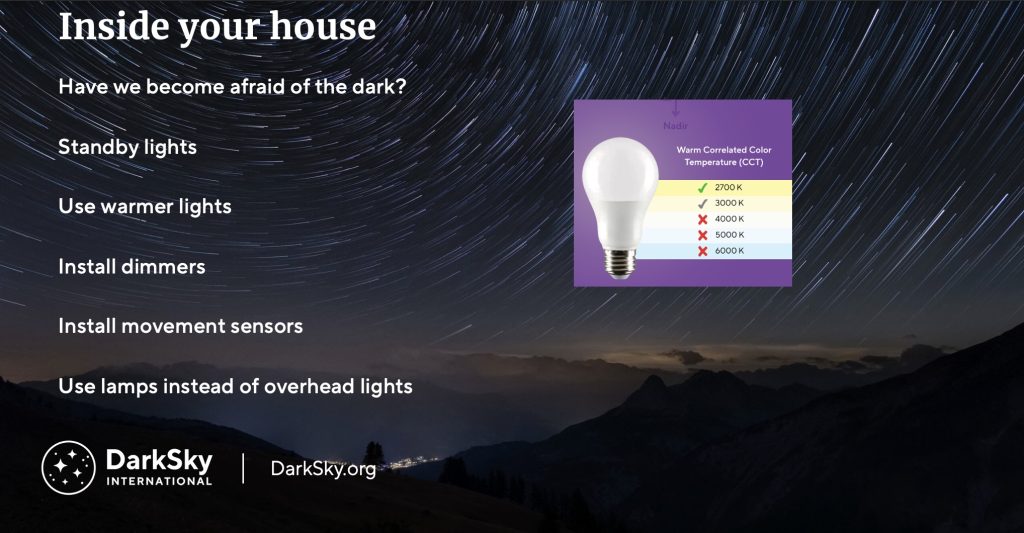
Red light, or warm, yellowish tones, like candlelight or a sunset, is good for the eyes. These have a low K value of under 3,000K. Cool, blue colours are harsher on the eyes. They have a high K value of over 5,000K. K stands for Kelvin, a measure of the “colour temperature” of the light. In WA, lights producing 3,000K are now offered to shires.
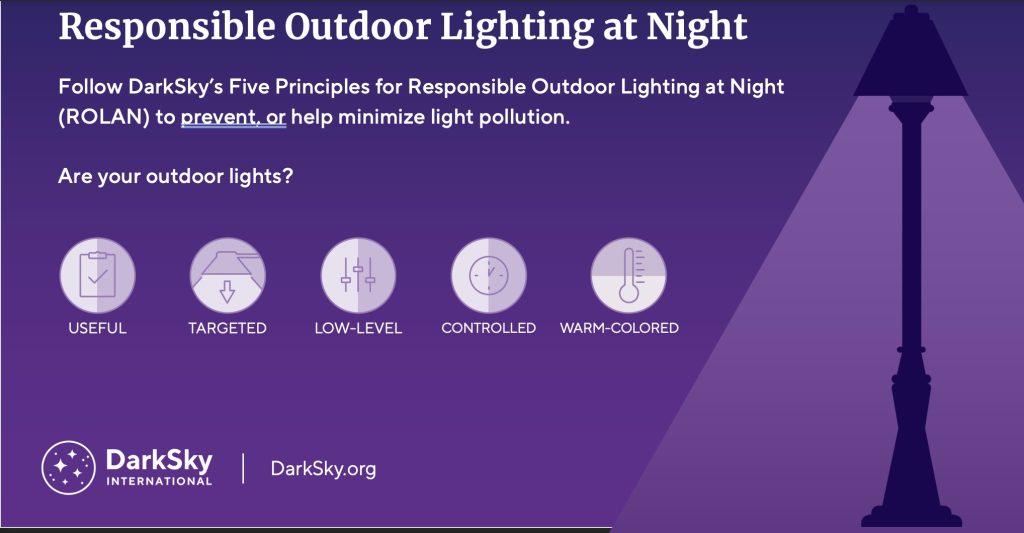
Craig suggests that many of us are obsessed with security, and that security lights should be less bright, shielded, controlled by a sensor/timer, and targeted to a useful area. It’s as if we’re afraid of the dark! The same applies to streetlights and sports oval lights, with properly capped lights where all the light (not most) is directed downwards to where it is needed. “Lights down, stars up.”
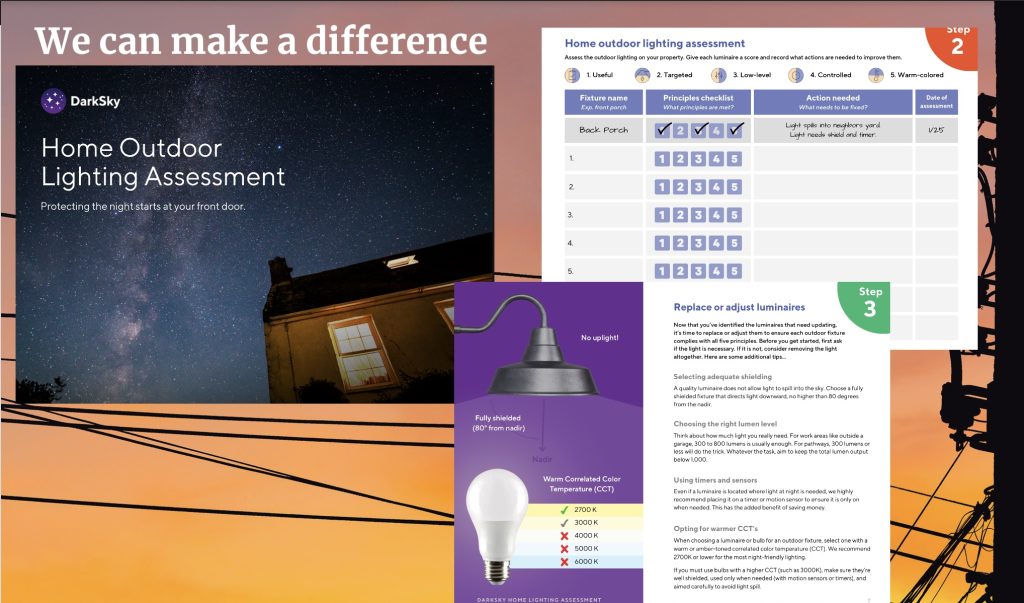
To find out more about how we can mitigate light pollution, Craig directed us to the Australasian Dark Sky Alliance, the websites Globe at Night and Dark Sky International, and the app Loss of the Night. “We can make a difference”, he says.
Mike Gregson