

As with any good field trip preparation the organizer conducts a recce (aka Twink Smurthwaite). As such, the week before the DRB Avon Valley National Park excursion, a quick trip up the Toodyay Road was made to check out the opportunities for the weekend ahead.
On arrival, however, the park gate was closed, flames licked and flicked slowly through the bush and a lone, empty DEC fire tanker stood at the entrance, its radio blaring out fire chatter to no one in particular. The very location where our field trip was to be held was undergoing a prescribed burn!
This did not bode well for the weekend. A scout around the area for an alternative site did not reveal anything particularly interesting so it was decided to continue with Plan A and ‘wait and see’.
This proved to be a good decision. By the time DRB arrived three days later, it had rained, the smoke had cleared and the park gates were wide open. What we found was a mosaic of burnt and unburnt bushland through which we could explore.
Evidence to suggest that the burn off did not interfere with our trip was the slow pace of the 19 members – 250 metres or so in 2.5 hours!
The openness of the undergrowth enabled us to step carefully off the track and examine the vegetation. While still early in the season a few plants were in flower, and it was also possible to inspect exposed piles of leaf litter, the trunks of trees and Xanthorrhoea, fallen logs and soil heaps and other interesting exposed elements – albeit getting a bit blackened in the process.
We parked at the “Homestead” parking area, approximately 10 km into the park, in an area of (extremely) tall open Wandoo woodland. The Weebill was one of the few birds calling; several Splendid Wrens were hopping among the low scrub. Up above, in the lower Wandoo branches a Grey Fantail, dancing and flitting, ignored us.
Although burnt, it appeared to have been a cool burn and a few plants were in bloom. These included the red leaved Sundew [Drosera bulbosa], Drooping Leucopogon [Leucopogon nutans], the eight petaled Eight Nancy [Wurmbea tenella], Candle Cranberry [Astroloma ciliatum], and a female Reidle’s Zamia [Macrozamia riedlei]. Further uphill were several 3-4 m tall Kingia in flower.
Several nests of the stick and stone Ant [Irodomyrmex conifer] were seen; the tallest being just over 20 cm, with stones on the outer surface to be heated by the sun. The curled body of a millipede was found on the ground near a Volcano Ants nest.
Quite afew species of fungi were seen including the scarlet Bracket [Pycnoporus coccineus].
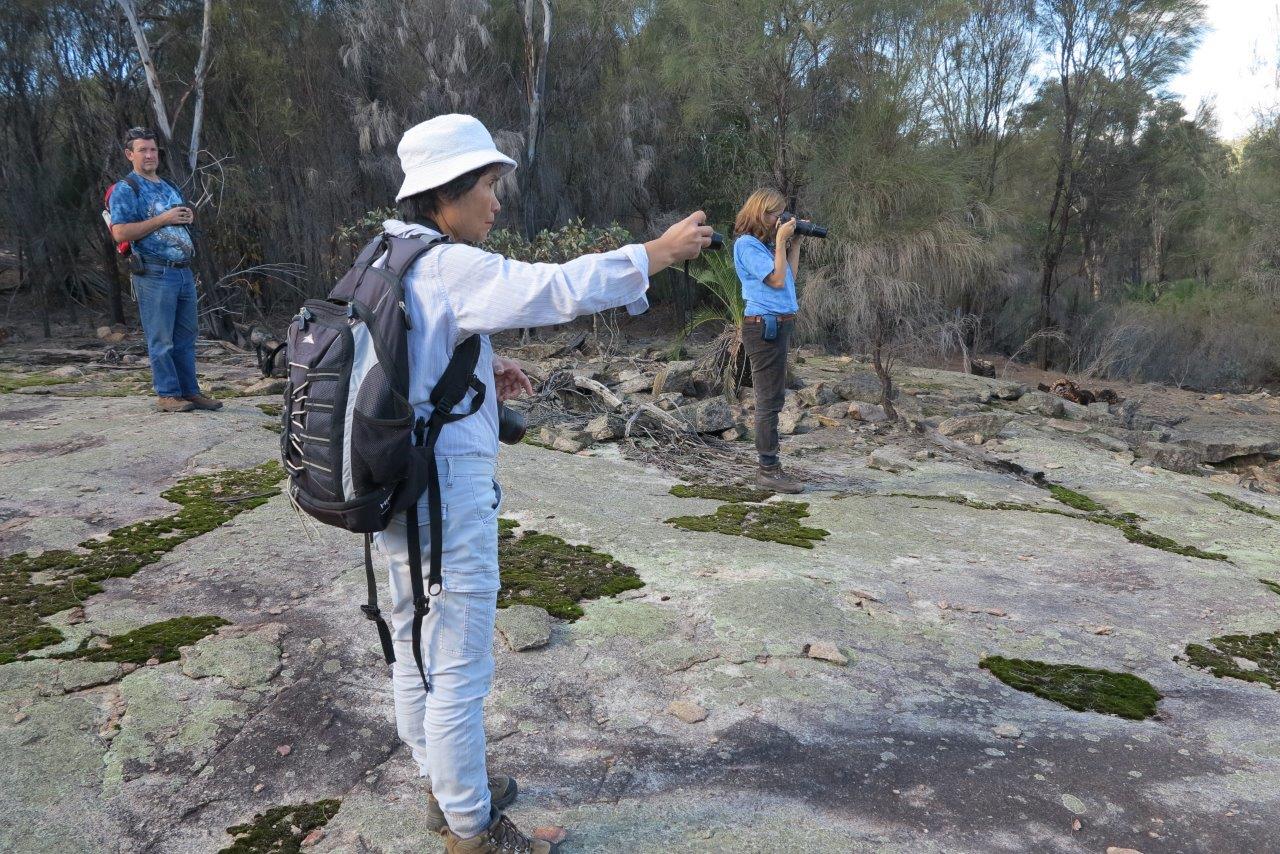
After lunch we explored the granite outcrop west of the parking area. Several species of rock lichen Xanthoparmelia coated some of the surfaces and at least two species of moss formed mats on the granite. In the shallow pits around the granite Allocasuarina trees and Riedle’s Zamia were dominant. Several Rock Dragons took shelter among the loose boulders and sheets of granite.
Later in the day when most people had left the three Whistlers – Golden, Rufous and Grey shrike Thrush – all began their opus and from the top of a tall Wandoo on an exposed branch, a Fantailed Cuckoo began its chime. A wedge-tailed Eagle was seen circling high above the valley. A Brush Wallaby was seen south of Homestead in open scrub. Emus, Ring-necked Parrots, a Scarlet Robin and the white-tailed Black Cockatoos were also seen.
A wonderful area, well worth the visit.
Eric McCrum and Diana Papenfus