

The Cockburn Wetlands Education Centre is near the eastern shore of Bibra Lake. Denise Crosby, the Centre manager, talked to us about the local frogs, before taking us for a walk at night.
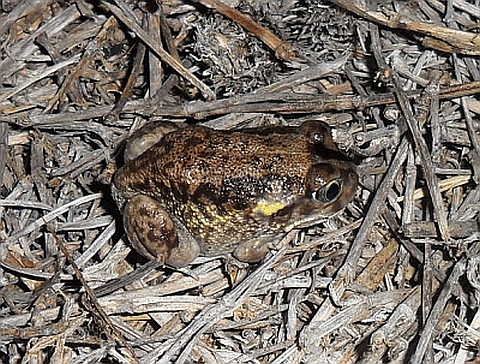
Moaning-frog Photo: Felix
We learnt that the male Moaning Frog burrows backwards, digging a deep burrow. There he calls for a female, who lays her eggs, which he fertilizes. After the eggs hatch, the tadpoles can swim out when the burrow is flooded in winter. Banjo Frogs do it differently. They make a raft of froth on the surface of the water to lay their eggs on.
Then there are the two species of tree frog – the ones with sucker-disks on their toes – the Slender Tree Frog and the Motorbike Frog. They just lay their eggs on the surface of the water underneath the rushes. There is also the strange-looking, termite-eating Turtle Frog, which digs forwards into the sand. There the female lays her eggs, which hatch into tadpoles that stay inside the egg capsule until they change into adult frogs. (There is no free-swimming tadpole.) Denise said you can hear them croaking after summer rain in Banksia woodland. (Will we ever get any summer rain?) There are several other species of frog, which are mostly small, and lay their eggs in puddles, where they sink to the bottom. Denise showed us what the different frog species look like and played us their recorded calls.
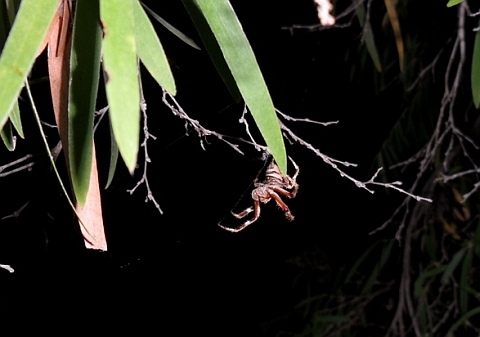
Spider Photo: Felix
After that, she took us for our night walk from the Education Centre to the “lake”. Bibra Lake is not a lake at all at the moment – it is almost completely dry due to the lack of rain. For a long time we saw no frogs at all, but we found dozens of wolf spiders on the ground using the head-torch method to search for the tiny “cat’s-eye” shine. They are called wolf spiders because they hunt their prey on the ground. They live in burrows. Also, we were delighted to find a number of large, colourful orb-weaver spiders sitting in their webs. Some of us were lucky enough to see a pair of them performing their mating dance.
Then at last we did see frogs – first some Moaning Frogs on the ground, and then two Slender Tree Frogs sitting on rushes. We had a good close-up look, as they sat there, unconcerned. They would have been feeding on insects at night.
Insects such as beetles and grasshoppers (and midges!) were active at night. Unfortunately we didn’t see any owls or bats, despite the nesting boxes made for them, but they are often spotted there at night. There were no encounters with Tiger Snakes either. (Was that lucky or unlucky?) But there were plenty of frogs there, ready to be supper for a Tiger Snake!
We were accompanied by a Korean film team who were filming Australian wildlife on a short visit to Perth.
e are going back to the Cockburn Wetlands Environment Centre in September to find tadpoles, insect larvae and other fresh-water invertebrates, then look at them through microscopes and identify them. Let’s hope we have some decent rainfall over winter.
Mike Gregson