

Despite the low water, that exposed the shallow thrombolite edges of the lake, members and friends of DRB, had an exciting day at Lake Richmond, Rockingham on the 16th April. We assembled in the morning at the wonderful buildings of the Naragebup Regional Eco Centre at 10 a.m. for a cuppa and general talk.
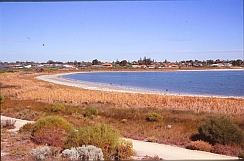
Vegetation zonation SE edge of Lake Richmond. Photo: Eric McCrum
We decided to walk anti-clockwise around the lake, with the sun at our backs. What a surprise to see a pair of White Breasted Sea Eagles resting on a rock near the water’s edge on our side. Pelicans, Coots and Silver Gulls were in great numbers at the southern edge of the lake, some swimming, others resting on the shore.
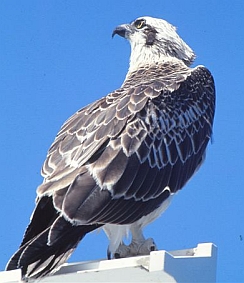
Osprey. Photo: Eric McCrum
The thickets of wattles, low gums, Hardenbergia, Melaleucas, Acanthocarpus and Muehlenbeckia that fringed the SW side of the lake, harboured White Cheeked Honeyeaters, Silvereyes and Willie Wagtails. About 60 Pelicans rested and preened on the water’s edge on this southern part of the lake, with Little Pied Cormorants, Black Cormorants, Darters and Yellow Billed Spoonbills resting near by. Hundreds of Coots dived and fed in the water here, with one Crested Grebe sleeping, and floating in their midst.
The first drainage cutting on the SE corner, had five Dusky Moorhens feeding on the mud and nearby reed edges. The Blue Skimmer and Tau Emerald dragonflies, flitted over the drainage area, catching small flying insects. This southern area of the lake was the only area where we saw Welcome Swallows hawking over the lake’s edge.
From the steel lookout on the eastern side of the lake, the group was pleased to add Chestnut Breasted Shelducks, Pacific Black Ducks, Little Grebe, Musk Duck, Little Eagle, Whistling Kite and Osprey to the bird list. Marilyn Honeybun got to within 7 m of the Osprey resting on the thrombolite walkway, before it lowered its head, raised its tail, sliced, then took off into the light northerly breeze. From the walkway, we watched as a group of about 20 Pelicans worked as a team, shoaling a group of fish into the shallows, to be caught and swallowed. This walkway is designed to keep the public from walking on the thrombolites, but to allow them to see the thrombolites relatively close.
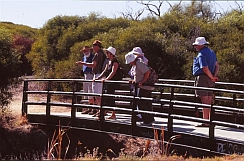
DRB members at Lake Richmond. Photo: Eric McCrum
At the northern edge of the lake, four Black Winged Stilts waded in the shallow waters, catching aquatic creatures in the unruffled waters. A cob Black Swan bathed with much splashing, and a solitary Egret fed in the shallow waters nearby. A total of 27 bird species was seen, as well as three species of grasshopper. Both the Meadow Argus and Lesser Wanderer butterflies were seen here too.
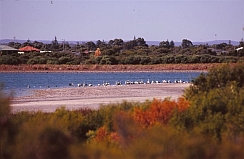
Resting pelicans and others Lake Richmond. Photo: Eric McCrum
Back at the Eco Centre, we had lunch, after which one of the volunteers showed us the live snakes, frogs, turtles and skinks held in the various displays. A rather large aquatic display is being built almost central in the building. Yet another volunteer walked us through the butterfly enclosure, where food plants, active larvae and adult Wanderer butterflies were viewed. In an adjoining enclosure, the chrysalises of these butterflies were displayed, with one emerging just before our visit.
The vast amount of static material in the Centre warrants a visit in itself, for turtle shells, bones and salt water aquaria, with colourful fish, are only part of the display. During wet periods, when outside walking would be unpleasant, this would make a wonderful venue for natural history. Highly recommended.
Eric McCrum