

15 February 2024
Our leader Dr John Huisman, Author, and Herbarium Curator is known for his extensive work in taxonomic research into Western Australia’s marine flora.
He gave a brief outline of the work undertaken at the site and the history of Western Australia (WA) as the first Herbarium in Australia set up over 30 years ago. There are over 4000 species that are under concern as not all WA species can be stored. The correct storage of plants and seeds is the principal role of the Herbarium. Consultants have an opportunity to work with specimens as well as Department Biodiversity, Conservation and Attractions (DBCA) staff.
Attendees enjoyed the glimpse into the seed and Drummond vault, which holds the plant material, including some collected in the 1790s. Andrew Crawford, the Research Scientist responsible for running the Department’s ex situ seed conservation facility, the Threatened Flora Seed Centre, gave us a tour of this area. Great care is taken to maintain the viability of specimens and seeds. Rarer seeds, even up to 1000 at a time, are hand-counted and prepared for storage at -20 degrees in low humidity. Fifty plant species have been successfully transplanted into a self-sustaining population, and the staff ensures they maximise survival at every stage of the process. Questions were asked about international seed banks and WA has arrangements worldwide.
… we could see a 1929 Banksia that looked as good as if it had been stored this year.
Photo: A. Quinn
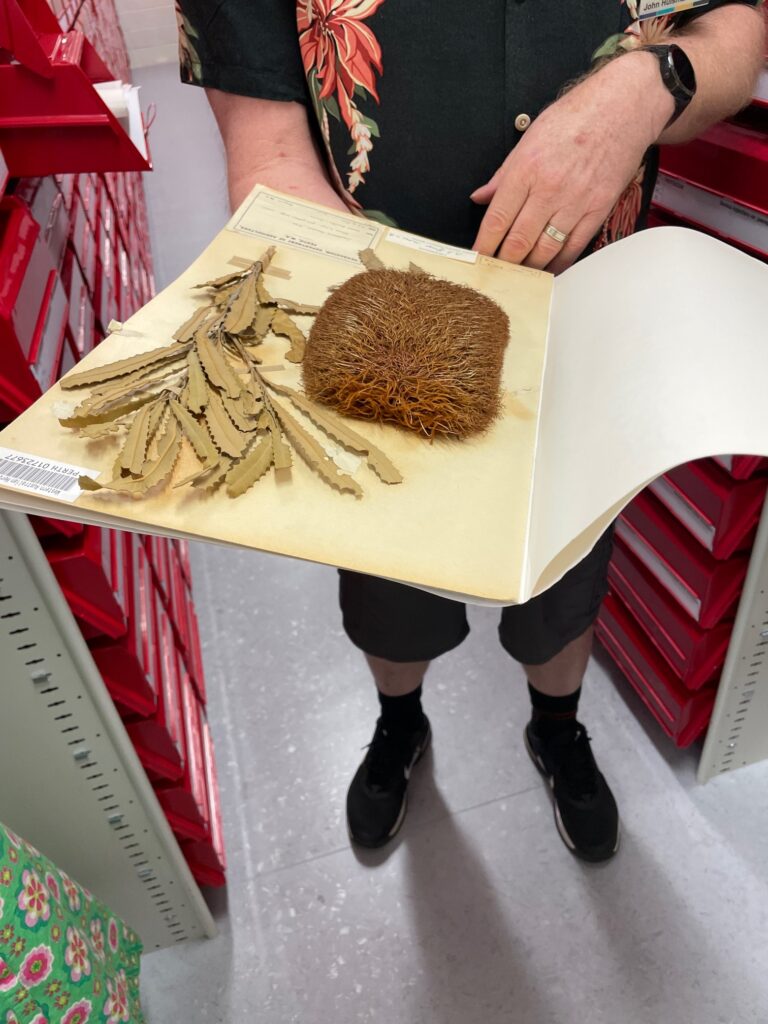
Dr Huisman advised attendees that over 10,000 specimens are collected or provided by the public every year. The Herbarium database contains details of soil, time and location collected. A type specimen whose botanical name is always the same, even if the typology or DNA may show differently in the future, is the first stage in correctly processing multiple specimens. These are kept separate from the main storage along with Loan Specimens from interstate or overseas for safekeeping. This involves pests being disposed of with the freezing process. Once drying specimens are safe, they can go to over 50 volunteers for processing in acid-free paper. Once ready for storage, they are put into a folder and into large waterproof boxes (to avoid damage in case of fire). The folder is labelled, and any changes to the taxonomy are added. Nothing was removed, and we could see a 1929 Banksia that looked as good as if it had been stored this year.
Arlene Quinn
reference: https://www.dbca.wa.gov.au/science/research-tools-and-repositories