

DRB September Meeting Report
Eric McCrum OAM (below) has presented talks to the DRB Nats and elsewhere for many years, but this was his debut using digital technology—at the age of 84 years, no less!
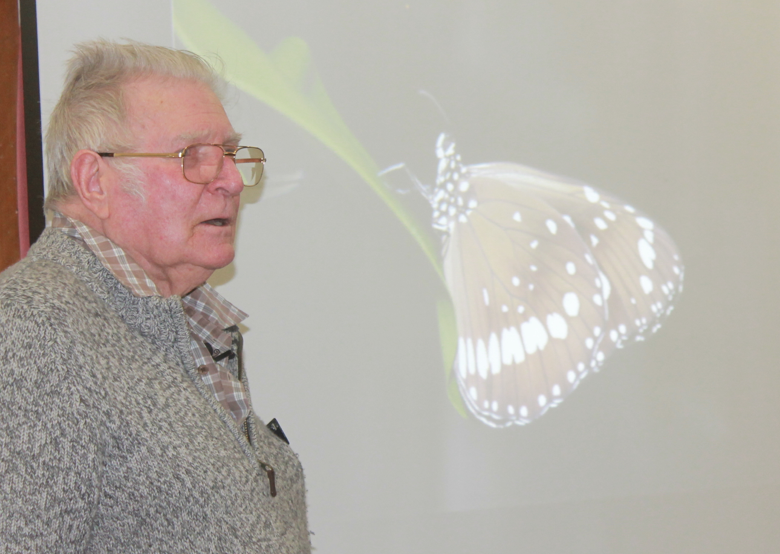
Eric began by introducing us to the history of the term ‘butterfly’. Apparently, it originated when someone saw a yellow thing the colour of butter which was flying—hence ‘butter-fly’!
Butterflies and moths belong to the order Lepidoptera—lepido means ‘scale’ and ptera means ‘wings’, so they have scaly wings. The scales are unique, almost like DNA, and can be used to identify the species. Butterflies and moths have a short life span because the wing scales are easily damaged. There are over 11,000 named species in the order Lepidoptera in Australia, but only 359 are butterflies. Incidentally, you can identify whether it is a moth or a butterfly by the way it folds its wings: butterflies fold their wings upwards and moths fold their wings down.
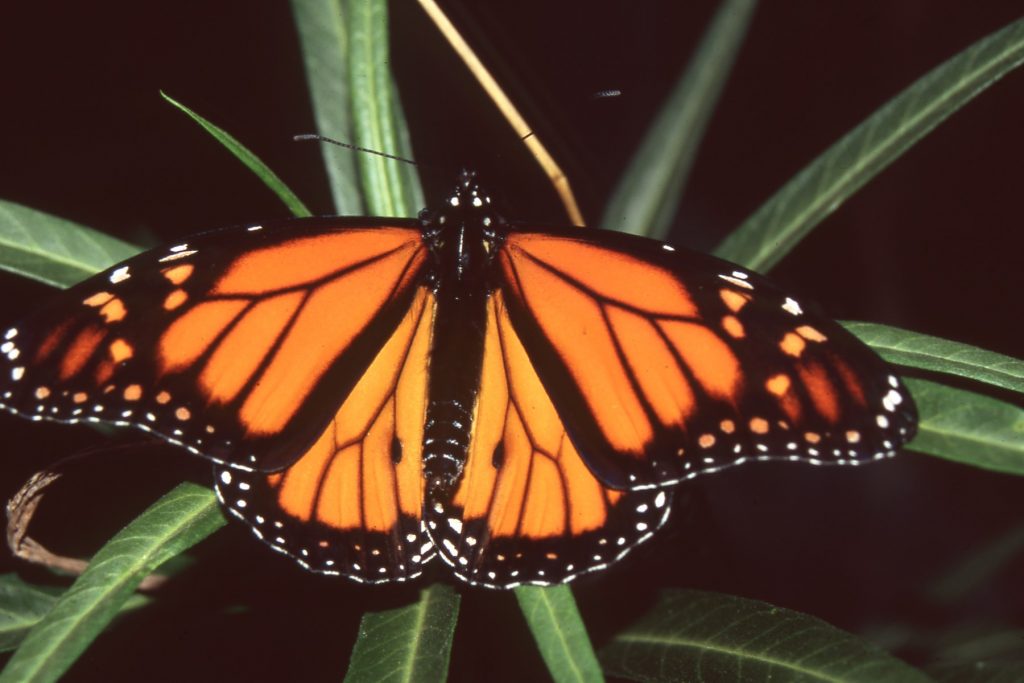
Wanderer butterflies (Above, Eric McCrum) were introduced to Australia in the early days of European settlement so that enthusiasts had something big to catch and pin for their collections. Their favourite food plant, Swan Plant or Cotton Bush (Gomphocarpus fruticosus) is now a declared weed. Butterfly females lay their eggs on a food plant. Many eggs are eaten by ants and praying mantises, but survivors hatch into caterpillars. All caterpillars have six legs because they are insects. If they appear to have more than six legs, the appendages are called ‘prolegs’ and help them walk. Caterpillars without prolegs move with a looping action. Caterpillars grow and shed their skin about five times before their next life stage: pupating. At this stage the caterpillar spins silk from its mouth onto a branch, hooks its cremaster (a support hook, or a cluster of small hooks, at the hind end of a pupa) into the silk, sheds its outer skin and within five minutes becomes a chrysalis. Inside the chrysalis the remains of the caterpillar turn to liquid and rebuild into a butterfly. When fully developed, the butterfly emerges from the chrysalis, pumps up its wings to full size, waits for them to harden and then it can fly. Amazing!

Wood White (Delias aganippe) E McCrum 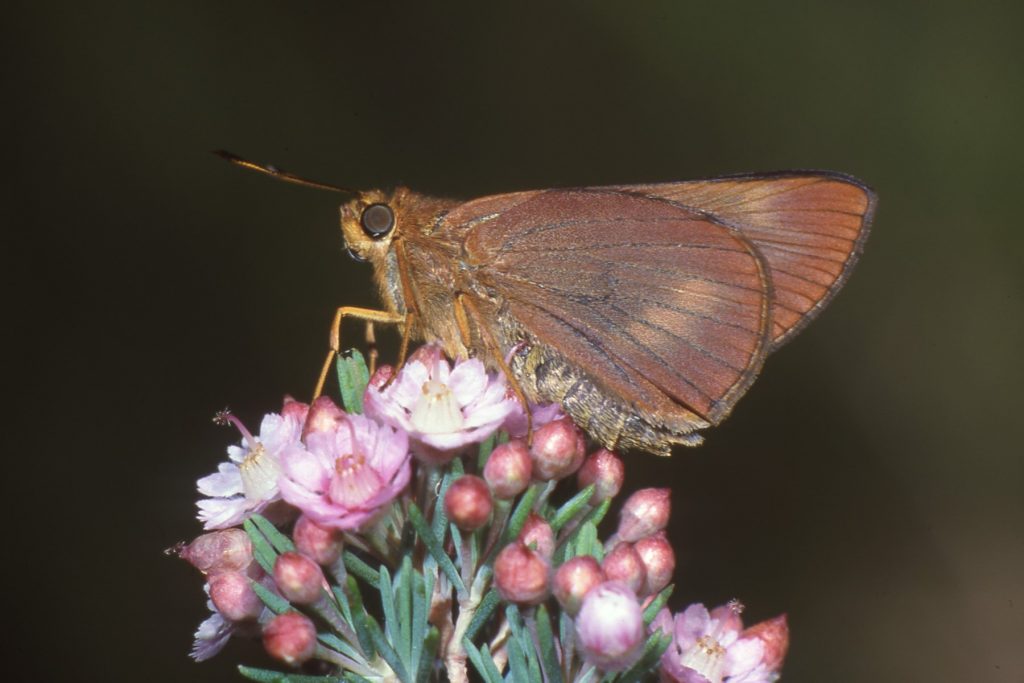
Orange Palm Dart
(Cephrenes augiades) on
Verticordia plumosa E McCrum
Eric showed us his photos of each of the six families of butterfly in Australia. Highlights included the Argus butterflies with bullseyes on their wings to deter predators, butterflies with black bodies and white spots with one pair of legs hidden, and the amazing Ant Liaison butterflies who lay their eggs in an ant nest. The ants tend to the eggs and when they hatch, carry the caterpillars to the food plant daily, in exchange for the honeydew exuded by the caterpillars when the ants tickle them. The habitat of these butterflies is highly specific, exemplified by the Western Jewel, which only lives in the Woodvale area because that is the only habitat containing both its food plants (certain species of Daviesia and Jacksonia) and its symbiotic ant species.
All in all it was a fascinating evening enjoyed by all who attended.
Shelley Campbell