

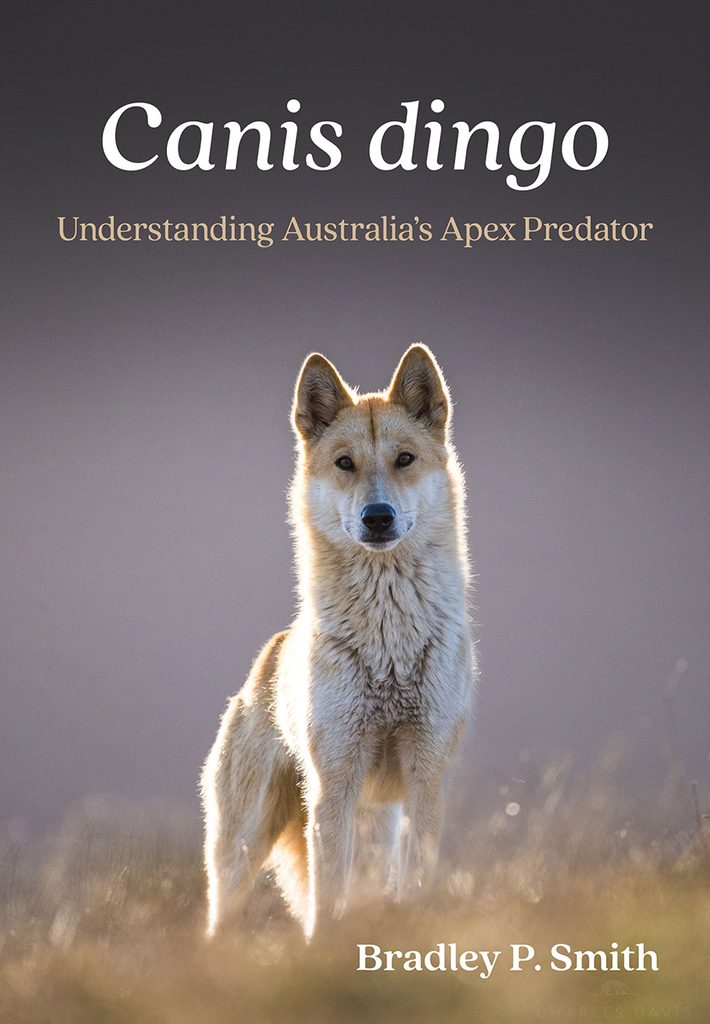
Canis dingo
Understanding Australia’s Apex Predator
- By Bradley Smith
- Published June 2026
Cuts through longstanding myth and political noise to offer a deeper understanding of the dingo.
- ePDF | June 2026
- ISBN: 9781486318490
- B&W photographs,Illustrations
- Publisher: CSIRO Publishing
- Available from eRetailers
- ePUB | June 2026
- ISBN: 9781486318506
- B&W photographs,Illustrations
- Publisher: CSIRO Publishing
- Available from eRetailers
- Paperback | June 2026
- ISBN: 9781486318483
- B&W photographs,Illustrations
- Publisher: CSIRO Publishing
Bradley Smith is a recognised authority on Dingo behaviour and ecology with a long personal interest in Australia’s iconic wild canid, and it shows in this fascinating book. He explores what is known about their relationships to other Dingo-like canids in Asia and New Guinea, prehistory and biology of Dingoes and their relationships to people. He squarely addresses long-standing questions: How native is the Dingo? How long has the Dingo been in Australia? Is the Dingo really just a form of the Domestic Dog or can it be considered a unique species? Are there many pure Dingoes left in Australia? He pulls no punches when it comes to dispelling popular myths surrounding Dingoes and backs up his views with strong evidence based on extensive recent research that many Australians may not be aware of.
Smith looks into the age-old question of when Dingoes were likely to arrive in Australia and points out that there is a lot more to the issue than the generally accepted date of approximately 3,000 – 3,500 years ago. Depictions of Dingoes in Aboriginal rock art suggest an age of at least 4,000 – 5,000 years ago and recent mitochondrial DNA studies in Asia and Australia suggest an arrival time in Australia was at least 4,600 – 5.400 years ago based on molecular clocks. After presenting a range of other research findings, he concludes that Dingoes most likely arrived in Australia 4,000 – 8,000 years ago. As if this wasn’t controversial enough, he questions the established assumption that the forebears of Aboriginal people brought Dingoes to Australia and points out that it is entirely possible that they walked across the Torres Strait land bridge of their own accord before it became submerged.
Smith draws attention to the Dingo’s closest relative, the New Guinea Singing Dog, and sheds some light on this fascinating animal that was only recently re-discovered in the wild. Dingoes and Singing Dogs are the only truly wild canids in this assemblance of South-east Asian and Australasian canids, and both are genetically and ecologically distinct from the related Asian village dogs. And this leads to another of Smith’s conclusions that is bound to raise eyebrows and kick off more lively Dingo debates across Australia – that the Dingo should be recognised as its own species. The taxonomic naming of the Dingo has long been hotly-debated but while many versions prevail, most zoologists generally regard it as a form of Canis lupus familiaris – a mere variation of the Domestic Dog which is itself is considered to be a subspecies of the Grey Wolf. Smith advocates that not only should the Dingo be regarded as a true native Australian wild species, it is distinct from domesticated dogs and wolves and should be recognised as its own species, Canis dingo. He dedicates a chapter of his book to this issue, and points out this is not just an academic question but that the established recognition of Canis lupus familiaris reinforces the legal status of the Dingo as an introduced, semi-domesticated pest, no more deserving of legal protection than any other Australian dogs. He presents robust evidence for Canis dingo based strongly on genetics, skull morphology, breeding, behaviour and ecology – all of which readers may find surprising.
Several chapters of this book are dedicated to the Dingo’s place in the Australian ecology and their impacts on the livestock industry, and this segues into another very contentious issue – that of the “wild dog” label used by the pastoral industry. He squarely tackles the entrenched belief that there are very few “pure” Dingoes remaining as their genes have been swamped by Domestic Dogs after decades of hybridising. He examines the source of this belief and looks at more recent research, concluding that it is vastly over-stated: “Every piece of scientific evidence suggests that dingoes are not being replaced by hybrids…” and points out that many aspects of the Dingo’s social structure and seasonal breeding as a wild animal limit hybridisation and that there are very few free-ranging domestic dogs in most of Australia. This “hybrid myth”, as he calls it, is deeply intertwined with the issues of the Dingo’s “nativeness” and its recognised taxonomic status as a Domestic Dog. He points to an attempt in 2018 by the WA Government to strip Dingoes of their native fauna status (which would have facilitated unrestricted lethal control) as an example of political decisions based on pressure from the pastoral lobby, despite the fact that Dingoes meet every scientific and legal benchmark for nativeness under the EPBC Act. Smith takes a fascinating look at Wooleen Station in WA’s Murchison district where Dingoes returned after a long absence, and draws some stunning conclusions: Dingoes do more than manage goats and kangaroos – they manage entire landscapes.
In the closing chapters of the book, Bradley Smith covers an issue that is not often discussed in the public arena: the Dingo is under serious threat of following the Thylacine to extinction if we don’t give the Dingo proper recognition as a native wild animal. We must learn from the lessons of the Thylacine, largely driven to extinction by a bounty system resulting from politics in the Tasmanian Parliament rather scientific knowledge. We must understand the Dingo better in order to co-exist with it.
Canis dingo challenges our entrenched views on Dingoes. It will make many naturalists, biologists and land managers stop and re-think all they thought they knew about these iconic Australian animals, particularly as they process the extensive and diverse research presented. Smith writes well and the book is engaging, easy to read and well-illustrated. His views are well supported by extensive scientific evidence and these are ingredients for compelling reading for any naturalist with even a passing interest in Dingoes.
Mike Griffiths